The 60-second verdict
Quick answer: AI recording is strongest as a source-capture and drafting tool, while manual minutes remain strongest for judgement, proportionality and formal approval. For most business meetings, the safest and fastest method is a hybrid workflow: record where authorised, generate a draft, verify the important points and approve concise minutes through the normal governance process.
Best fit: choose the option that passes your capture, recovery, privacy and total-cost gates. Do not decide on: price or a single accuracy claim in isolation.
Evidence basis and limits
- Decision factors covered: AI recording and manual minutes solve different problems; What manual minutes are designed to do; What an AI voice recorder adds.
- Evidence rule: The decision is based on the complete capture-to-action workflow, not a single feature or marketing accuracy percentage.
- Boundary: Examples and workflow recommendations must be tested with representative recordings, the intended users and the actual approval process before rollout.

AI recording and manual minutes solve different problems
An AI recorder captures more of what was said and makes the conversation searchable. A minute taker decides what the organisation needs to retain: decisions, authority, reasons, actions, dissent and follow-up. Treating either method as universally superior misses the distinction between a rich source and a concise approved record.
What manual minutes are designed to do
Minutes are not meant to be a transcript. Their job is to create a concise record of decisions, actions, owners, deadlines and material discussion. A skilled minute taker can ignore repetition, group related points and understand the organisation’s governance requirements.
The weakness is that selection happens in real time. A figure can be mistyped, a condition omitted or a tentative suggestion recorded as an agreed action.
What an AI voice recorder adds
A recorder creates a source layer. The original audio can be replayed, transcribed and searched. AI can help locate decisions and actions, but names, dates, numbers, obligations and disputed wording still need checking against the source.
A realistic conditional-decision example
Imagine a project meeting where a supplier quote will be approved only if delivery moves forward by two weeks. One participant says “we can approve it,” another adds the delivery condition and a third changes the proposed owner.
Rushed notes might say: “Approve supplier quote — Sam.” The checked minute should say: “Sam will seek a revised delivery date; approval remains conditional on the supplier confirming delivery by 14 September.”
The recording did not make the decision. It made the condition, owner and status easier to reconstruct accurately.
Where AI-assisted capture performs well
- Preserving discussion for later verification.
- Reducing continuous typing during the meeting.
- Finding names, topics and repeated themes.
- Drafting action lists and summaries quickly.
- Supporting participants who need searchable text.
- Providing timestamps for disputed wording.
Where human minute-taking remains essential
- Understanding the meeting's authority and purpose.
- Distinguishing discussion, recommendation and decision.
- Recording declarations, abstentions or formal dissent.
- Excluding irrelevant or restricted information.
- Confirming action ownership and deadlines.
- Applying the organisation's minute format and approval rules.
Compare the two methods
Balanced comparison matrix
Balanced decision rule: a cloud tool should win where automation and collaboration matter most; a dedicated recorder should win where independent capture and mobility matter most; manual notes should win when recording is inappropriate.
| Criterion | AI recorder | Manual minutes |
|---|---|---|
| Coverage | Broad source capture | Selective record |
| Speed | Fast first draft | Slower drafting |
| Judgement | Requires review | Applied during and after meeting |
| Formal status | Usually source or draft | Can become approved record |
Common AI minute errors
Automatic summaries can turn a proposal into a decision, remove a condition, assign words to the wrong person, manufacture an action or erase disagreement. Check names, figures, negative wording, votes, authority, owners and due dates against the source.
Common manual-minute errors
A human note taker can miss detail, paraphrase inaccurately, struggle to participate or reconstruct actions from memory. A recording can provide a verification route, but only when capture is appropriate and the source is controlled.
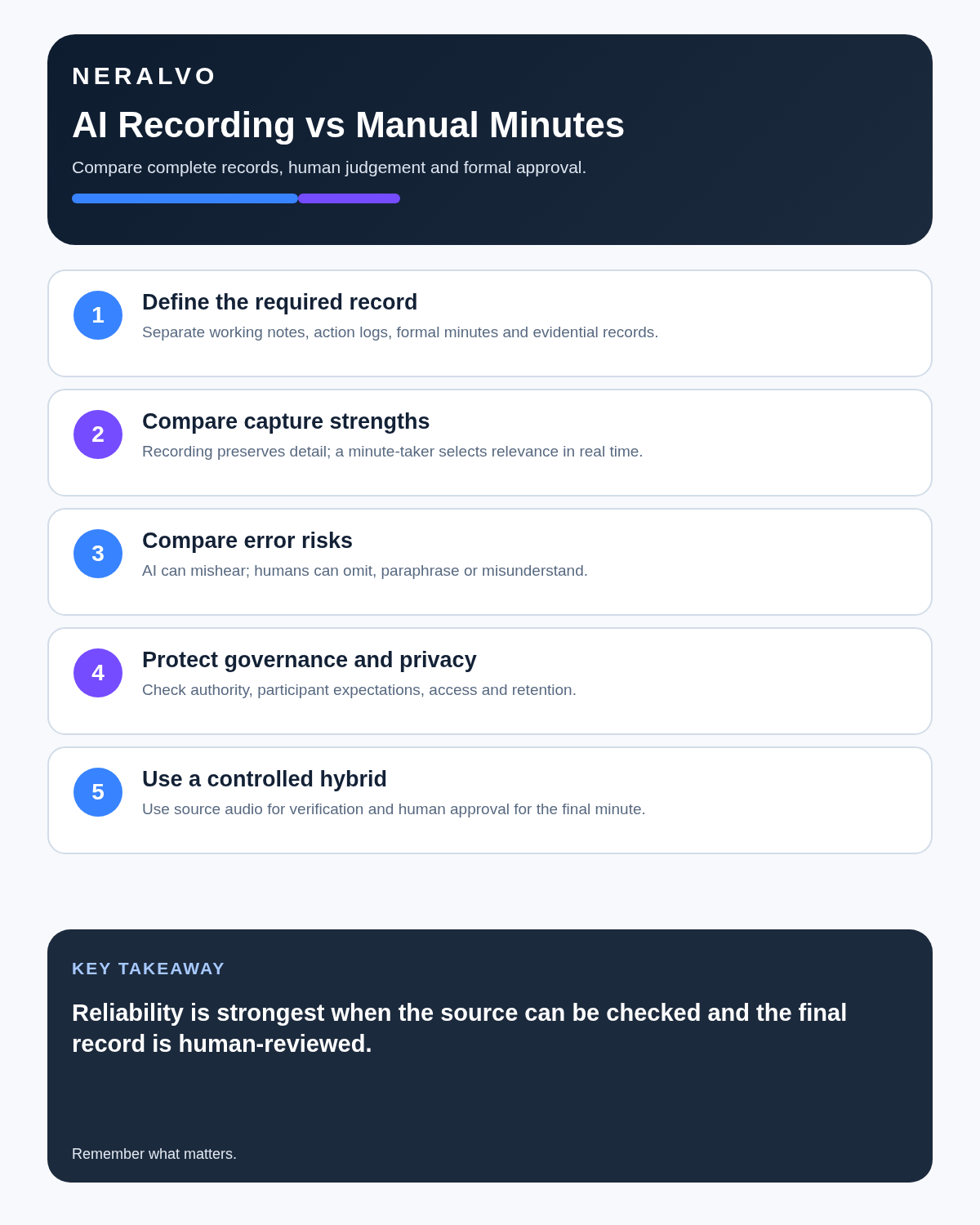
Use the strongest hybrid workflow
- Define what the official minutes must contain.
- Confirm that recording is authorised and explain it to participants.
- Use a structured agenda and mark decisions during the meeting.
- Keep a light live action list rather than relying entirely on automation.
- Generate a transcript and draft summary.
- Verify decisions, conditions, dissent, names, figures and actions.
- Remove unnecessary or restricted content.
- Circulate the draft through the usual approval process.
- Store the approved minutes in the authoritative system.
- Apply the retention rule to audio and working transcripts.
Choose the method by meeting type
Formal boards and committees require human-approved minutes. Project and operational meetings often benefit most from a hybrid method. Brainstorms may use broad capture with a separate decision note. Highly confidential, privileged or sensitive discussions may be unsuitable for recording at all.
When recording is unnecessary
A five-minute internal check-in with one obvious action may be better handled by a written confirmation. Recording every conversation creates review work and increases the amount of sensitive material that must be managed.
Use recording only when the value of a fuller source—complex conditions, disputed wording, accessibility or consequential decisions—outweighs the privacy and administrative burden.
Where NERALVO Halo fits
Compare Halo with the alternatives in this guide can act as the capture layer in a hybrid minutes workflow. It includes 64GB local storage, NOTE and supported CALL modes, up to 35 hours of recording and Bluetooth sync with DOWAY for transcripts, summaries and structured notes, with one year of DOWAY Max included.
Halo does not replace judgement, authority or formal approval. The concise reviewed minutes remain the organisational record.
Is cloud software or a physical recorder right for this workflow?
- Choose the software-led option when automated remote-meeting capture and collaboration remove more work than they add.
- Choose the dedicated-recorder option when independent in-person capture, mobility and source recovery matter more.
- Re-test after any material plan, app, operating-system or policy change.
How community feedback is used
Public reviews can reveal recurring friction, but an anonymous anecdote is not treated as measured proof. A pull-quote should appear only when it links to the original post, identifies the relevant product version or date and is presented as one user’s experience—not as universal fact.
Frequently asked questions
Can an AI summary become the official minutes?
Only after the organisation's required review and approval. The software output should begin as a draft.
Should the full transcript be circulated?
Usually not. Share the proportionate approved record unless a defined purpose requires wider access.
Who is accountable for mistakes?
The authorised meeting owner and approver remain responsible for the final record.
How should disagreement be recorded?
Preserve material dissent, the decision reached and any agreed reconsideration trigger.
How long should source audio be kept?
Only for the period justified by the recording purpose, policy and applicable records requirements.
Authoritative guidance and related reading
- ICO data-protection principles
- What Makes a Good AI Meeting Summary?
- How to Review AI Transcripts Before Business Systems
Final workflow checklist
- Recording purpose and authority confirmed.
- Draft and approved record clearly separated.
- Decisions, conditions and authority verified.
- Dissent preserved.
- Actions have owners and dates.
- Simple meetings are not recorded unnecessarily.
- Audio retention controlled.
Bottom line: use recording as a source when detail and verification matter, then approve concise human-reviewed minutes as the authoritative record.
On this page
Related guides
See whether Halo fits this workflow
Review the NERALVO Halo specifications, included services, delivery information and current offer only after completing the guide.
Found an error or an out-of-date claim? Email support@neralvo.com with the article address and a supporting source.