The 60-second verdict
Quick answer: an AI voice recorder can support authorised criminal-defence conferences by preserving instructions, chronology and evidence leads, but it must not override setting restrictions, compromise privilege, replace official interview records or substitute for the solicitor-approved attendance note.
Best fit: Criminal Defence Solicitors who need recoverable audio and human-verified notes in an authorised workflow. Use another method when: recording is prohibited, a participant declines or the approved process requires manual notes.
Evidence basis and limits
- Decision factors covered: Authority comes before recording; Create an allegation map; Take an uninterrupted first account.
- Evidence rule: Claims are weighted by consequence: capture failure, changed meaning, access and recovery matter more than polished wording.
- Boundary: Examples and workflow recommendations must be tested with representative recordings, the intended users and the actual approval process before rollout.
Criminal defence work depends on exact sequence, attribution and the difference between what a client knows, believes, was told or cannot remember. Recording can preserve detail, but the legal file remains evidence-led and professionally controlled.
Authority comes before recording
Confirm:
- the setting permits the device;
- the firm approves the workflow;
- privilege and confidentiality are protected;
- participants understand the purpose;
- the processing and storage route is approved;
- the source remains within the controlled matter file.
Custody suites, prisons, courts and secure facilities may apply separate restrictions. A client’s agreement does not override those rules.
Create an allegation map
- allegation or count;
- date and location;
- prosecution theory;
- principal witnesses;
- key exhibits or digital material;
- formal interview references;
- matters admitted and disputed;
- legal and evidential questions;
- disclosure or expert evidence required.
Take an uninterrupted first account
Allow the client to explain events in their own order. Then clarify:
- what happened immediately before and after;
- who was present;
- what the client could see or hear;
- what the client understood at the time;
- what action followed;
- which messages, records, witnesses or location data may exist;
- which details are certain and which are approximate.
Keep approximate times approximate until evidence confirms them.
Use a source-labelled chronology
| Label | Meaning |
|---|---|
| Client first-hand account | What the client personally saw, heard or did |
| Information from another person | Attributed reported information |
| Prosecution allegation | The case advanced against the client |
| Document-supported | Linked to an exhibit, message or formal record |
| Disputed | Not accepted or contradicted by another source |
| To verify | Requires disclosure, witness or expert material |
An AI summary must not collapse allegation, instruction and verified evidence into one settled narrative.
Protect exact wording
Alleged admissions, threats, cautions, police questions and answers may depend on precise words. For any material phrase:
- mark the timestamp;
- identify the speaker;
- check the original audio, body-worn video, formal interview or written record;
- preserve qualifications, interruptions and uncertainty;
- record whether the client accepts the wording;
- do not present an AI-generated quotation as exact without verification.
Compare later instructions with the formal interview
Create a comparison record containing:
- topic;
- formal interview answer;
- current instruction;
- client’s explanation for any difference;
- evidence required;
- advice given;
- further decision needed.
A discrepancy may require careful advice, but an automated summary must not label it dishonesty.
Turn instructions into an evidence plan
Extract specific enquiries:
- witnesses to approach;
- CCTV and scene evidence;
- messages, calls and account records;
- location and device data;
- medical and expert material;
- identity or attribution issues;
- timing and route checks;
- unused-material and disclosure requests;
- documents the client must provide.
Each item should identify the issue, purpose, owner, deadline and result. “Check CCTV” is weaker than identifying the location, time period and proposition the footage would test.
Separate legal advice from factual instructions
- Client instructions.
- Evidence reviewed.
- Conflicts and gaps.
- Legal issues.
- Advice provided.
- Client decision.
- Actions and deadlines.
This allows another authorised lawyer to understand which part of the note records fact, analysis or advice.
Hearing and conference notes need decision status
For hearings, conferences and case reviews, record:
- issue before the court or team;
- submission or position advanced;
- response from the other side;
- judicial indication or ruling;
- order made;
- deadline created;
- client advice and decision;
- follow-up action.
Do not confuse a judicial question with a ruling or counsel’s suggestion with the client’s final instruction.
Protect highly sensitive material
Criminal matters may contain witness details, covert material, medical information, addresses, security-sensitive facts and privileged advice. Define:
- who may access source audio;
- whether the transcript is stored separately;
- how exports and downloads are controlled;
- which portions require redaction;
- how temporary files are deleted;
- which document becomes the official matter record.
The complete transcript should not be circulated simply because it is easy to share.
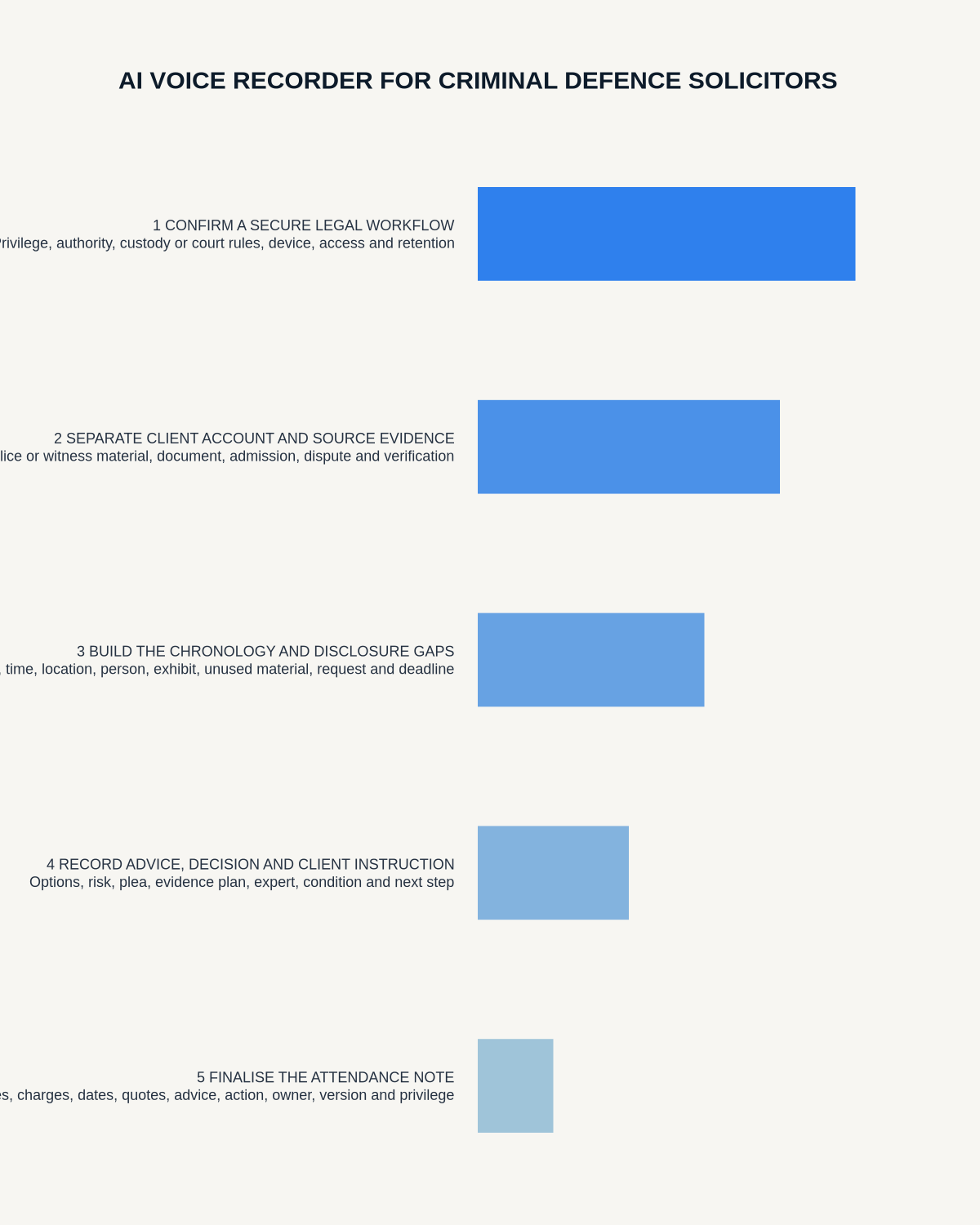
Controlled defence-instructions workflow
- Confirm setting-specific authority and firm approval.
- Define the allegation map and conference purpose.
- Take the client’s uninterrupted first account.
- Build the source-labelled chronology.
- Check material wording against formal records.
- Compare instructions with disclosure and interview evidence.
- Extract evidence leads and requests.
- Separate factual note, legal analysis and advice.
- Confirm the client’s decisions.
- Store the reviewed attendance note and remove temporary copies.
How NERALVO Halo may support approved defence work
Check whether NERALVO Halo fits criminal defence solicitors work may support firm-approved office interviews, case reviews and private dictation through NOTE mode, supported CALL capture, 64GB local storage and DOWAY transcription tools where recording is clearly permitted.
Suitability depends on the setting, firm policy, confidentiality controls and the complete device-and-app data route. Verify every name, quotation, date, figure and exhibit reference manually.
Cloud software, a dedicated recorder or manual notes?
For Criminal Defence Solicitors, the right answer changes with the setting. This matrix deliberately gives each method a situation where it can be the strongest choice.
| Situation | Best starting point | Reason |
|---|---|---|
| scheduled remote case meetings | Cloud meeting software | Calendar automation and shared integrations are usually the strongest advantage. |
| authorised interviews or field discussions | Dedicated recorder | Independent capture reduces reliance on an active phone or laptop. |
| privilege, procedure or an objection prevents recording | Manual notes or an approved alternative | The boundary takes priority over convenience. |
| mixed casework | Governed hybrid | Use each method only in the setting it actually fits. |
Frequently asked questions
Can a client’s agreement override custody, prison or court rules?
No. Setting restrictions and firm policy still apply.
Can AI identify which account is stronger?
No. Evidential assessment and legal judgement remain professional responsibilities.
Can the transcript replace the attendance note?
No. The final matter record must be reviewed and approved.
What if the transcript changes a critical word?
Check the original source, correct the note and record a material correction where required.
Should every conference be recorded?
No. Recording should be necessary, proportionate and authorised.
Final defence-note checklist
- Recording was authorised for the setting.
- Allegations are separated from client instructions.
- First-hand facts, reported information and gaps are labelled.
- Material wording has been checked against original records.
- Differences are preserved fairly.
- The interview produced a specific evidence plan.
- Legal advice and client decisions are clearly recorded.
- Privileged files are controlled and temporary copies removed.
Bottom line: an AI voice recorder can help preserve dense defence instructions, but the defensible record still depends on authority, privilege, exact source checking and a solicitor-reviewed attendance note.
Related guides
Profession workflow
Visual map for AI Voice Recorder for Criminal Defence Solicitors: Instructions and Evidence Plans
- Prepare the approved useDefine purpose, safe position, permission and the required formal record.
- Capture context firstState the case, asset, person, location or event identifier before detail.
- Human-verify evidenceCheck technical terms, units, names, dates, decisions and uncertainty.
- Complete the formal recordTransfer only verified information and apply access and retention controls.
On this page
Related guides
Check permission, retention and access before choosing hardware
Once the policy requirements in this guide are satisfied, compare Halo’s specifications, local storage, included services and current offer against your approved workflow.
Found an error or an out-of-date claim? Email support@neralvo.com with the article address and a supporting source.