The 60-second verdict
Quick answer: geotechnical engineers can use an AI voice recorder to preserve authorised location-and-depth observations, process behaviour and handover context, but every depth, sample ID, test value, unit and engineering interpretation must be verified against formal logs, instruments and laboratory records.
Best fit: Geotechnical Engineers who need recoverable audio and human-verified notes in an authorised workflow. Use another method when: recording is prohibited, a participant declines or the approved process requires manual notes.
Evidence basis and limits
- Decision factors covered: Anchor every note to location and depth; Keep four evidence layers distinct; Create a complete field item.
- Evidence rule: The decision is based on the complete capture-to-action workflow, not a single feature or marketing accuracy percentage.
- Boundary: Examples and workflow recommendations must be tested with representative recordings, the intended users and the actual approval process before rollout.
One misheard depth or sample number can weaken an entire ground-investigation record. Audio should preserve context while controlled site logs and professional review remain authoritative.

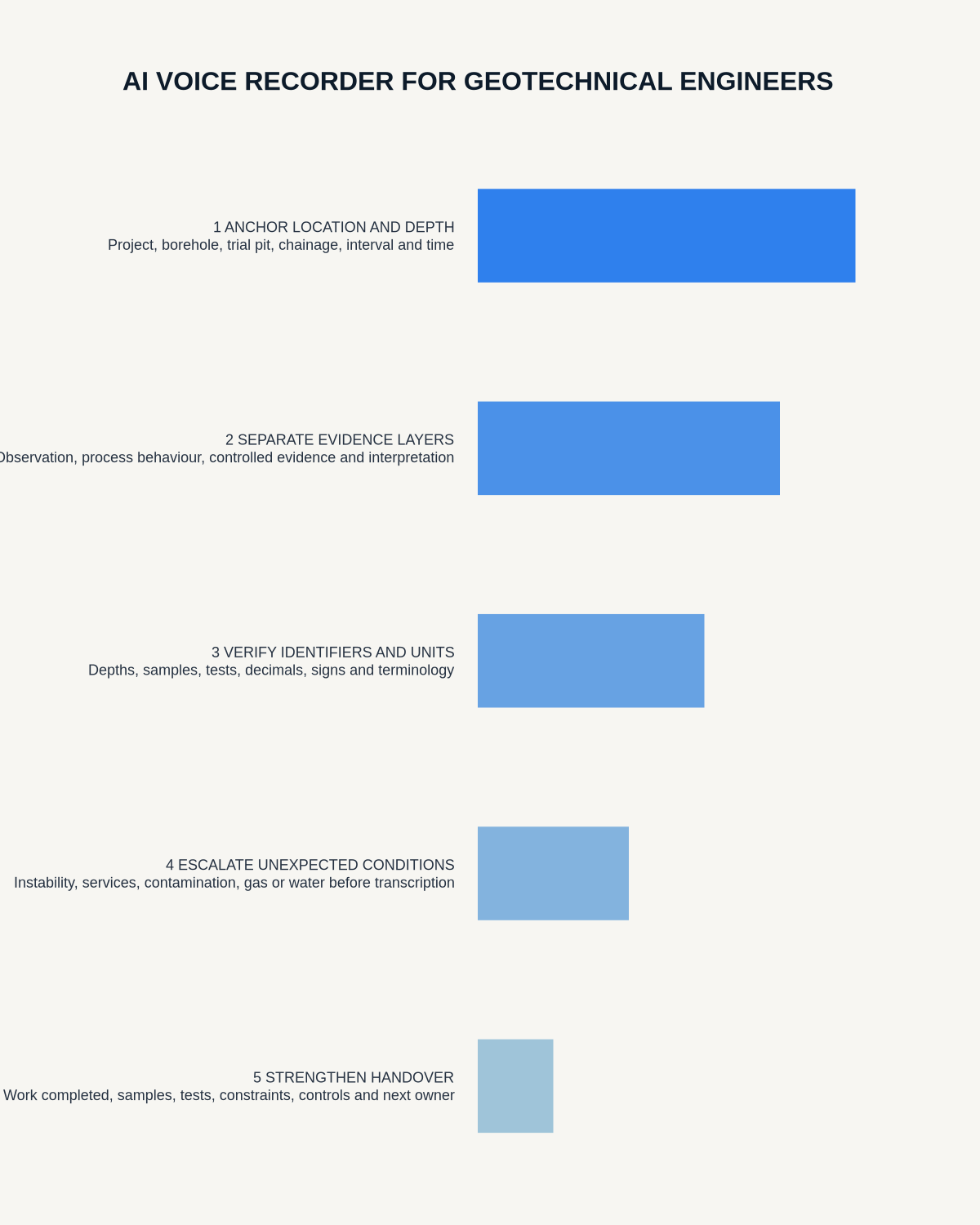
Anchor every note to location and depth
State the project, borehole, trial pit or inspection ID, coordinate or chainage reference, depth interval, time and current activity. Repeat the identifier after interruptions or movement.
Keep four evidence layers distinct
- Direct observation: material, groundwater, instability or visible condition.
- Process behaviour: drilling, sampling or excavation response.
- Controlled evidence: sample, test, photograph, instrument or log.
- Preliminary interpretation: working ground model or possible design concern.
AI must not turn preliminary interpretation into a verified stratum, parameter or design conclusion.
Create a complete field item
Record location and depth interval, neutral material description, groundwater or inflow, sample or test reference, recovery or disturbance, unexpected condition, immediate safety action and evidence still required.
Verify units and identifiers
Check depths, sample numbers, test values, technical terms, decimal points and units against formal logs, instruments and laboratory records. The transcript must not become the only design-relevant source.
Handle unexpected conditions safely
Instability, services, contamination indicators, gas or water concerns require immediate safety and escalation action before routine transcription. Record chronology and notifications after control is established.
Strengthen shift handover
Identify work completed, location or depth reached, samples and tests outstanding, plant and access constraints, active safety controls, next activity and one accountable owner for every unresolved action.
Record limitations explicitly
State access, visibility, sampling, equipment and weather limitations. A complete record shows what could not be confirmed.
Field-to-record workflow
- Confirm recording is approved and safe.
- State location, investigation ID and depth.
- Separate observations, process behaviour, evidence and interpretation.
- Reference samples, photographs and tests.
- Correct IDs, depths, units and terminology.
- Match formal logs and laboratory records.
- Complete project review and approval.
- Assign outstanding tests and actions.
- Delete temporary audio under policy.
Cloud software, a dedicated recorder or manual notes?
For Geotechnical Engineers, the right answer changes with the setting. This matrix deliberately gives each method a situation where it can be the strongest choice.
| Situation | Best starting point | Reason |
|---|---|---|
| scheduled video briefings | Cloud meeting software | Native remote-meeting workflows can be more efficient here. |
| site visits, inspections or mobile calls | Dedicated recorder | A separate battery and recoverable local source improve resilience. |
| a restricted site or participant prevents recording | Manual notes or an approved alternative | Manual notes are the correct control when recording is unavailable. |
| office-to-site work | Governed hybrid | A hybrid can combine automation with reliable physical capture. |
Frequently asked questions
Can AI classify the ground?
No. Classification and interpretation require the approved field, laboratory and review process.
Can spoken depths go straight into a borehole log?
Only after being checked against the field source.
What happens when an urgent risk appears?
Safety and escalation take priority over recording.
Useful resources
- HSE excavation-safety guidance
- AI Voice Recorder for Geologists
- AI Voice Recorder for Structural Engineers
- View Halo specifications for geotechnical engineers use
Final geotechnical checklist
- Correct location and depth throughout
- Samples, tests and units verified
- Observation separated from interpretation
- Unexpected conditions and actions recorded
- Limitations explicit
- Outstanding work owned
On this page
Related guides
See whether Halo fits this workflow
Review the NERALVO Halo specifications, included services, delivery information and current offer only after completing the guide.
Found an error or an out-of-date claim? Email support@neralvo.com with the article address and a supporting source.