The 60-second verdict
Quick answer: marine surveyors can use an AI voice recorder to preserve authorised field observations by identifying the vessel, deck, compartment, component and viewing position before each note. Measurements, photographs, certificates, limitations and professional conclusions must be verified before the formal report is approved.
Best fit: Marine Surveyors who need recoverable audio and human-verified notes in an authorised workflow. Use another method when: recording is prohibited, a participant declines or the approved process requires manual notes.
Evidence basis and limits
- Decision factors covered: Begin with survey scope; Use a compartment-to-component route; Build a complete defect record.
- Evidence rule: A claim earns weight only when the source, date, configuration and limitation are clear enough for a reader to check.
- Boundary: Examples and workflow recommendations must be tested with representative recordings, the intended users and the actual approval process before rollout.
A description such as “corrosion near the pump” is weak unless another surveyor can locate the exact condition, review the evidence and understand the inspection limits.

Begin with survey scope
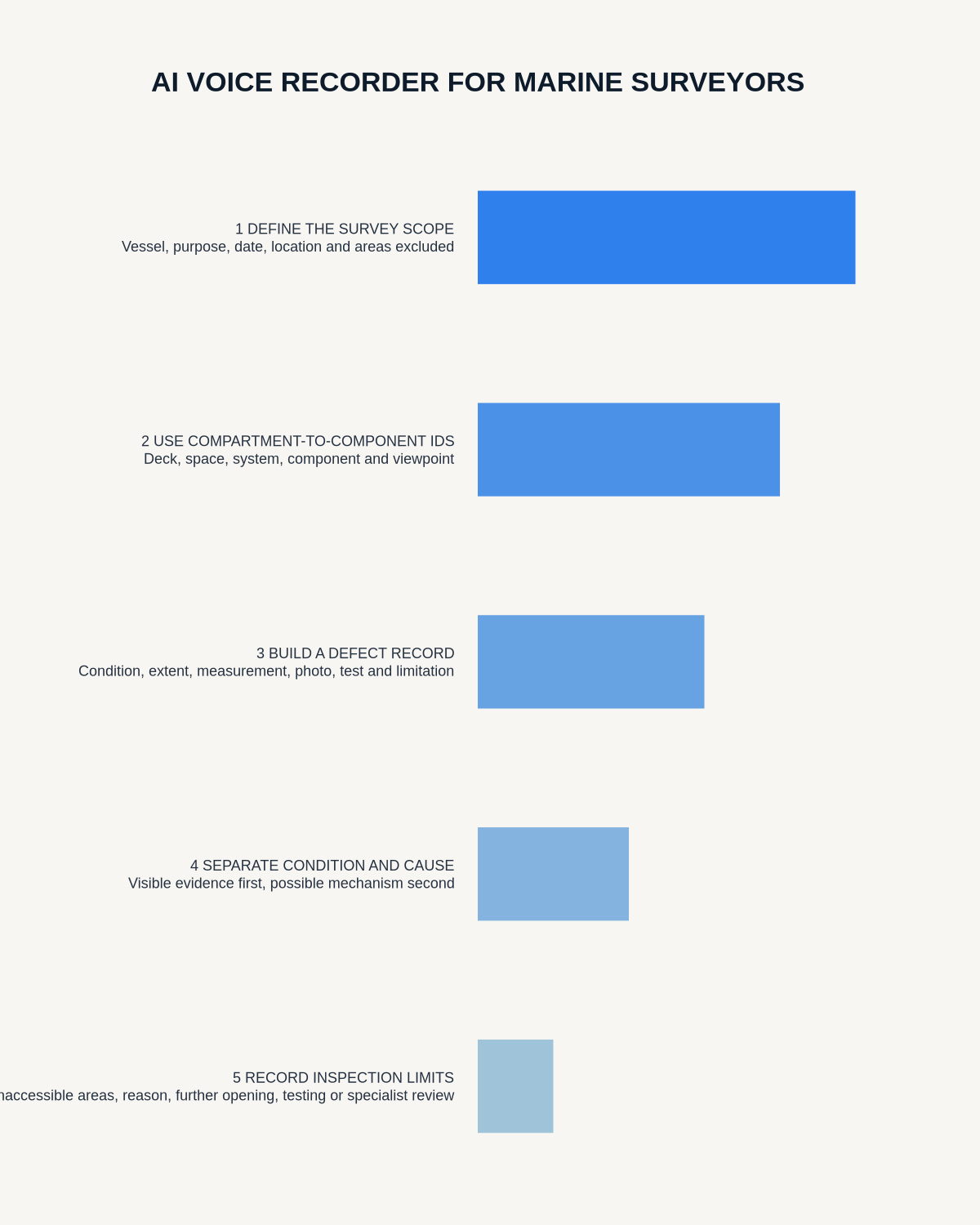
State the vessel, survey reference, purpose, date, location, people present and included or excluded areas. Different survey types have different evidence and reporting boundaries.
Use a compartment-to-component route
Announce the deck or compartment, system, component and viewing position before each observation. Repeat the location after moving or resuming recording.
Build a complete defect record
- vessel, deck, compartment and component;
- neutral visible condition;
- extent, measurement or area affected;
- photograph, test, certificate or drawing reference;
- access, visibility and operating limitations;
- immediate safety action or notification;
- required testing, opening-up, repair or specialist review.
Separate condition from possible cause
Describe what is visible before suggesting a mechanism. Corrosion, cracking, leakage, distortion or wear may have several causes. Preserve uncertainty and identify the evidence required for a supported conclusion.
Verify terminology, units and identity
Check equipment names, serials, dimensions, thickness readings and standards against drawings, certificates, instruments and survey documents. The transcript must not invent a component or classification.
Link photographs and measurements
Speak image numbers and viewing direction. Keep measurements in the approved field sheet or instrument system and verify transcript references against them.
Record inaccessible areas
State compartments, surfaces or systems that could not be inspected and why. Identify whether dismantling, cleaning, testing, a return visit or specialist attendance is required.
Work within vessel safety controls
Recording must not distract during ladders, confined spaces, machinery movement, work aloft or hazardous areas. Follow vessel, permit and communication procedures first.
Field-to-report workflow
- Identify and preserve source files.
- Correct vessel, compartment and component names.
- Verify dimensions, readings and technical terms.
- Match photographs, tests, drawings and certificates.
- Separate observation, interpretation and recommendation.
- Record inaccessible areas and evidence gaps.
- Apply technical review.
- Issue the report through the authorised process.
- Assign follow-up work.
- Delete temporary audio under policy.
Cloud software, a dedicated recorder or manual notes?
For Marine Surveyors, the right answer changes with the setting. This matrix deliberately gives each method a situation where it can be the strongest choice.
| Situation | Best starting point | Reason |
|---|---|---|
| scheduled video briefings | Cloud meeting software | Auto-join and central collaboration can remove routine admin. |
| site visits, inspections or mobile calls | Dedicated recorder | Dedicated hardware suits movement, variable rooms and offline source capture. |
| a restricted site or participant prevents recording | Manual notes or an approved alternative | A clear alternative respects policy and participant choice. |
| office-to-site work | Governed hybrid | One governed process prevents gaps between desk and field work. |
Frequently asked questions
Can AI determine the cause of a defect?
No. Cause requires supporting evidence and professional review.
Can a transcript replace thickness records?
No. Source measurements and instrument records remain authoritative.
Should inaccessible areas be omitted?
No. Record the limitation and any further work required.
Useful resources
- GOV.UK maritime-safety guidance
- AI Voice Recorder for Building Surveyors
- AI Voice Recorder for Private Investigators
- Assess Halo against the marine surveyors workflow matrix
Final survey checklist
- Every defect tied to the correct location
- Condition separated from cause
- Measurements and identifiers verified
- Photographs and records matched
- Limitations explicit
- Recommendations reviewed and supported
On this page
Related guides
See whether Halo fits this workflow
Review the NERALVO Halo specifications, included services, delivery information and current offer only after completing the guide.
Found an error or an out-of-date claim? Email support@neralvo.com with the article address and a supporting source.