The 60-second verdict
A useful sales-call summary should help the team answer five questions: what changed, what evidence supports it, whether the offer fits, what both sides agreed to do and what belongs in the CRM. It should not simply compress the transcript.
Decision focus: use the method below only where it produces a recoverable source, a verifiable output and a clear next action. If one of those fails, change the workflow rather than trusting a polished summary.
Evidence basis and limits
- Decision factors covered: The signal → evidence → fit → mutual action → CRM workflow; Comply before analysing; Start with a call hypothesis—not a script to prove.
- Evidence rule: A claim earns weight only when the source, date, configuration and limitation are clear enough for a reader to check.
- Boundary: Examples and workflow recommendations must be tested with representative recordings, the intended users and the actual approval process before rollout.
An AI voice recorder for sales calls can surface buyer language, objections and next steps quickly. It cannot decide that an opportunity is qualified, infer budget or authority without evidence or replace lawful marketing and recording processes.
The signal → evidence → fit → mutual action → CRM workflow
| Stage | Sales question | Useful output |
|---|---|---|
| Signal | What did the buyer say that may indicate a problem, priority or concern? | Attributed language |
| Evidence | Which facts, examples or metrics support the signal? | Verified context |
| Fit | Can the offer address the need under the buyer’s constraints? | Qualified assessment |
| Mutual action | What will the buyer and seller each do next? | Two-sided commitment |
| CRM | Which concise facts and actions should become the operational record? | Clean pipeline data |
This workflow keeps buyer evidence separate from seller optimism.
Comply before analysing
Outbound marketing calls, use of contact data and call recording may involve PECR, data-protection law and sector-specific requirements. The sales organisation should establish:
- Whether the call itself is permitted.
- Which TPS, CTPS, objection or consent checks apply.
- The lawful basis for using personal information.
- How callers are identified.
- What the person is told about recording and processing.
- How objections and opt-outs are recorded.
- Who can access and analyse the call.
- How long audio and derived data are retained.
The ICO’s current direct-marketing guidance covers planning, lawful basis, fair collection and respecting people’s preferences. Its live-call guidance addresses PECR in more detail.
Start with a call hypothesis—not a script to prove
Before the call, state:
- Likely business problem.
- Reason for speaking now.
- What evidence would support or disprove the hypothesis.
- The people or process likely to be affected.
- What useful next step would be appropriate if fit exists.
The summary should show when the original hypothesis was wrong.
Stage 1: Capture buyer signals accurately
Potential signals include:
- Repeated operational pain.
- A new deadline, event or trigger.
- Current workaround or cost.
- Risk of doing nothing.
- Success measure.
- Decision criterion.
- Concern about the proposed approach.
- Internal stakeholder or dependency.
Preserve the buyer’s wording where it matters. Do not convert “it is annoying” into a quantified business case the buyer never supplied.
Separate the statement types
| Statement | Correct treatment |
|---|---|
| Buyer fact | Attribute and verify where material |
| Buyer estimate | Mark as estimate |
| Seller claim | Check against approved product information |
| Objection | Preserve the underlying concern |
| Interest | Do not automatically label as intent |
| Provisional next step | Confirm before entering as committed |
| Unknown | Leave open rather than inventing an answer |
Stage 2: Build the evidence
For each important need, record:
- Current process.
- People affected.
- Frequency or volume.
- Time, cost, risk or missed outcome.
- Example or source.
- Desired result.
- How the buyer would measure success.
When a number matters to ROI or qualification, confirm the unit, period and source. AI transcripts commonly confuse percentages, currencies and time periods.
Stage 3: Assess fit honestly
Fit should consider:
- Need: is there a material problem the buyer wants to address?
- Capability: can the product meet the required use case?
- Constraint: budget, security, integration, timeline or policy.
- Process: who evaluates and approves?
- Evidence: what proof does the buyer require?
- Risk: what would make the solution unsuitable?
Record a disqualification reason where appropriate. A clean “not a fit” protects forecast quality and buyer trust.
Do not infer authority, budget or urgency
The summary should distinguish:
- Confirmed decision-maker.
- Influencer or evaluator.
- Person who has not yet been involved.
- Approved budget.
- Rough expectation.
- Target date.
- External deadline.
- Seller-created urgency.
A title alone does not prove authority, and a question about price does not prove budget.
Handle objections as unresolved conditions
Use this structure:
- Buyer’s exact concern.
- Business or personal consequence behind it.
- Evidence requested.
- Seller response.
- What remains unanswered.
- Who must resolve it.
- Decision point.
Do not summarise a polite acknowledgment as an objection being resolved.
Stage 4: Create a mutual action plan
A strong next step includes commitments from both sides:
| Field | Example question |
|---|---|
| Buyer action | Which data, stakeholder or requirement will the buyer supply? |
| Seller action | Which demonstration, document or answer will the seller deliver? |
| Owner | Who is accountable on each side? |
| Date | When will each action occur? |
| Purpose | Which decision will the next step enable? |
| Exit condition | What result would stop or change the opportunity? |
“Follow up next week” is not a mutual action plan.
Stage 5: Write the CRM record
The CRM should contain verified operational facts, not the complete transcript. A useful structure is:
- Account, contact and call purpose
- Trigger or business change
- Confirmed problem and evidence
- Desired outcome and success measure
- Current process or alternative
- Fit, constraint and open risk
- Stakeholders and decision process
- Objections and proof required
- Buyer and seller actions
- Dates and next decision point
- Qualification confidence and missing information
Mark the note as AI-assisted and reviewed where the organisation’s governance requires it.
Verify before updating the forecast
Check:
- Contact and company names.
- Products, packages and pricing.
- Currency and contract period.
- Dates and deadlines.
- Decision roles.
- Buyer commitments.
- Probability or stage criteria.
- Whether a new concern changed fit.
The call summary should not automatically move a deal stage or change forecast value without the organisation’s defined criteria and human review.
Use recordings for coaching—not hidden surveillance
Where recordings are reviewed for quality or coaching, tell staff clearly about the purpose, access, assessment method and retention. Evaluate observable skills such as:
- Question quality.
- Listening and follow-up.
- Evidence gathering.
- Accuracy of product claims.
- Handling uncertainty.
- Clarity of next steps.
Avoid unsupported AI scores for personality, confidence, honesty or future performance.
How NERALVO Halo can support sales-call review
Apply this guide before assessing NERALVO Halo provides NOTE recording, supported CALL capture, 64GB local storage, up to 35 hours of recording and Bluetooth sync with DOWAY.
DOWAY can create transcripts, summaries, speaker-separated notes, templates, translations, mind maps and exports. One year of DOWAY Max is included from activation.
CALL compatibility varies by phone, operating system and call setup. Sales organisations remain responsible for marketing compliance, recording transparency, approved product claims and CRM accuracy.
Sales-summary quality check
- Was the call and its recording permitted under the organisation’s process?
- Are buyer words separated from seller interpretation?
- Is every material metric tied to a source and period?
- Were interest and intent kept distinct?
- Were fit and disqualification considered honestly?
- Are authority, budget and timing confirmed rather than inferred?
- Does the next step contain commitments from both sides?
- Was the CRM updated with concise verified facts?
- Was forecast or stage movement reviewed by a person?
A strong AI sales-call summary preserves the buyer’s evidence, protects pipeline accuracy and creates a mutual next step rather than a seller-centred recap.
Workflow choice matrix for How to Use AI to Summarise Sales Calls
Choose the method that protects the source and reduces downstream correction. The table makes the non-hardware options explicit.
| Condition | Preferred route | Why |
|---|---|---|
| Repeatable remote work with approved integrations | Cloud software | Automation and central collaboration may outweigh device independence. |
| In-person, mobile or unreliable-connectivity work | Dedicated recorder | Independent capture and a recoverable local source are usually more resilient. |
| Recording is refused, prohibited or unnecessary | Manual notes / no recording | Respecting the boundary is the correct workflow, not a product failure. |
| High-risk or mixed work | Governed hybrid | Separate capture, review, approval and retention rather than trusting one tool. |
Related AI voice recorder guides
See client-call follow-up notes, phone-call recording checks and the guide for sales professionals.
Related guides
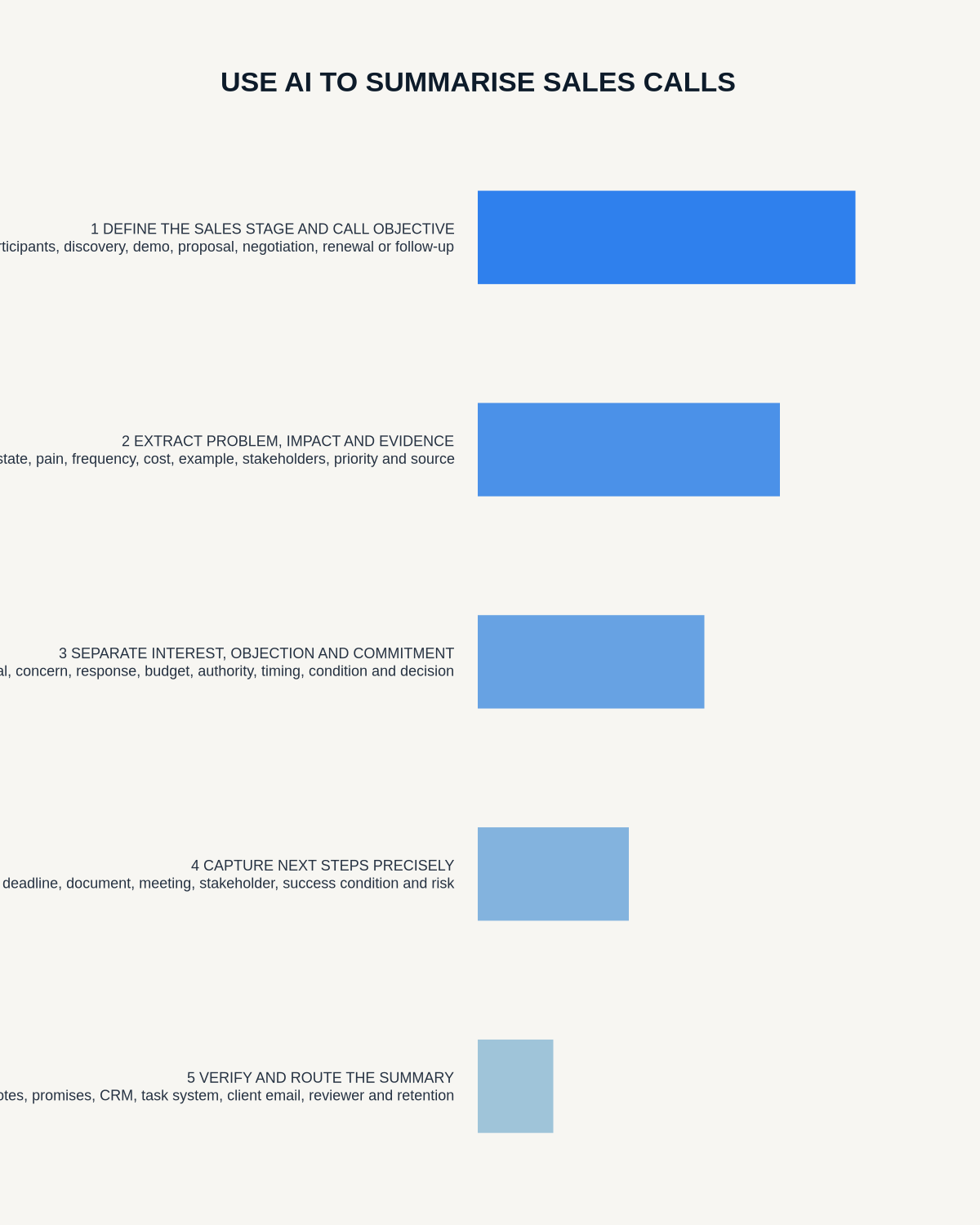
Workflow map
Visual map for How to Use AI to Summarise Sales Calls
- Define the decisionState the question, required output and acceptance rule.
- Capture the sourceUse the approved route and preserve context, identity and limitations.
- Verify material detailsReplay or check names, numbers, negatives, decisions and actions.
- Move into the real recordAssign an owner, retain evidence and apply the deletion rule.
On this page
Related guides
See whether Halo fits this workflow
Review the NERALVO Halo specifications, included services, delivery information and current offer only after completing the guide.
Found an error or an out-of-date claim? Email support@neralvo.com with the article address and a supporting source.