The 60-second verdict
Quick answer: build an incident chronology by preserving the earliest source files, separating event time from report time, linking every entry to evidence, marking uncertainty and contradiction, and keeping immediate controls, investigation findings and later interpretation as distinct layers.
Decision focus: use the method below only where it produces a recoverable source, a verifiable output and a clear next action. If one of those fails, change the workflow rather than trusting a polished summary.
Evidence basis and limits
- Decision factors covered: Define the chronology scope; Separate four time fields; Preserve conflicting accounts.
- Evidence rule: Claims are weighted by consequence: capture failure, changed meaning, access and recovery matter more than polished wording.
- Boundary: Examples and workflow recommendations must be tested with representative recordings, the intended users and the actual approval process before rollout.
Recorded debriefs can reveal sequence and decision context, but people remember incidents differently and may speak before all facts are known. The chronology should expose that uncertainty rather than smooth it away.

Prioritise safety and preserve sources
Immediate emergency, safeguarding or operational action comes first. Once controlled, preserve authorised recordings, logs, photographs, system data and documents without editing the originals.
Define the chronology scope
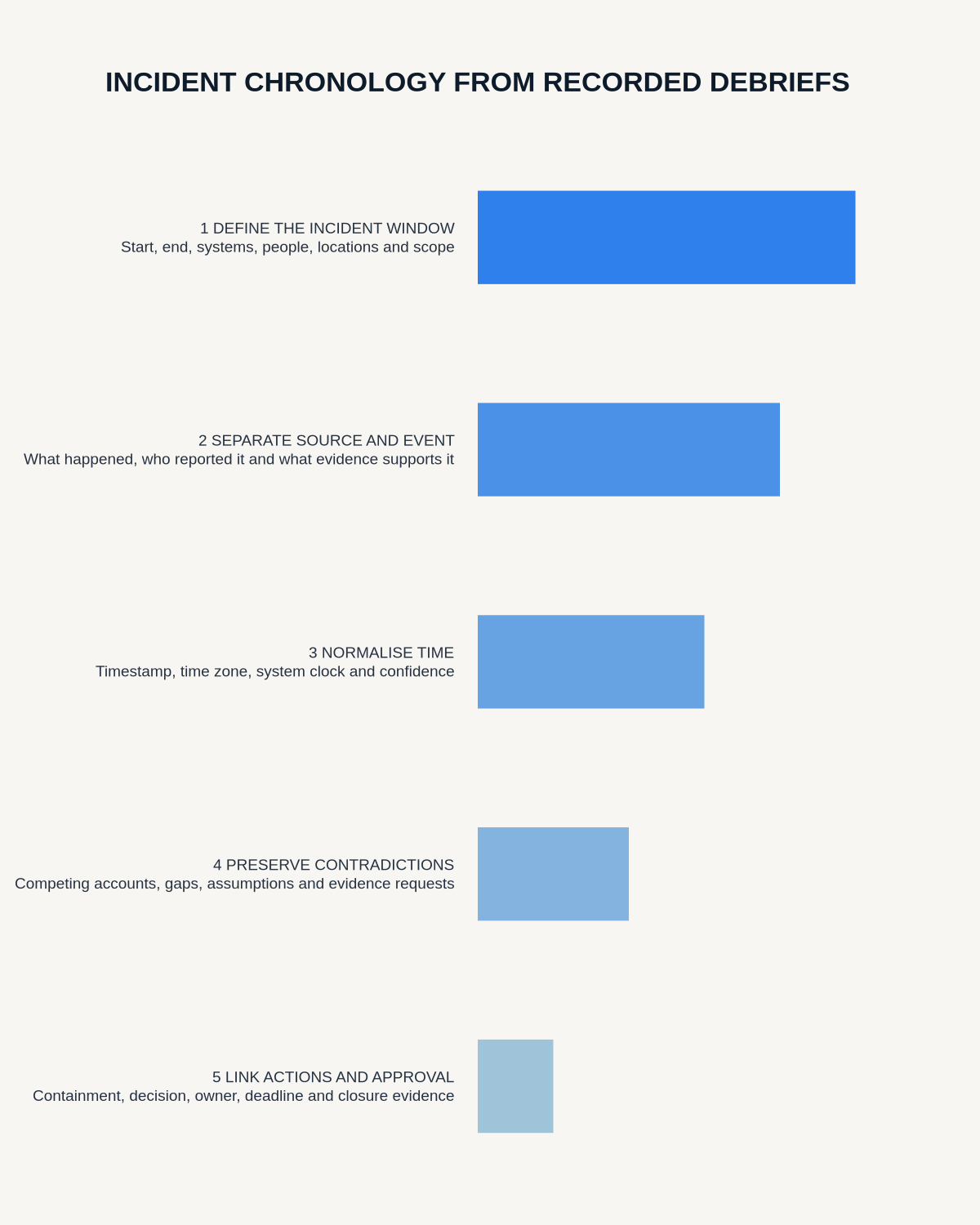
State the incident, location, period, systems, people and decision the chronology supports. Record exclusions and evidence still unavailable.
Separate four time fields
- Event time: when the event occurred.
- Observation time: when somebody saw or detected it.
- Report time: when it was communicated or recorded.
- Record time: when the chronology entry was created.
These may differ materially and should not be collapsed.
Use a source-linked chronology row
- Exact, approximate or bounded time
- Neutral event description
- Source and evidence location
- Direct, reported, inferred or disputed status
- Immediate impact and control
- Decision or action
- Confidence and evidence gap
Preserve conflicting accounts
Record each account separately and identify why they differ—timing, viewpoint, terminology, stress, missing data or genuine disagreement. Do not choose one version because it is more fluent.
Separate chronology from causal analysis
The chronology records sequence and evidence. Root-cause analysis evaluates why the incident occurred. Keep hypotheses, contributing factors and findings in linked but distinct fields.
Record control and escalation decisions
State who acted, when, what evidence was available, which control was applied and what triggered escalation. Later review should not replace the information available at the time.
Validate critical entries
Check names, asset IDs, times, units, alarms, locations and negative wording against original sources. Use timestamps and document references for material events.
Control later amendments
Add new evidence as a dated amendment. Do not silently rewrite the original chronology. Preserve which entries changed and why.
Workflow choice matrix for How to Build an Incident Chronology from Recorded Debriefs
Choose the method that protects the source and reduces downstream correction. The table makes the non-hardware options explicit.
| Condition | Preferred route | Why |
|---|---|---|
| Repeatable remote work with approved integrations | Cloud software | Automation and central collaboration may outweigh device independence. |
| In-person, mobile or unreliable-connectivity work | Dedicated recorder | Independent capture and a recoverable local source are usually more resilient. |
| Recording is refused, prohibited or unnecessary | Manual notes / no recording | Respecting the boundary is the correct workflow, not a product failure. |
| High-risk or mixed work | Governed hybrid | Separate capture, review, approval and retention rather than trusting one tool. |
Frequently asked questions
Can debrief recordings prove the chronology?
They are one source and must be compared with contemporaneous records and other evidence.
Should approximate times be excluded?
No. Include them with a clear confidence or range label.
Can AI identify the root cause?
No. It can organise evidence, but investigation findings require authorised human analysis.
Useful resources
- HSE incident-preparation guidance
- AI Voice Recorder for Health and Safety Managers
- How to Create a Lessons-Learned Report
- How to Build a Claims Chronology
Final chronology checklist
- Immediate safety action completed
- Original sources preserved
- Event and report times separate
- Every entry source-linked
- Contradictions visible
- Causal analysis kept separate
On this page
Related guides
See whether Halo fits this workflow
Review the NERALVO Halo specifications, included services, delivery information and current offer only after completing the guide.
Found an error or an out-of-date claim? Email support@neralvo.com with the article address and a supporting source.