Reviewed and updated: 21 July 2026.
The 60-second verdict
An internal decision brief should help an authorised decision-maker understand the question, evidence, options, trade-offs and recommendation without treating an AI transcript as verified fact. The recording is source material; the approved brief is a controlled business document.
Decision focus: use the method below only where it produces a recoverable source, a verifiable output and a clear next action. If one of those fails, change the workflow rather than trusting a polished summary.
Quick verdict: define one decision question, build a traceable evidence table, separate facts from assumptions and interpretation, compare credible options and require accountable human approval before the brief enters governance.
Evidence basis and limits
- Decision factors covered: Classify evidence before drafting; Build an evidence matrix; Use a controlled decision-brief structure.
- Evidence rule: A claim earns weight only when the source, date, configuration and limitation are clear enough for a reader to check.
- Boundary: Examples and workflow recommendations must be tested with representative recordings, the intended users and the actual approval process before rollout.
Start with one decision question
A weak brief begins with a broad topic such as “new supplier” or “project delay.” A useful brief asks a decision that an authorised person can answer:
- Should the organisation renew Supplier A for twelve months?
- Should the launch move from September to November?
- Which of three delivery options should be approved?
- Should the pilot proceed to controlled rollout?
State the decision owner, deadline, scope and constraints before analysing the transcripts.
Identify the source set
List every meeting, interview, document or data source used. For recordings, include:
- Meeting title and date
- Participants and roles
- Purpose
- Recording or transcript identifier
- Relevant timestamps
- Verification status
- Known gaps or access restrictions
Do not ask AI to summarise an undefined folder and assume the result is complete.
Classify evidence before drafting
| Category | Meaning | Treatment |
|---|---|---|
| Verified fact | Supported by an authoritative source | May be stated as fact with citation |
| Participant report | What a person said or believed | Attribute to the source |
| Assumption | Unverified premise used for analysis | Label and test sensitivity |
| Estimate | Calculated or forecast value | Show method and range |
| Opinion | Judgement or preference | Preserve attribution and rationale |
| AI inference | Pattern or conclusion generated by software | Treat as a hypothesis requiring review |
| Unknown | Information not established | Keep visible; do not fill plausibly |
Build an evidence matrix
For every material claim, record:
- Claim or issue
- Source meeting or document
- Timestamp or page
- Evidence category
- Confidence or verification status
- Conflicting source
- Owner for follow-up
This prevents a polished paragraph from hiding weak or contradictory evidence.
Use a controlled decision-brief structure
- Decision required: one sentence.
- Recommended option: clear but provisional until approved.
- Why now: deadline, trigger or consequence of delay.
- Context: only the background needed to decide.
- Evidence: verified facts and attributed reports.
- Options: credible alternatives, including status quo where relevant.
- Evaluation: benefits, costs, risks and dependencies.
- Assumptions and unknowns: visible rather than buried.
- Implementation: owner, milestones and controls.
- Decision record: approver, date, conditions and review trigger.
Compare options consistently
| Criterion | Questions |
|---|---|
| Strategic fit | Does it support the agreed objective? |
| Benefits | Which outcomes are supported by evidence? |
| Cost | What is the complete financial and operational cost? |
| Risk | What can fail and how severe is the impact? |
| Dependencies | Which approvals, suppliers or resources are required? |
| Reversibility | Can the organisation change course? |
| Timing | When can value begin and what creates delay? |
| Evidence strength | Which claims are verified, estimated or unknown? |
Use the same criteria for every option. Do not write the preferred option in detail while reducing alternatives to straw-man sentences.
Preserve disagreement and change over time
Multi-meeting analysis can flatten an evolving discussion into false consensus. Record:
- Which view was held at which time
- What new evidence changed the position
- Which objections remain unresolved
- Whether disagreement reflects different assumptions
- Whether a later meeting superseded an earlier statement
Where sources conflict, show the conflict and its consequence for the decision.
Separate recommendation from authority
The analyst or AI system may recommend an option. Only the authorised person or body can decide. The brief should state:
- Who prepared the analysis
- Who reviewed the evidence
- Who recommends
- Who approves
- Which conditions limit approval
Do not allow a generated recommendation to appear as a completed governance decision.
Test the recommendation against uncertainty
Ask:
- Which assumption most affects the recommendation?
- What happens if the estimate is wrong?
- Which missing fact could change the choice?
- Can the organisation pilot or stage the decision?
- What is the cost of waiting?
- What is the cost of reversing later?
Include ranges or scenarios where a single precise number would create false confidence.
Workflow from recordings to approved brief
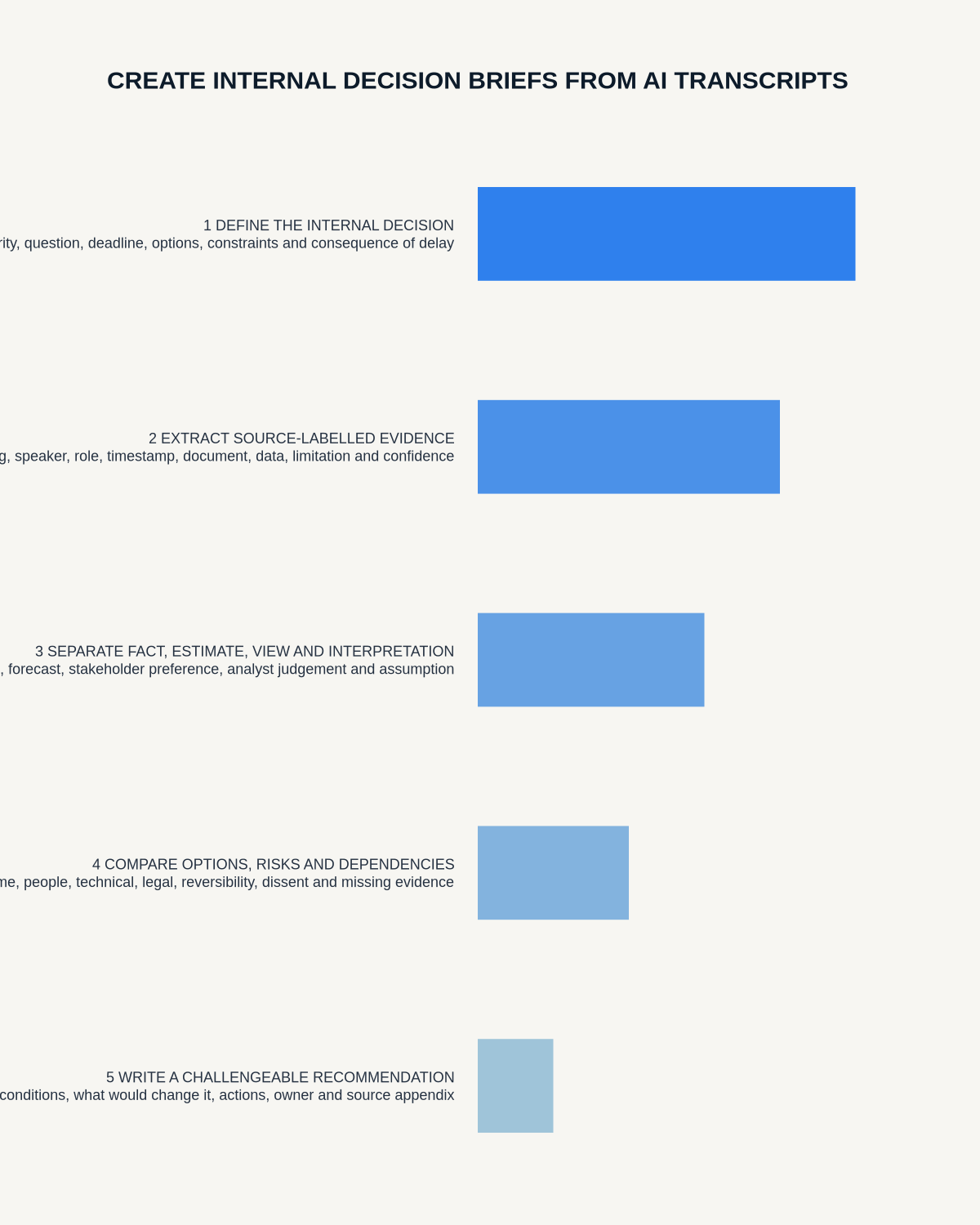
- Define the decision question and owner.
- Select the authorised source set.
- Correct material transcript errors.
- Build the evidence matrix.
- Identify conflicts, gaps and assumptions.
- Define credible options and common criteria.
- Generate a structured draft.
- Verify every material claim against source evidence.
- Obtain subject-matter, finance, legal or risk review where required.
- Present the recommendation to the decision authority.
- Record the actual decision, conditions and review trigger.
- Store the approved brief and apply retention rules to source material.
Common AI failures
- Turning an opinion into a verified fact
- Inventing a missing cost or deadline
- Removing a condition from an agreement
- Ignoring an earlier or minority objection
- Merging two options
- Presenting the recommendation as the decision
- Using obsolete information from an earlier meeting
- Creating unsupported certainty from incomplete evidence
Protect sensitive and confidential material
A decision brief should contain only the evidence needed by its audience. Restrict raw transcripts more tightly where they contain personal, privileged, commercially sensitive or third-party information. Use approved accounts, controlled sharing, version management and purpose-based retention.
Measure brief quality
- Material claims with source references
- Unverified claims clearly labelled
- Conflicting evidence visible
- Options assessed consistently
- Decision authority explicit
- Correction requests after circulation
- Time from meeting to approved brief
- Implementation variance from the approved decision
Where NERALVO Halo fits
Apply this guide before assessing NERALVO Halo can capture suitable meetings to 64GB local storage and synchronise recordings to DOWAY. DOWAY can create transcripts, summaries, speaker-separated notes and structured templates.
Use those outputs to identify evidence and options, then verify every material claim before the brief enters governance. One year of DOWAY Max is included with the current Halo package.
Workflow choice matrix for How to Create Internal Decision Briefs from AI Transcripts
Choose the method that protects the source and reduces downstream correction. The table makes the non-hardware options explicit.
| Condition | Preferred route | Why |
|---|---|---|
| Repeatable remote work with approved integrations | Cloud software | Automation and central collaboration may outweigh device independence. |
| In-person, mobile or unreliable-connectivity work | Dedicated recorder | Independent capture and a recoverable local source are usually more resilient. |
| Recording is refused, prohibited or unnecessary | Manual notes / no recording | Respecting the boundary is the correct workflow, not a product failure. |
| High-risk or mixed work | Governed hybrid | Separate capture, review, approval and retention rather than trusting one tool. |
Frequently asked questions
Can AI choose the best option?
It can organise evidence and model trade-offs, but accountable people must validate assumptions, apply judgement and make the decision.
Should every statement have a timestamp?
Material and disputed claims should be traceable. Routine background may use a grouped source reference.
What if the meetings disagree?
Show the disagreement, timing and assumptions rather than forcing one combined narrative.
Can the recommendation be filed as the decision?
No. Record the actual authorised outcome separately, including conditions and review triggers.
Final checklist
- One decision question defined
- Decision owner and deadline identified
- Source set complete and authorised
- Facts, reports, assumptions and inferences separated
- Evidence matrix completed
- Conflicts and unknowns visible
- Options compared consistently
- Recommendation tested against uncertainty
- Required specialist reviews completed
- Authority and conditions recorded
- Source and final records stored appropriately
A strong AI-assisted decision brief is concise because the evidence has been organised—not because uncertainty has been removed.
Related AI voice recorder guides
Workflow map
Visual map for How to Create Internal Decision Briefs from AI Transcripts
- Define the decisionState the question, required output and acceptance rule.
- Capture the sourceUse the approved route and preserve context, identity and limitations.
- Verify material detailsReplay or check names, numbers, negatives, decisions and actions.
- Move into the real recordAssign an owner, retain evidence and apply the deletion rule.
On this page
Related guides
See whether Halo fits this workflow
Review the NERALVO Halo specifications, included services, delivery information and current offer only after completing the guide.
Found an error or an out-of-date claim? Email support@neralvo.com with the article address and a supporting source.