The 60-second verdict
Quick answer: measure AI transcript correction time with a locked sample, fixed start and stop rules, identical reviewer instructions and one final quality gate. Separate setup, processing wait, active correction, quality assurance, routing and rework, then compare the total labour and cost with a real baseline.
Decision focus: use the method below only where it produces a recoverable source, a verifiable output and a clear next action. If one of those fails, change the workflow rather than trusting a polished summary.
Evidence basis and limits
- Decision factors covered: Define the comparison and hypothesis; Lock the sample and stopping rule; Set one completion standard.
- Evidence rule: Claims are weighted by consequence: capture failure, changed meaning, access and recovery matter more than polished wording.
- Boundary: Examples and workflow recommendations must be tested with representative recordings, the intended users and the actual approval process before rollout.
Headline accuracy can hide the work required to correct names, figures, speaker labels and unsupported words. The credible productivity measure is the effort required to produce an approved result—not the speed of the first draft.

Define the comparison and hypothesis
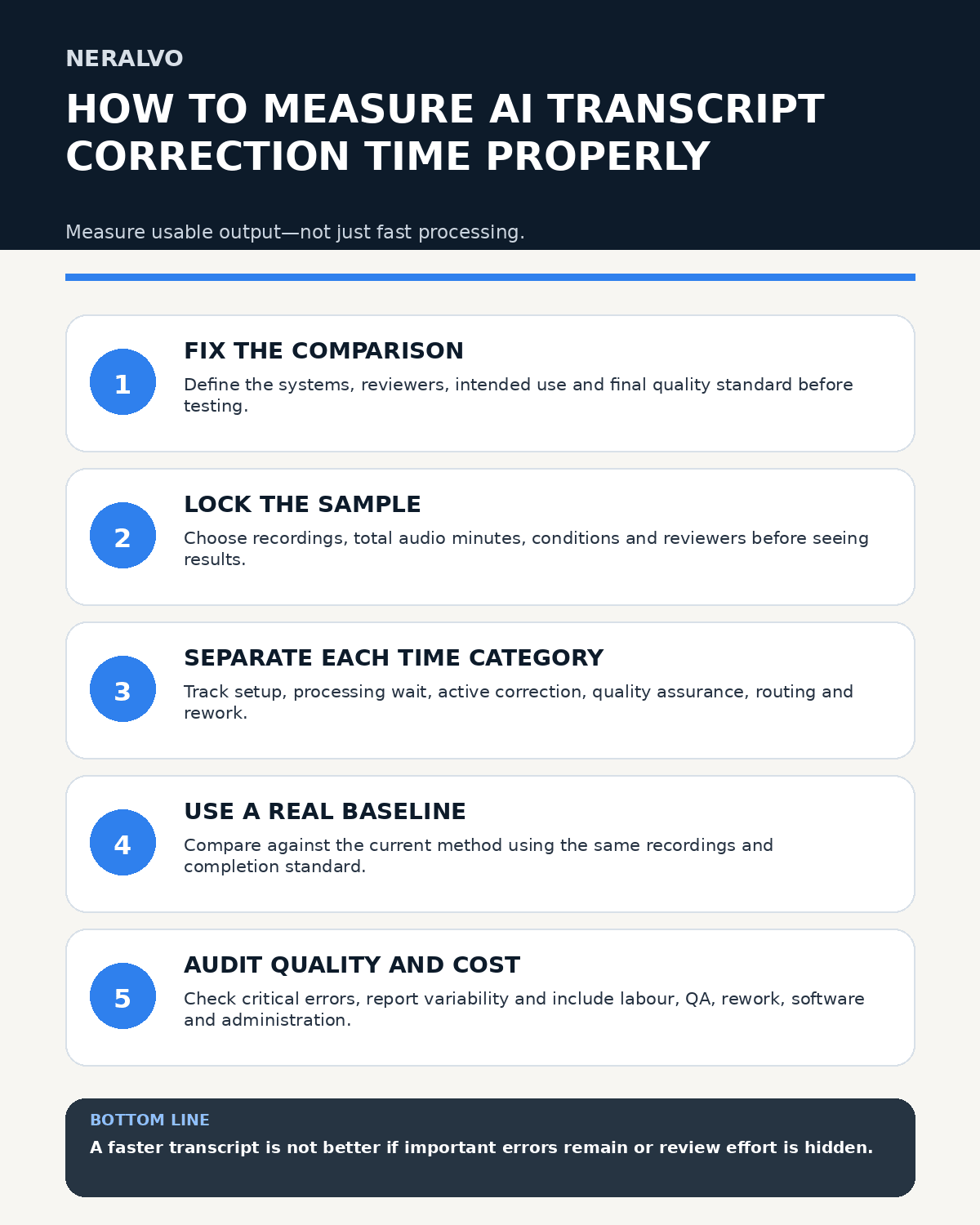
State whether the study compares AI correction with manual transcription, two transcription systems or two configurations. Define the intended use and required final quality.
Write the hypothesis, success threshold and analysis plan before collecting results. Do not stop the test because an early sample looks favourable.
Lock the sample and stopping rule
Choose the recordings, total audio minutes, conditions and reviewers before viewing outputs. Include quiet and noisy rooms, different speaker counts, long and short files, specialist vocabulary, accents and overlap.
The stopping rule may require every file in the manifest or a minimum number of files and audio minutes per condition. Explain any later exclusion or addition and report it as a separate analysis.
Set one completion standard
The timer should stop only when the transcript reaches the same quality gate for every method. The gate may require:
- all recoverable speech represented under the chosen convention;
- names, dates, amounts and technical terms verified;
- speaker labels corrected where required;
- unsupported words removed;
- uncertain passages marked;
- formatting and naming completed;
- the selected quality-assurance check passed;
- the file routed to its final destination.
If one reviewer stops when text merely looks readable while another checks every number, the results cannot be compared.
Separate workflow time states
- Setup: importing, naming and preparing files.
- Processing wait: automated transcription time.
- Active correction: listening and editing.
- Quality assurance: final or second-person review.
- Routing: exporting, filing and moving actions.
- Rework: corrections after a failed quality check.
Report active labour separately from elapsed turnaround. Waiting may be productive in one workflow and idle in another.
Measure a real baseline
Benchmark the current alternative using the same recordings and final standard. The baseline may be manual transcription, live human notes or an outsourced process.
Do not use an assumed typing speed or an unrelated industry average.
Use paired or matched comparisons
Where practical, process the same source through both methods. Use different reviewers or carefully balance order to reduce memory effects. In a matched design, allocate files with similar length and difficulty across methods.
A reviewer should not manually transcribe a file immediately after correcting its AI transcript.
Control learning, order and fatigue
Randomise or balance file order. Use practice recordings outside the measured set. Record session time, breaks, playback speed, software shortcuts, vocabulary assistance and reviewer familiarity.
Performance may improve through learning or worsen through fatigue. Keep those effects visible.
Fix start, stop and pause rules
Start at the same operational point, such as when the reviewer opens the assigned source and candidate output. Stop when the quality gate is met and the approved file reaches the stated destination.
Pause only for predefined interruptions outside the task. Do not exclude normal terminology lookup, difficult listening, application delays or export work when they are part of real operations.
Audit final quality independently
A faster transcript is not better when serious errors remain. Have an independent reviewer check a predefined subset for ordinary word errors, names, figures, negations, speaker attribution, unsupported additions and missed content.
Report first-pass success and final success separately. Add quality-assurance and rework time needed to reach the standard.
Calculate useful metrics
- Active correction minutes per file
- Active correction minutes per audio minute
- Total active workflow minutes
- Elapsed turnaround time
- Quality-assurance and rework minutes
- Median, range and condition-level results
- Processing-failure rate
- Final residual error rate
Active-effort ratio = active correction minutes ÷ audio minutes.
Define every denominator. Report the median and range so a few difficult files do not disappear inside an average.
Calculate total recurring cost
Recurring workflow cost = active labour + quality-assurance and rework labour + processing or subscription cost + routine administration.
State hourly rates, allocation of shared subscriptions and whether processing wait creates paid idle time. Report one-off setup, training and integration costs separately.
Include failures
Track upload failures, unsupported formats, missing sections, application crashes, incomplete outputs and export problems. Include recovery, retry and rework time.
Processing-failure rate = failed files ÷ attempted files.
Worked example
Suppose a locked sample contains 12 recordings totalling 360 audio minutes. The AI-assisted workflow takes 48 minutes of active correction, 18 minutes of quality assurance and 6 minutes of rework. The manual baseline takes 210 active minutes to reach the same quality gate.
| Measure | AI-assisted | Manual baseline |
|---|---|---|
| Audio minutes | 360 | 360 |
| Correction or transcription | 48 minutes | 180 minutes |
| Quality assurance | 18 minutes | 30 minutes |
| Rework | 6 minutes | 0 minutes |
| Total active labour | 72 minutes | 210 minutes |
| Labour per audio hour | 12 minutes | 35 minutes |
In this illustrative sample, active labour is lower by about 65.7%. That is not a product guarantee. The report should include individual files, conditions, failures, reviewer experience and uncertainty.
Report uncertainty honestly
Show the number of recordings, audio minutes and reviewers. Report median, range and, where supported, a confidence or resampling interval. Label small studies as exploratory. Do not claim a universal saving from one person correcting one clean recording.
Use a standard results table
Record source ID, condition, duration, method, software version, reviewer, order, setup time, processing wait, correction time, quality-assurance time, rework, elapsed time, final quality, failure and cost. Preserve the raw table for later retesting.
Workflow choice matrix for How to Measure AI Transcript Correction Time, Labour Savings and True Workflow Cost
Choose the method that protects the source and reduces downstream correction. The table makes the non-hardware options explicit.
| Condition | Preferred route | Why |
|---|---|---|
| Repeatable remote work with approved integrations | Cloud software | Automation and central collaboration may outweigh device independence. |
| In-person, mobile or unreliable-connectivity work | Dedicated recorder | Independent capture and a recoverable local source are usually more resilient. |
| Recording is refused, prohibited or unnecessary | Manual notes / no recording | Respecting the boundary is the correct workflow, not a product failure. |
| High-risk or mixed work | Governed hybrid | Separate capture, review, approval and retention rather than trusting one tool. |
Frequently asked questions
Should automated processing time count as labour?
No. Report it as elapsed time unless a person must actively supervise it.
Why report the median?
The median is less distorted by one unusually difficult or failed recording. Report the range as well.
Should failed transcriptions be included?
Yes. Recovery, retries and rework are part of the real workflow.
Can correction time be used in marketing claims?
Only with transparent conditions, sample, quality gate and limitations. Avoid implying that an exploratory benchmark guarantees the same saving for every user.
Useful resources
- UK government portfolio of AI assurance techniques
- How to Compare Two AI Transcription Systems Fairly
- Check whether NERALVO Halo fits this workflow
Measurement checklist
- Question and hypothesis defined
- Sample and stopping rule locked
- One quality gate used
- Real baseline measured
- Order, learning and fatigue controlled
- Active time and waiting separated
- Quality assurance, rework and failures included
- Total recurring cost calculated
- Variability and uncertainty reported
Related AI voice recorder guides
On this page
Related guides
See whether Halo fits this workflow
Review the NERALVO Halo specifications, included services, delivery information and current offer only after completing the guide.
Found an error or an out-of-date claim? Email support@neralvo.com with the article address and a supporting source.