The 60-second verdict
Quick answer: reduce meeting administration with AI by automating capture, transcription and first-draft structure while keeping human control over recording decisions, speaker identity, formal decisions, actions, distribution and deletion. Measure the full process, not the speed of the first summary.
Decision focus: use the method below only where it produces a recoverable source, a verifiable output and a clear next action. If one of those fails, change the workflow rather than trusting a polished summary.
Evidence basis and limits
- Decision factors covered: Start by removing unnecessary meetings and records; Design a clear meeting workflow; Automate low-risk stages.
- Evidence rule: Claims are weighted by consequence: capture failure, changed meaning, access and recovery matter more than polished wording.
- Boundary: Examples and workflow recommendations must be tested with representative recordings, the intended users and the actual approval process before rollout.
Start by removing unnecessary meetings and records
AI should not make a poor meeting process faster. Before recording, ask:
- Could this be an asynchronous update?
- Is a decision or discussion genuinely required?
- Which participants are necessary?
- What exact output must exist afterwards?
- Does the conversation need recording?
Design a clear meeting workflow
- Purpose and decisions required.
- Agenda and papers circulated.
- Recording decision and participant process.
- Clear discussion by agenda item.
- Spoken confirmation of decisions and actions.
- AI first draft.
- Human review and approval.
- One-time routing to the correct systems.
- Retention and deletion.
Automate low-risk stages
- transcription;
- topic headings;
- timestamps;
- candidate decisions and actions;
- standard summary templates;
- search within source material;
- draft follow-up messages.
Retain human control over high-risk stages
| Stage | Why human control remains |
|---|---|
| Whether to record | Necessity, privacy and participant context |
| Speaker identity | AI labels can merge or split voices |
| Formal decision | Authority and conditions require verification |
| Client or legal instruction | Wording and formalities may matter |
| External distribution | Sensitive and irrelevant content must be removed |
| Deletion | Every copy and retention purpose must be understood |
Use a standard spoken close
At the end of each agenda item, confirm:
- What was decided?
- What was not decided?
- What condition remains?
- Who owns the next action?
- What is the deadline?
- When will the item be reviewed?
This improves the source and reduces correction later.
Create one final record
Choose the authoritative destination for minutes, decisions, actions, risks and client notes. Do not copy the same AI output into email, chat, CRM, project software and documents without clear ownership.
Measure total meeting administration
| Stage | Time to include |
|---|---|
| Preparation | Agenda, papers and participant setup |
| Capture | Equipment and explanation |
| Processing | Transfer and transcription |
| Correction | Names, figures, speakers, decisions and actions |
| Approval | Reviewer and meeting-owner time |
| Routing | Tasks, decisions, CRM and filing |
| Recovery | Failures and duplicate cleanup |
Use quality gates
Do not release the output until:
- source audio is complete;
- names and figures are checked;
- proposals are separated from decisions;
- conditions and dissent are preserved;
- action owners and deadlines are verified;
- unnecessary sensitive detail is removed;
- status is marked draft, reviewed or approved.
Prevent AI backlog
Set a fixed processing window, a maximum unreviewed-file count and priority rules for urgent client instructions or decisions. Delete accidental and duplicate files promptly under policy.
Use templates selectively
A project review, discovery call and formal committee meeting should not use the same output. Templates save time when they match the purpose and do not force unsupported fields.
Run a controlled pilot
- Select one repeated meeting type.
- Measure the current process.
- Use representative users and rooms.
- Test failure and correction scenarios.
- Measure total time and material errors.
- Decide to expand, modify or stop.
Where NERALVO Halo fits
Check whether NERALVO Halo fits this workflow can reduce continuous typing through local capture and DOWAY drafting. Value depends on controlled review and integration with the organisation’s real systems.
Workflow choice matrix for How to Reduce Meeting Admin with AI Without Losing Control
Choose the method that protects the source and reduces downstream correction. The table makes the non-hardware options explicit.
| Condition | Preferred route | Why |
|---|---|---|
| Repeatable remote work with approved integrations | Cloud software | Automation and central collaboration may outweigh device independence. |
| In-person, mobile or unreliable-connectivity work | Dedicated recorder | Independent capture and a recoverable local source are usually more resilient. |
| Recording is refused, prohibited or unnecessary | Manual notes / no recording | Respecting the boundary is the correct workflow, not a product failure. |
| High-risk or mixed work | Governed hybrid | Separate capture, review, approval and retention rather than trusting one tool. |
Frequently asked questions
Should every meeting be recorded?
No. Record only where a defined purpose justifies it.
Can AI send minutes automatically?
Only after the organisation decides which meeting types and controls permit automatic distribution.
What is the best efficiency measure?
Total time to an accurate approved record and completed actions.
Does more automation always save time?
No. Automation can spread errors and duplicates faster when review and routing are poorly designed.
Final meeting-admin checklist
- Unnecessary meetings and records removed
- Required output defined
- Low-risk drafting automated
- High-risk decisions remain human-controlled
- One authoritative destination selected
- Quality gates applied
- Total time and error rate measured
- Retention and deletion completed
Related AI voice recorder guides
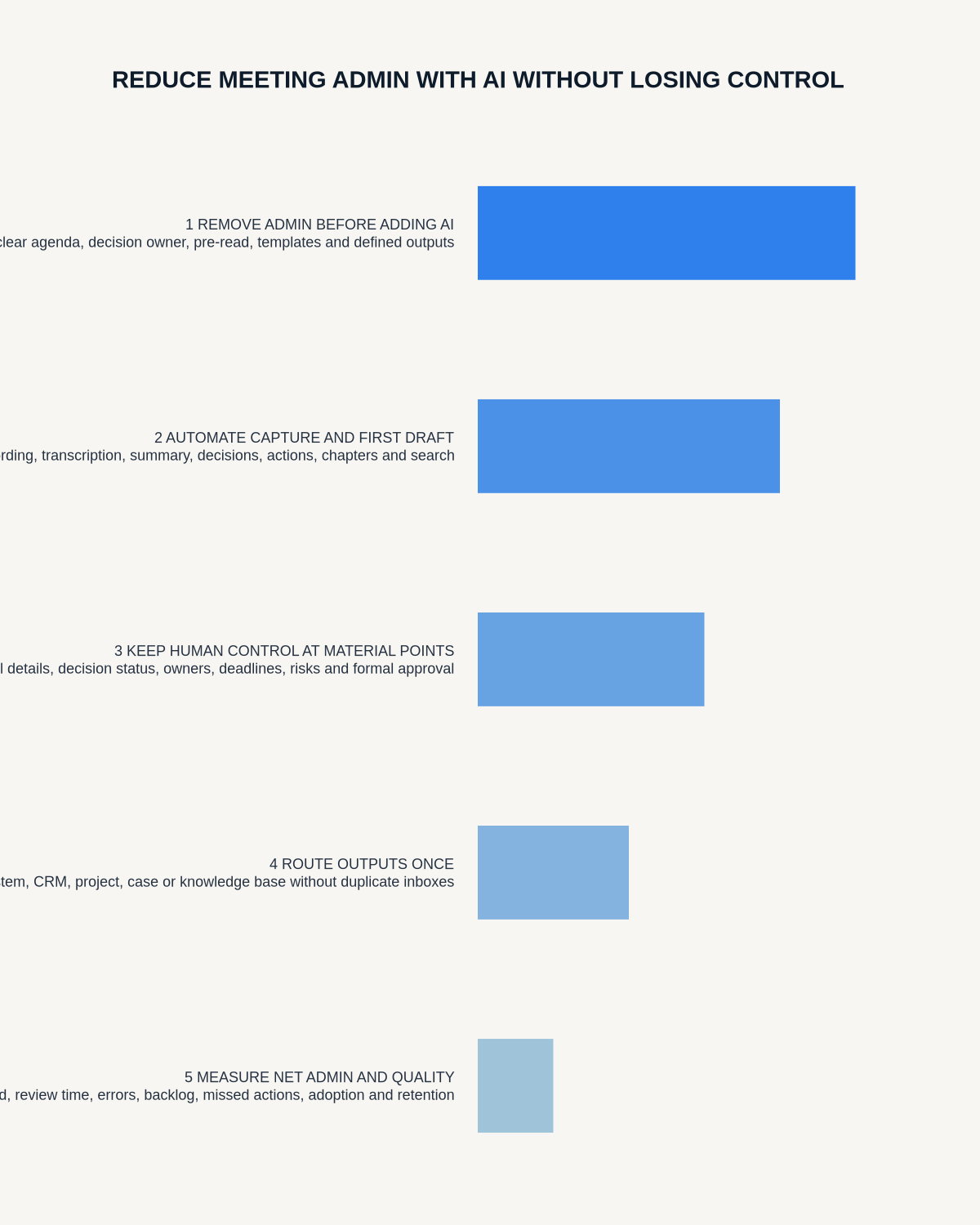
Workflow map
Visual map for How to Reduce Meeting Admin with AI Without Losing Control
- Define the decisionState the question, required output and acceptance rule.
- Capture the sourceUse the approved route and preserve context, identity and limitations.
- Verify material detailsReplay or check names, numbers, negatives, decisions and actions.
- Move into the real recordAssign an owner, retain evidence and apply the deletion rule.
On this page
Related guides
See whether Halo fits this workflow
Review the NERALVO Halo specifications, included services, delivery information and current offer only after completing the guide.
Found an error or an out-of-date claim? Email support@neralvo.com with the article address and a supporting source.