The 60-second verdict
Quick answer: build a service blueprint from customer interviews by defining one journey and user group, linking every customer step to frontstage service, backstage work, systems, evidence, failure points and owners, then validating the map with operational teams and real service data.
Decision focus: use the method below only where it produces a recoverable source, a verifiable output and a clear next action. If one of those fails, change the workflow rather than trusting a polished summary.
Evidence basis and limits
- Decision factors covered: Define one journey and user group; Extract customer evidence carefully; Separate evidence from inference.
- Evidence rule: A claim earns weight only when the source, date, configuration and limitation are clear enough for a reader to check.
- Boundary: Examples and workflow recommendations must be tested with representative recordings, the intended users and the actual approval process before rollout.
Interview recordings reveal what customers experience and how they describe problems. They do not automatically show the internal process or prove that one participant represents every user.

Define one journey and user group
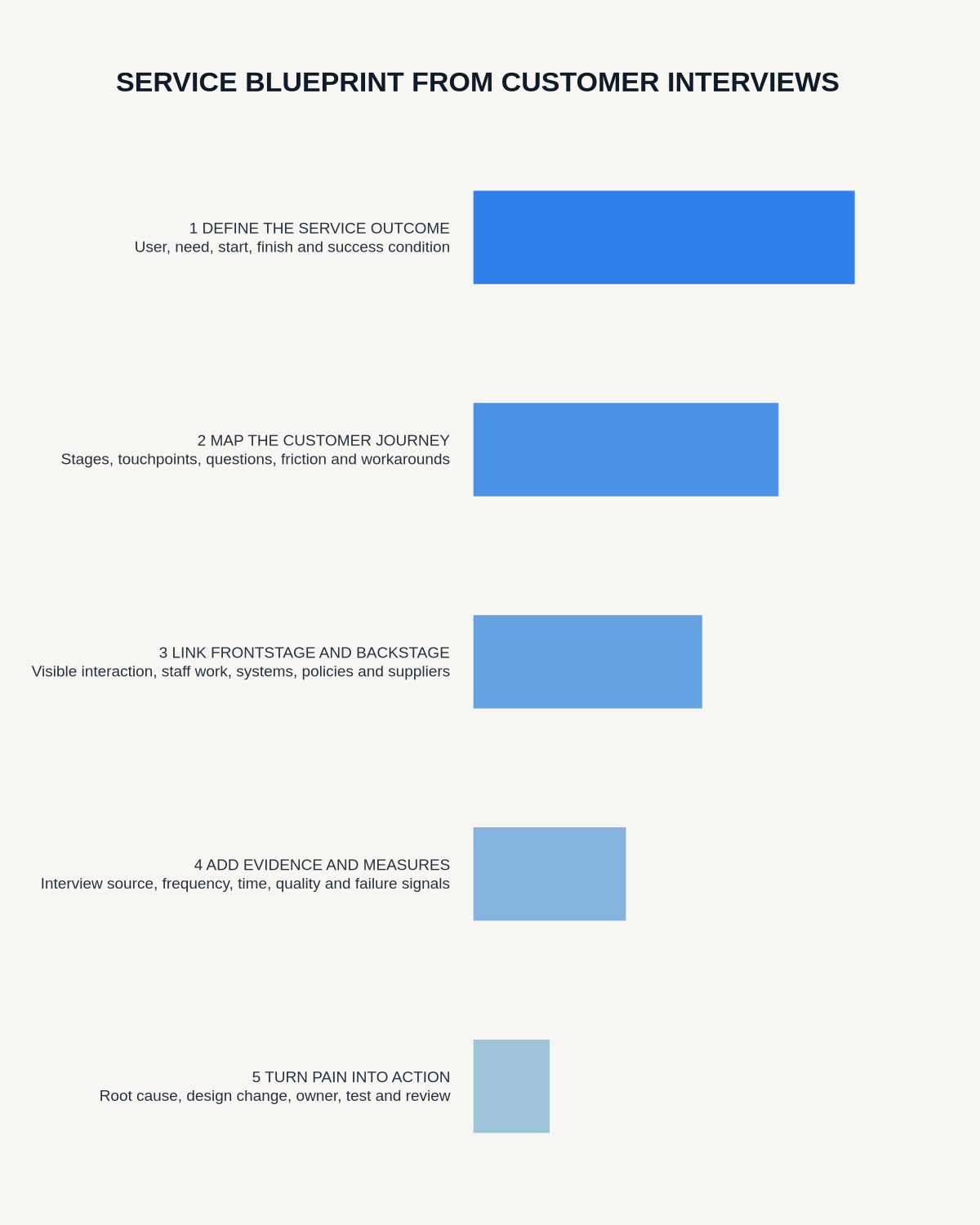
State the service, user segment, trigger, start point, end point and desired outcome. Avoid trying to map an entire organisation from several broad interviews.
Extract customer evidence carefully
For each journey stage, capture the customer’s action, goal, question, evidence used, difficulty, workaround, emotion stated in their own words and desired outcome. Verify important quotations and preserve contradictory experiences.
Separate evidence from inference
- Observed behaviour: what the participant did or demonstrated.
- Reported experience: what they said happened.
- Interpretation: the researcher’s explanation.
- Hypothesis: a cause requiring operational evidence.
Do not use AI to infer emotion or motivation from voice.
Build the blueprint layers
- Customer actions and decisions
- Visible touchpoints and frontstage activity
- Backstage staff activity
- Supporting systems, data and suppliers
- Policies, controls and evidence
- Failure points, waits, handoffs and recovery
- Measures, owners and improvement opportunities
Link pain points to causes
A customer may experience delay at one step while the cause exists earlier in eligibility, data, approval, staffing or supplier handoff. Record the pain, working hypothesis, supporting evidence and verification action separately.
Include exceptions and accessibility
Map alternative channels, support needs, failure recovery and users who cannot complete the standard route. A single “happy path” hides where service design most often fails.
Validate with operational evidence
Review the map with frontline staff, process owners, technical teams and policy owners. Compare it with analytics, support tickets, process documents, system data and observation.
Turn the blueprint into action
Each improvement should identify the problem, evidence, affected users, proposed change, owner, dependency, measure and review date. Preserve current, proposed and approved status.
Workflow choice matrix for How to Build a Service Blueprint from Customer Interviews
Choose the method that protects the source and reduces downstream correction. The table makes the non-hardware options explicit.
| Condition | Preferred route | Why |
|---|---|---|
| Repeatable remote work with approved integrations | Cloud software | Automation and central collaboration may outweigh device independence. |
| In-person, mobile or unreliable-connectivity work | Dedicated recorder | Independent capture and a recoverable local source are usually more resilient. |
| Recording is refused, prohibited or unnecessary | Manual notes / no recording | Respecting the boundary is the correct workflow, not a product failure. |
| High-risk or mixed work | Governed hybrid | Separate capture, review, approval and retention rather than trusting one tool. |
Frequently asked questions
Can interviews alone produce a final blueprint?
No. They provide customer evidence that must be connected to operational and system evidence.
Should every customer quote appear?
No. Use checked, representative evidence with enough context and preserve material exceptions.
Can AI identify the root cause?
It can organise hypotheses, but root causes require operational testing.
Useful resources
- GOV.UK Service Manual design guidance
- AI Voice Recorder for User Interviews
- How to Create a Customer FAQ from Support Calls
- How to Create an Evidence Matrix
Final blueprint checklist
- Journey and user group defined
- Customer evidence traceable
- Inference and cause labelled
- Frontstage, backstage and systems connected
- Exceptions and accessibility included
- Improvements have owners and measures
On this page
Related guides
See whether Halo fits this workflow
Review the NERALVO Halo specifications, included services, delivery information and current offer only after completing the guide.
Found an error or an out-of-date claim? Email support@neralvo.com with the article address and a supporting source.