The 60-second verdict
Quick answer: approve an AI voice recorder only after evidence shows that the complete workflow works under representative conditions. Define measurable requirements, test capture, transfer, transcription, review, storage, exports, deletion and predictable failures, then document defects, retest corrections and approve a limited operating scope.
Use this guide when: the recording purpose, authority, participants, access and retention can be defined. Pause when: any of those controls is unclear.
Evidence basis and limits
- Decision factors covered: Define the operating claim; Convert expectations into measurable requirements; Create a representative test set.
- Evidence rule: Claims are weighted by consequence: capture failure, changed meaning, access and recovery matter more than polished wording.
- Boundary: This is practical information, not legal advice. Verify current ICO guidance, sector rules, contracts and organisational policy for the real use case.
An impressive demonstration is not an acceptance test. The device and its companion services must work with the organisation’s real phones, rooms, speakers, information, accounts and downstream systems.

Define the operating claim
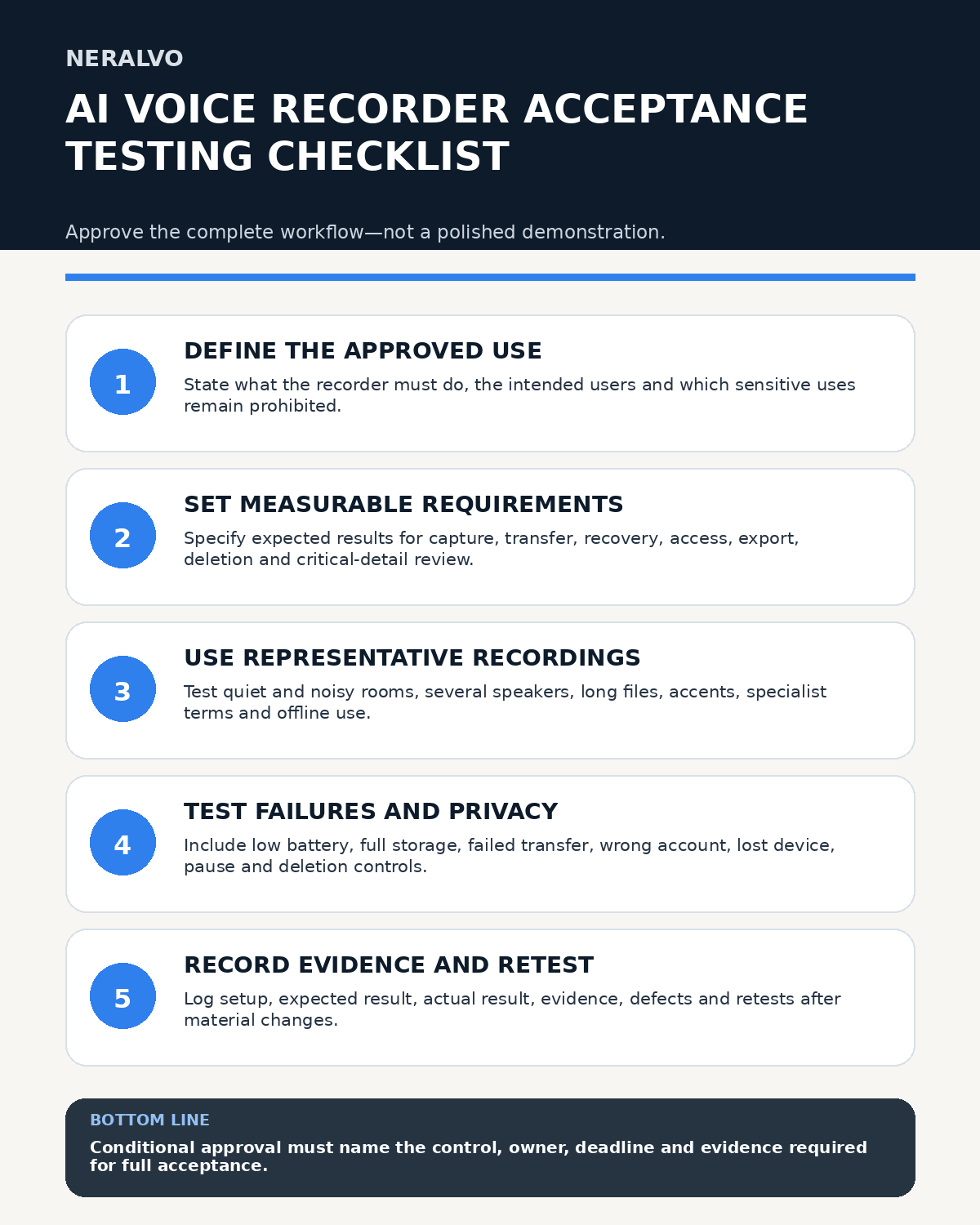
State exactly what the workflow is expected to do, such as record authorised internal meetings, create draft transcripts, extract actions for review or support searchable site notes.
Also define prohibited or unapproved uses. Acceptance for routine meetings does not automatically cover covert recording, high-risk clinical or legal records, automatic performance assessment or unattended decision-making.
Convert expectations into measurable requirements
Each requirement should identify the condition, expected behaviour and evidence. Replace vague statements such as “must be accurate” with requirements such as:
- a sixty-minute meeting records without interruption under approved settings;
- a failed transfer does not destroy the only source file;
- authorised users can export the original audio and checked transcript;
- unauthorised users cannot access retained recordings;
- critical details are checked before formal use;
- a selected record can be removed from each expected storage location.
Create a representative test set
Include:
- quiet and noisy rooms;
- one speaker and several speakers;
- short and long recordings;
- remote, in-person and hybrid meetings;
- different microphone distances;
- specialist vocabulary, names, numbers and negations;
- the real accents and languages used;
- supported phones, operating systems and app versions;
- normal connectivity, offline capture and interrupted transfer;
- every intended recording mode and call route.
Give each requirement and test sample a stable identifier. Preserve the conditions so later versions can be retested against the same benchmark.
Test capture quality and endurance
Verify start, pause, resume and stop behaviour. Check duration, audibility, clipping, missing sections, background noise, storage warnings and battery behaviour. Test the longest approved scenario rather than only short clips.
Where phone-call capture is intended, test the exact handset, case, operating system, application and call route. Do not generalise one successful configuration to all phones.
Test transfer and source recovery
Confirm that transferred files open correctly, duplicates are identifiable and the source remains recoverable after an interrupted transfer or failed processing attempt. Test what happens when the paired phone is replaced or the user signs into another authorised device.
Test transcription and structured outputs
Use a checked reference for representative samples. Measure ordinary word errors separately from critical-field errors, speaker attribution and unsupported additions. Check summaries, action lists, translations and templates against the source.
Set stricter pass criteria for names, amounts, deadlines, conditions, decisions and negative wording. A transcript can pass an overall threshold while failing the intended workflow.
Test participant and privacy controls
Confirm that the process supports the required participant explanation, objection route, pause method and non-recorded alternative. Verify storage, access, sharing, exports, retention and deletion.
Check whether audio or transcripts appear in personal accounts, automatic backups, downloads or notifications outside the approved route.
Test security and administration
Confirm account ownership, strong authentication, role-based access, administrator controls, user removal, device registers and lost-device response. Do not perform destructive or intrusive security tests without authority.
Test workflow integration
Verify that approved outputs reach the correct task, calendar, project, customer, case or evidence system. Check naming, ownership, source links and version status. The recording application should not become a second uncontrolled task list or archive.
Test predictable failures
- Low battery or interrupted power
- Insufficient device or phone storage
- Bluetooth disconnection
- Offline capture
- Failed or interrupted transfer
- Wrong account selection
- Duplicate upload
- App or phone restart
- Expired processing allowance
- Accidental recording
- Lost device or suspected access
Staff should be able to detect the failure, protect the source, recover through an approved method and report incidents without unsafe workarounds.
Define measurable pass criteria
For each requirement, record:
- pass and fail conditions;
- allowed tolerance;
- sample size;
- evidence required;
- reviewer and approver;
- severity if the requirement fails.
A conditional pass must identify the compensating control, owner, deadline and retest. It should never hide an unresolved high-risk failure.
Use a controlled evidence table
Each execution should contain requirement ID, test-case ID, sample version, device and software versions, preconditions, steps, expected result, actual result, evidence link, tester, date, outcome, defect reference and retest result.
Avoid placing confidential meeting content in a widely accessible test report.
Manage defects and remediation
Classify failures by impact and urgency. Record the requirement affected, evidence, immediate containment, owner, target date and retest method. Separate product limitations from configuration, training, policy or workflow defects.
Do not close a defect because a workaround was written down. Implement the correction and rerun the affected test.
Define change-triggered retesting
Retest after material changes to:
- device, accessory or firmware;
- phone model or operating system;
- companion application or AI processing;
- language, speaker or call settings;
- accounts, access, storage or deletion configuration;
- supplier terms, processing route or data location;
- internal policy, approved use or retention;
- integrations and export formats;
- a serious incident, complaint or audit finding.
Obtain human approval
The final decision should list the tested scope, passed requirements, conditional controls, failed requirements, limitations, approved users, prohibited uses and review triggers. Approval should come from the business, privacy, security and governance roles required by the organisation.
Workflow choice matrix for AI Voice Recorder Acceptance Testing Checklist
Apply the strongest control before choosing a device. The table makes the non-hardware options explicit.
| Condition | Preferred route | Why |
|---|---|---|
| Repeatable remote work with approved integrations | Cloud software | Automation and central collaboration may outweigh device independence. |
| In-person, mobile or unreliable-connectivity work | Dedicated recorder | Independent capture and a recoverable local source are usually more resilient. |
| Recording is refused, prohibited or unnecessary | Manual notes / no recording | Respecting the boundary is the correct workflow, not a product failure. |
| High-risk or mixed work | Governed hybrid | Separate capture, review, approval and retention rather than trusting one tool. |
Frequently asked questions
How long should acceptance testing take?
Long enough to cover the longest approved recording, representative environments, intended devices and the main failure and recovery scenarios.
Can a product pass with known defects?
Only when the defect is understood, the residual risk is acceptable and a documented control, owner, deadline and retest exist.
When should testing be repeated?
After material hardware, firmware, phone, operating-system, app, model, account, storage, supplier or use-case changes.
Can manufacturer specifications replace testing?
No. Specifications inform requirements, but acceptance depends on evidence from the organisation’s actual configuration.
Useful resources
- UK government portfolio of AI assurance techniques
- NIST AI Risk Management Framework
- Review NERALVO Halo against these controls
Acceptance checklist
- Operating claim and prohibited uses defined
- Requirements measurable
- Representative conditions tested
- Capture, transfer and source recovery verified
- Transcript and summary quality measured
- Privacy, access and deletion checked
- Failures and recovery included
- Evidence and defects controlled
- Retesting triggers defined
- Authorised scope approved
Related AI voice recorder guides
On this page
Related guides
Check permission, retention and access before choosing hardware
Once the policy requirements in this guide are satisfied, compare Halo’s specifications, local storage, included services and current offer against your approved workflow.
Found an error or an out-of-date claim? Email support@neralvo.com with the article address and a supporting source.