The 60-second verdict
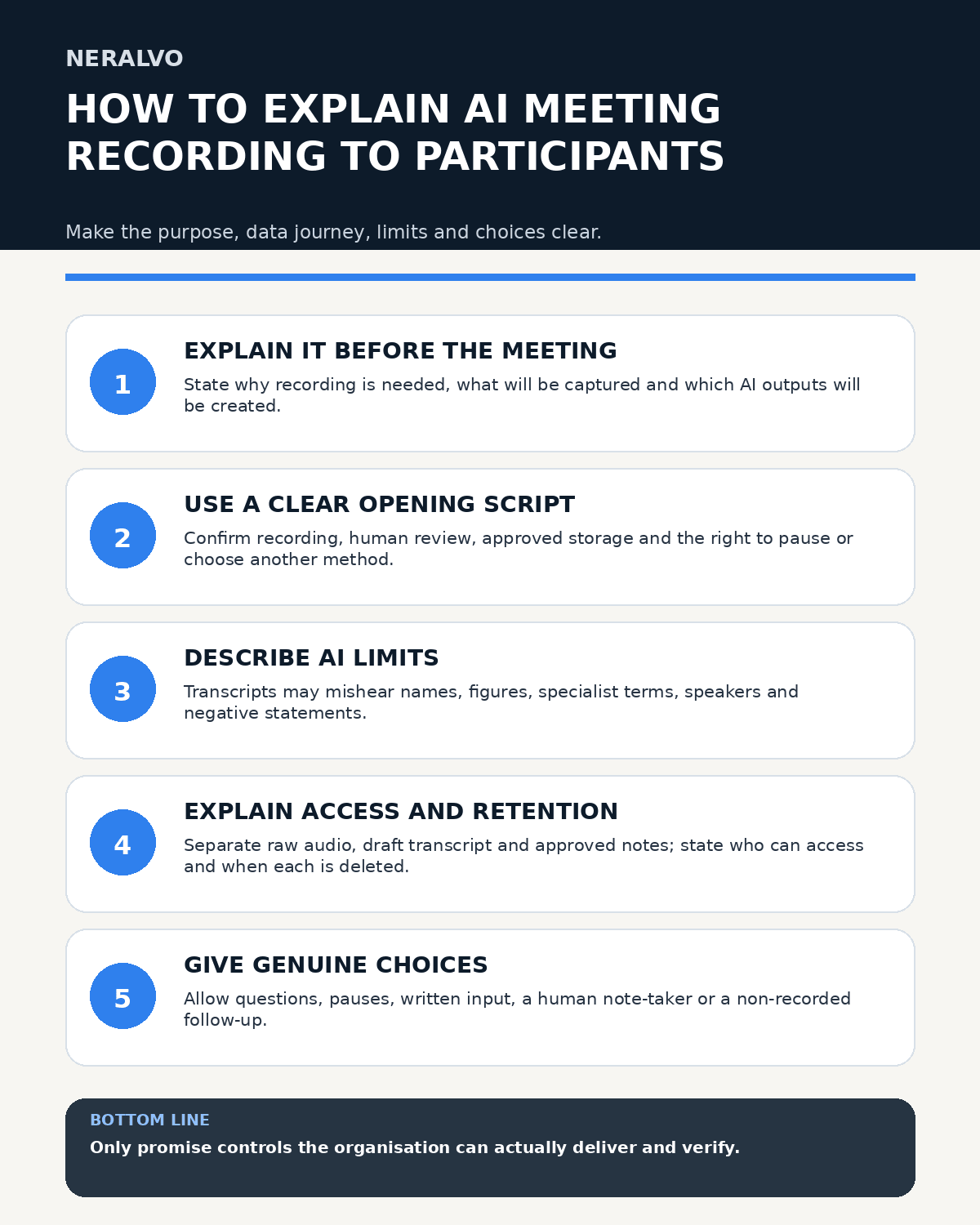
Quick answer: explain AI meeting recording before capture begins by stating the purpose, what will be recorded, which AI outputs will be created, who can access them, how long they will be retained, how important details will be checked and which non-recorded alternatives are available. Repeat the essential notice for late arrivals and make pausing or stopping straightforward.
Use this guide when: the recording purpose, authority, participants, access and retention can be defined. Pause when: any of those controls is unclear.
Evidence basis and limits
- Decision factors covered: Give written information in advance; Use a truthful verbal opening; Explain the specific purpose.
- Evidence rule: The decision is based on the complete capture-to-action workflow, not a single feature or marketing accuracy percentage.
- Boundary: This is practical information, not legal advice. Verify current ICO guidance, sector rules, contracts and organisational policy for the real use case.
A vague statement such as “this is being recorded for notes” does not explain a workflow that may create source audio, a transcript, a summary, speaker labels and action items. Participants should receive enough information to understand what is happening and make use of the choices available to them.

Give written information in advance
Where practical, include a concise notice with the invitation or agenda. It should explain:
- the purpose of recording;
- whether the whole meeting or selected sections will be captured;
- whether audio, transcript, summary, translation or action lists will be created;
- the approved users and storage location;
- the expected retention rule for audio and written outputs;
- how participants can ask questions, object or request a pause;
- the alternative available when recording is not suitable.
Use accessible language and provide translation, plain-language or other support where needed. Do not rely solely on a link participants may be unable to access.
Use a truthful verbal opening
“I plan to record this meeting to create a draft transcript and action summary. The recording will be stored in our approved system and accessed only by the people responsible for the meeting record. The AI output will be checked by a person. Please tell me now or at any time if you have a concern, want the recording paused or would prefer another note-taking method.”
Adapt the wording to the real workflow. Do not promise deletion, processing locations or access restrictions that the organisation cannot deliver.
Explain the specific purpose
State why recording is needed, such as preparing an authorised action note, supporting an interview record or reducing duplicate note-taking. Avoid broad purposes such as “for future use.” The final record should remain tied to the stated purpose.
Describe what will and will not be captured
Explain whether the recording covers the entire meeting, named agenda items or only a closing recap. Identify breaks, private side discussions and sensitive sections that will be excluded. Tell participants how they will know when recording starts, pauses, resumes and stops.
If a meeting platform, captioning tool or another authorised service creates a separate recording or transcript, explain that route separately. Stopping one device may not stop every system.
Explain the AI processing plainly
Participants should know whether audio will be transcribed, summarised, translated or converted into templates, mind maps or action lists. Explain that automated processing may mishear names, amounts, specialist terms, speaker identity and negative statements.
The transcript and summary should be described as drafts until checked. Do not imply that AI can reliably judge emotion, honesty, agreement, attention or employee performance.
State access, sharing and retention
Separate the raw audio, draft transcript and approved meeting note because they may have different access and retention rules. Name the role or team that can access the source and identify who may receive the final record.
Explain whether a wider summary will be redacted and how long each record is expected to remain. Available storage should not determine retention.
Give participants genuine choices
- Ask questions before recording starts.
- Request a pause for a particular contribution.
- Use written input or a non-recorded follow-up.
- Use a human note-taker where appropriate.
- Ask how to correct inaccurate personal information.
- Raise a concern about access, sharing or deletion.
Do not treat silence, attendance or failure to leave as agreement when the applicable process requires something more.
Handle objections without pressure
If someone objects, pause first. Clarify whether the concern covers the whole meeting, one topic or their own contribution, then use the organisation’s approved alternative or escalation route. Refusal should not reduce the person’s ability to participate.
For a detailed process, read What to Do When Someone Refuses to Be Recorded.
Manage hybrid meetings and late arrivals
Use the platform’s visible recording indicator where available and announce recording to both in-room and remote participants. Cover chat, captions and platform-generated transcripts where they form part of the record.
When someone joins late, provide the essential explanation before capturing their contribution. Record only the minimum evidence that the notice was repeated.
Make the explanation accessible
Use direct sentences and avoid unnecessary technical or legal jargon. Give participants time to ask questions. Consider captions, translated information, large print, plain language or individual explanation where appropriate.
Meetings involving children, vulnerable people, health information, employment disputes or other highly sensitive matters may require a specialist process. A generic script is not a substitute for that procedure.
Document what participants were told
The meeting record can note:
- the notice version and date;
- when and how it was provided;
- the stated purpose and recording scope;
- the chair or record owner;
- questions, objections or agreed alternatives;
- late-arrival notices;
- any authorised exception.
Do not record speculative reasons for a participant’s concern.
Use a reliable pause and stop procedure
The chair should know how to pause every recording route immediately. When capture resumes, state that it has restarted and confirm the authorised scope. At the end, announce that recording has stopped before informal conversation begins.
If recording continues accidentally, secure the files and use the approved incident, restriction and deletion process.
Workflow choice matrix for How to Explain AI Meeting Recording to Participants
Apply the strongest control before choosing a device. The table makes the non-hardware options explicit.
| Condition | Preferred route | Why |
|---|---|---|
| Repeatable remote work with approved integrations | Cloud software | Automation and central collaboration may outweigh device independence. |
| In-person, mobile or unreliable-connectivity work | Dedicated recorder | Independent capture and a recoverable local source are usually more resilient. |
| Recording is refused, prohibited or unnecessary | Manual notes / no recording | Respecting the boundary is the correct workflow, not a product failure. |
| High-risk or mixed work | Governed hybrid | Separate capture, review, approval and retention rather than trusting one tool. |
Frequently asked questions
Is saying “this meeting is being recorded” enough?
Usually not for an AI workflow. Participants should also understand the purpose, outputs, access, retention, review and alternatives.
Should the transcript be described as a draft?
Yes. Important names, figures, decisions and actions should be checked before the output becomes an authoritative record.
What should happen when someone joins late?
Give the essential explanation before capturing their contribution and provide a clear way to object or request a pause.
Can the recording be used for another purpose later?
Do not assume so. Assess the new purpose, participant information, authority, access and retention before reuse.
Useful resources
- ICO guidance on lawfulness, fairness and transparency
- How to Get Consent Before Recording a Conversation
- Assess Halo only after the recording controls are clear
Participant-transparency checklist
- Written notice provided where practical
- Truthful verbal explanation given
- Purpose, scope and AI processing clear
- Access, sharing and retention described
- Alternatives genuine
- Accessibility needs addressed
- Late arrivals covered
- Pause and stop procedure tested
- Notice and objections documented minimally
On this page
Related guides
Check permission, retention and access before choosing hardware
Once the policy requirements in this guide are satisfied, compare Halo’s specifications, local storage, included services and current offer against your approved workflow.
Found an error or an out-of-date claim? Email support@neralvo.com with the article address and a supporting source.