The 60-second verdict
Quick answer: UK GDPR compliance for an AI voice recorder requires a specific purpose, an appropriate lawful basis, transparent information, data minimisation, supplier and security checks, controlled access, human verification and a documented retention and deletion process.
Use this guide when: the recording purpose, authority, participants, access and retention can be defined. Pause when: any of those controls is unclear.
Evidence basis and limits
- Decision factors covered: Start with a one-sentence purpose; Map every copy of the data; Complete the governance decisions before use.
- Evidence rule: The decision is based on the complete capture-to-action workflow, not a single feature or marketing accuracy percentage.
- Boundary: This is practical information, not legal advice. Verify current ICO guidance, sector rules, contracts and organisational policy for the real use case.

Using an AI voice recorder at work can involve personal data at several stages: original audio, speaker names, transcript, summary, actions, translations, exports and account or device logs. A responsible UK GDPR workflow therefore begins before the record button is pressed.
This guide is a practical governance framework, not legal advice. UK data-protection law and official guidance can change, so organisations should check current ICO guidance, sector rules and professional advice for their use case.
Start with a one-sentence purpose
Write down exactly why recording is necessary. “For better notes” is too broad. A stronger purpose might be: “to create an accurate attendance note from an authorised client meeting and transfer the verified facts into the case-management system.”
The purpose controls what is recorded, who receives it, how long it is kept and whether a less intrusive method would work.
Map every copy of the data
| Stage | Questions to answer |
|---|---|
| Capture | Which device records, and can bystanders or unrelated discussion be excluded? |
| Transfer | How does audio move from device to app or account? |
| Processing | Which service creates transcripts, summaries or translations? |
| Storage | Where do the audio, transcript and exports remain? |
| Sharing | Who can open, download or forward each copy? |
| Deletion | How are local, cloud, exported and backup copies handled? |
Do not assume that deleting the transcript deletes the audio, or that removing a file from one device removes exported copies elsewhere.
Complete the governance decisions before use
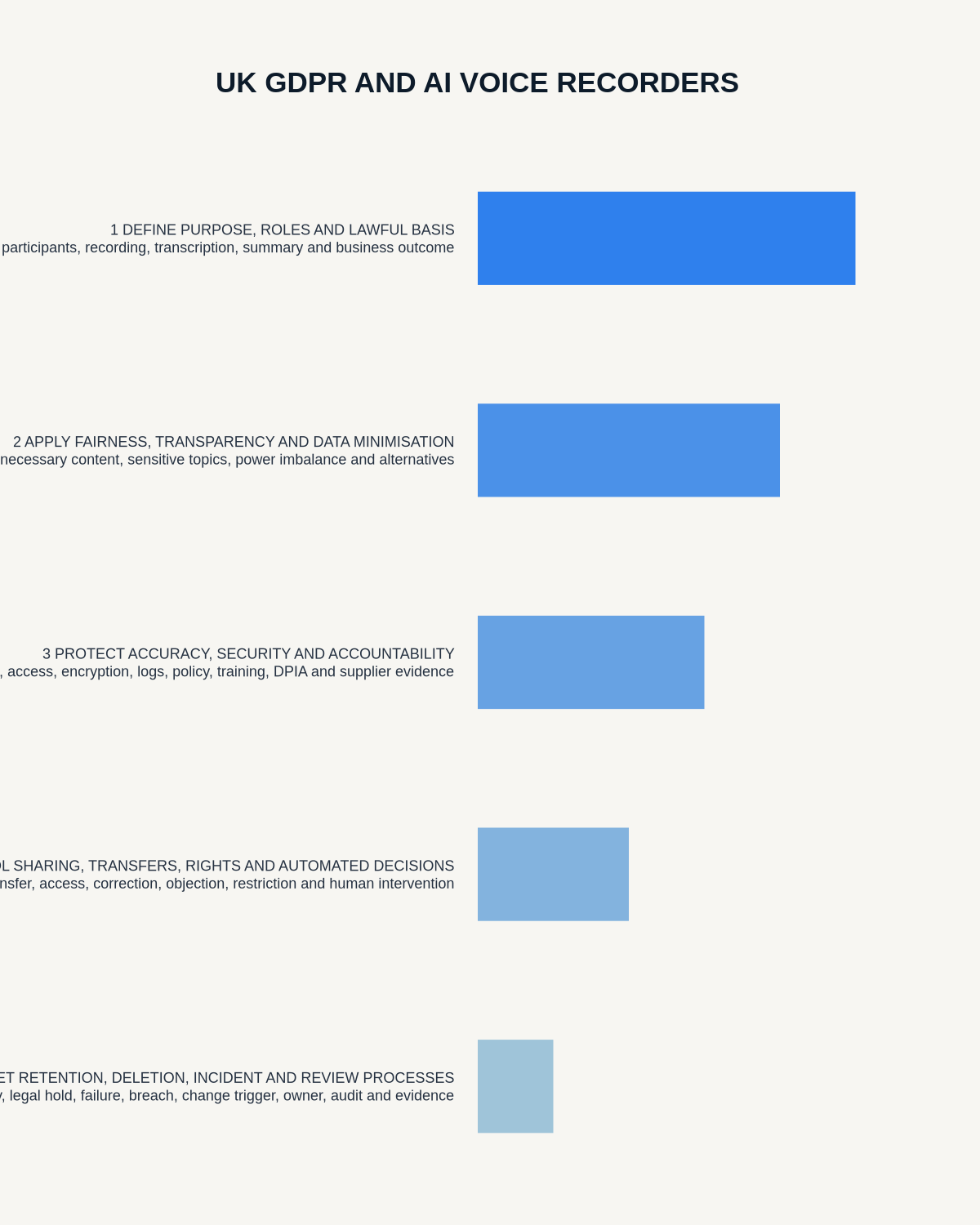
- Lawful basis: identify and document the appropriate basis for the organisation’s purpose. Consent is not automatically the correct basis in every workplace or professional setting.
- Fairness and transparency: explain the purpose, data use, sharing and retention in a way participants can understand.
- Necessity and proportionality: confirm why recording is needed and why a less intrusive method is insufficient.
- Data minimisation: record only the relevant meeting, pause for unrelated or highly sensitive discussion and avoid unnecessary names.
- Special-category or criminal-offence data: identify whether additional conditions, safeguards or advice are required.
- Impact assessment: consider whether the scale, sensitivity, monitoring or technology risk requires a DPIA. Check current ICO DPIA guidance.
- Processor and supplier controls: understand the provider’s role, contract, locations, subprocessors, security and deletion process.
- Individual rights: design a process for access, correction, objection, restriction, erasure and complaints where applicable.
- Retention: set separate periods where appropriate for raw audio, working transcript and final controlled record.
- Security: protect devices, accounts, exports and sharing links according to the sensitivity of the information.
Separate source material from the official record
The audio and AI output should usually be treated as working source material. The verified attendance note, CRM entry, decision log or case record should be identified as authoritative. This reduces the risk of several inconsistent versions circulating.
Correct speaker attribution, names, dates, numbers and technical terms before relying on the transcript. Record disagreements and uncertainty rather than allowing a summary to merge them.
Use role-based access
Access should follow need, not convenience. Someone who needs the action list may not need the full audio.
| Role | Likely access |
|---|---|
| Recording administrator | Configuration, device and account controls |
| Reviewer or approver | Source material needed to verify consequential details |
| Action owner | Approved action or summary, not necessarily raw audio |
| IT or security | Technical logs and incident evidence under controlled access |
| External adviser or supplier | Minimum authorised information under contract |
Avoid unrestricted public links, uncontrolled email attachments and broad access granted merely because storage makes it easy.
Plan deletion before recording
Define the event that starts retention, the person responsible and the method used to confirm deletion. Consider device storage, processing accounts, downloads, shared folders, email, backups and litigation or regulatory holds. Keep material longer only for a documented reason.
Individual rights and accuracy challenges
The organisation should be able to locate relevant audio and derived records without exposing unrelated files. Define how access, correction, restriction, objection, erasure and complaints are assessed and handled.
If a transcript or summary is challenged, preserve the challenge and correct the operational record through the authorised process rather than silently overwriting a material audit trail.
Supplier and international-transfer controls
Review controller and processor roles, contract terms, subprocessors, processing locations, customer-content training, support access, security evidence, incident notification, international-transfer safeguards and deletion after termination.
Do not assume local device storage means later AI processing remains local.
How NERALVO Halo fits the control model
Assess Halo only after the recording controls are clear provides NOTE recording, supported CALL capture, 64GB local storage, up to 35 hours of recording and Bluetooth sync with DOWAY. DOWAY can create transcripts, summaries, speaker-separated notes, templates, translations, mind maps and exports, with one year of DOWAY Max included from activation.
Those capabilities do not determine the lawful basis, retention period or permitted audience. The organisation remains responsible for approving the purpose and complete data flow.
Workflow choice matrix for UK GDPR and AI Voice Recorders
Apply the strongest control before choosing a device. The table makes the non-hardware options explicit.
| Condition | Preferred route | Why |
|---|---|---|
| High-risk or mixed work | Governed hybrid | Separate capture, review, approval and retention rather than trusting one tool. |
| Recording is refused, prohibited or unnecessary | Manual notes / no recording | Respecting the boundary is the correct workflow, not a product failure. |
| In-person, mobile or unreliable-connectivity work | Dedicated recorder | Independent capture and a recoverable local source are usually more resilient. |
| Repeatable remote work with approved integrations | Cloud software | Automation and central collaboration may outweigh device independence. |
Frequently asked questions
Does local storage mean the workflow is private?
No. Later transfer, AI processing, account storage and exports must be assessed separately.
Is consent always required?
No single lawful basis applies to every use. Select and document the basis appropriate to the specific purpose and context.
Can audio be kept in case it becomes useful?
Open-ended retention is difficult to justify. Keep it only for a defined purpose and period.
Deployment gate
- The purpose is specific and documented.
- The lawful basis and any additional conditions have been assessed.
- Participants receive appropriate information.
- The full data flow and supplier route are known.
- A DPIA decision has been recorded.
- Access, verification and individual-rights procedures exist.
- Audio and transcript retention are defined separately.
- The final authoritative record is named.
- Deletion has an owner, trigger and evidence.
- Incidents and material supplier changes trigger review.
Bottom line: a good UK GDPR workflow does not begin with a feature list. It begins with a justified purpose, a mapped data path and a controlled end point for the information.
Related guides
On this page
Related guides
Check permission, retention and access before choosing hardware
Once the policy requirements in this guide are satisfied, compare Halo’s specifications, local storage, included services and current offer against your approved workflow.
Found an error or an out-of-date claim? Email support@neralvo.com with the article address and a supporting source.