Reviewed and updated: 21 July 2026.
The 60-second verdict
Fast transcription should be measured from pressing stop to saving an approved note in the correct business system. A product that displays text quickly may still be slow if names, figures, speakers and commitments require extensive repair.
Decision focus: use the method below only where it produces a recoverable source, a verifiable output and a clear next action. If one of those fails, change the workflow rather than trusting a polished summary.
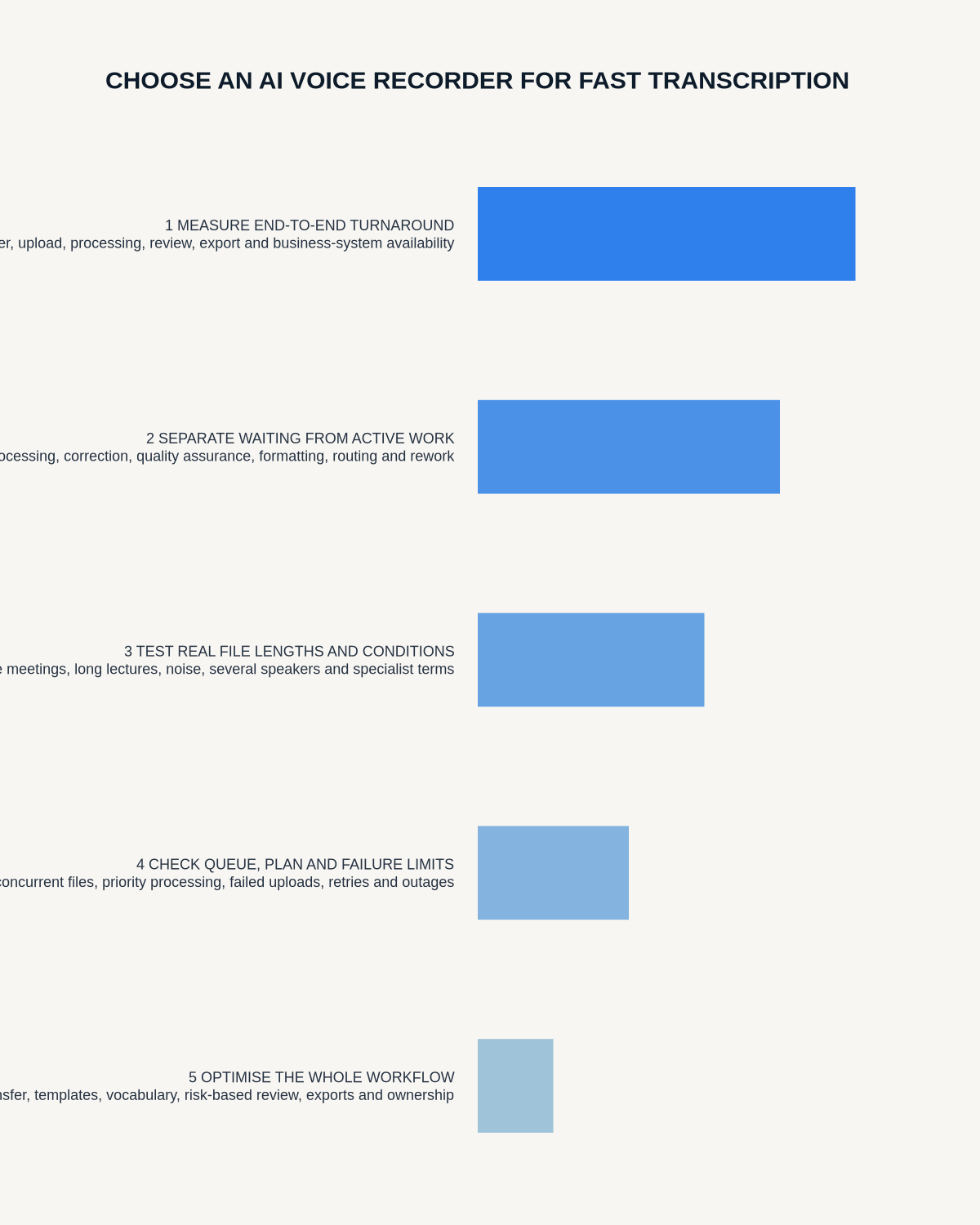
Quick verdict: benchmark transfer, processing, correction, structuring and export with the same realistic recording, then choose the workflow with the lowest repeatable time to verified output—not the fastest first text.
Evidence basis and limits
- Decision factors covered: Break turnaround into six stages; Create a fair benchmark file; Use a timing scorecard.
- Evidence rule: Claims are weighted by consequence: capture failure, changed meaning, access and recovery matter more than polished wording.
- Boundary: Examples and workflow recommendations must be tested with representative recordings, the intended users and the actual approval process before rollout.
Define the final output
Before testing, decide whether the workflow must produce:
- Raw transcript
- Meeting summary
- Client or matter note
- Action list
- CRM update
- Research transcript
- Lecture revision notes
- Subtitles or content draft
Speed is meaningless without a defined destination and quality standard.
Break turnaround into six stages
- Capture close: file finalises after pressing stop
- Transfer: recorder to phone or processing service
- Processing: transcript becomes available
- Correction: important errors are fixed
- Structuring: required note, summary or actions are prepared
- Export: verified output reaches the approved destination
Record each stage separately so a slow transfer is not confused with slow transcription.
Create a fair benchmark file
Use one recording containing:
- Two speakers
- Surnames
- Dates and numbers
- Specialist terms or acronyms
- One negative statement
- One rejected proposal
- One confirmed decision
- Two actions with owners
- One missing deadline
Keep duration, source audio, phone, connectivity and destination consistent across products.
Use a timing scorecard
| Metric | Measurement |
|---|---|
| File finalisation | Stop to file ready |
| Transfer | File ready to upload complete |
| Processing | Upload complete to transcript available |
| Critical errors | Names, numbers, negatives, terms and speakers |
| Human editing | Transcript available to approved content |
| Export | Approved content to final system |
| Total | Stop to usable destination |
Count correction burden
Record:
- Wrong names
- Wrong numbers or dates
- Missing negatives
- Speaker-label errors
- Lost qualifications
- Invented decisions
- Wrong action owners
- Formatting repairs
A slower initial transcript with fewer important errors may produce the faster approved record.
Test workflow features
- Reliable file naming
- Timestamped audio replay
- Search within transcript
- Editable speaker labels
- Custom vocabulary or correction tools
- Reusable templates
- Batch processing
- Editable exports
- Clear failure and retry controls
Test realistic connectivity
Run the benchmark on:
- Normal office Wi-Fi
- Typical mobile data
- A weak or interrupted connection
- A short recording
- The longest normal recording
Record failure frequency and recovery time, not only the fastest run.
Measure consistency
Repeat the same benchmark at least several times. Compare average total time, slowest run, failed transfers, duplicate uploads, processing delays and variation in transcript quality.
Include privacy and authentication time
Secure login, approved connectivity, access controls and safe export are part of the workflow. Do not choose an unapproved faster route for confidential recordings.
Calculate cost per verified hour
Include hardware, subscription or credits, human correction time, failure recovery, user training, export or integration work and support.
Compare cost per approved hour or record, not just advertised transcription minutes.
Where NERALVO Halo fits
Check whether NERALVO Halo fits this workflow provides NOTE mode, supported CALL mode, 64GB local storage, up to 35 hours of recording and Bluetooth synchronisation with DOWAY. DOWAY supports transcripts, summaries, templates, translations, mind maps and exports, with one year of DOWAY Max included.
Halo’s suitability for a rapid workflow should be measured with the buyer’s normal recording length, phone, connection, DOWAY template and final destination.
Fast-workflow buying checklist
- Required final output defined
- Standard benchmark file created
- All six stages timed
- Critical errors counted
- Correction time measured
- Timestamp replay tested
- Templates and exports tested
- Short and long files compared
- Weak connectivity tested
- Repeated runs completed
- Privacy time included
- Cost per verified output calculated
Workflow choice matrix for Fast AI Transcription Workflows
Choose the method that protects the source and reduces downstream correction. The table makes the non-hardware options explicit.
| Condition | Preferred route | Why |
|---|---|---|
| High-risk or mixed work | Governed hybrid | Separate capture, review, approval and retention rather than trusting one tool. |
| Recording is refused, prohibited or unnecessary | Manual notes / no recording | Respecting the boundary is the correct workflow, not a product failure. |
| In-person, mobile or unreliable-connectivity work | Dedicated recorder | Independent capture and a recoverable local source are usually more resilient. |
| Repeatable remote work with approved integrations | Cloud software | Automation and central collaboration may outweigh device independence. |
Frequently asked questions
What is a good transcription-time benchmark?
There is no universal figure. Compare the same recording and required output across workflows.
Does instant text mean instant notes?
No. Verification, structuring and export can take longer than processing.
Should speed be tested once?
No. Repeat tests to identify variability, failures and recovery time.
What is the most useful speed metric?
Total repeatable time from pressing stop to an approved output in the correct system.
Choose the lowest time to verified output
The practical winner is the workflow that reaches an accurate destination quickly and consistently, not the one that first displays unverified text.
Related guides
Workflow map
Visual map for Fast AI Transcription Workflows: Choosing a Recorder That Saves Time
- Define the decisionState the question, required output and acceptance rule.
- Capture the sourceUse the approved route and preserve context, identity and limitations.
- Verify material detailsReplay or check names, numbers, negatives, decisions and actions.
- Move into the real recordAssign an owner, retain evidence and apply the deletion rule.
On this page
Related guides
See whether Halo fits this workflow
Review the NERALVO Halo specifications, included services, delivery information and current offer only after completing the guide.
Found an error or an out-of-date claim? Email support@neralvo.com with the article address and a supporting source.