Reviewed and updated: 21 July 2026.
The 60-second verdict
An AI voice recorder for field interviews must remain dependable away from controlled rooms, power and reliable connectivity while preserving the participant’s meaning and the complete source file. Portability alone is not enough.
Best fit: Field Interviews who need recoverable audio and human-verified notes in an authorised workflow. Use another method when: recording is prohibited, a participant declines or the approved process requires manual notes.
Quick verdict: test the actual field environment, run a full offline and interrupted-sync workflow, verify quotations and speaker labels, and define consent, security and loss controls before choosing a recorder.
Evidence basis and limits
- Decision factors covered: Map the field conditions; Run a realistic environment test; Control wind and environmental noise.
- Evidence rule: Claims are weighted by consequence: capture failure, changed meaning, access and recovery matter more than polished wording.
- Boundary: Examples and workflow recommendations must be tested with representative recordings, the intended users and the actual approval process before rollout.
Map the field conditions
- Indoor or outdoor location
- Wind, traffic, machinery or crowds
- Interviewer and participant movement
- Speaker distance
- Expected duration
- Charging opportunities
- Connectivity
- Weather exposure
- Participant sensitivity
- Travel and loss risk
- Required quotation or research accuracy
Run a realistic environment test
- Use a safe non-confidential sample in the actual environment.
- Place or hold the recorder as it would be used.
- Include names, dates, numbers and a specialist term.
- Ask a quiet question and a longer narrative answer.
- Add normal movement or background noise.
- Include one correction and one interruption.
- Review the source audio before the transcript.
- Verify quotations and speaker labels.
- Process the file after returning to connectivity.
- Export the intended research or interview record.
Score the field source
| Area | Pass condition |
|---|---|
| Participant voice | Complete and intelligible despite normal conditions |
| Interviewer voice | Questions remain understandable |
| Noise | Important wording is not masked |
| Movement | Handling and clothing noise remain manageable |
| Corrections | Later clarification is visible |
| File integrity | Beginning, middle and end are complete |
Control wind and environmental noise
- Use shelter where possible.
- Position the microphone away from direct wind.
- Use a suitable windscreen when supported.
- Avoid rubbing against clothing or bags.
- Move away from machinery or loudspeakers.
- Choose a quieter nearby location when the interview allows.
- Keep the device stable.
Software noise reduction cannot restore speech that wind or machinery completely masks.
Plan battery and storage for the whole trip
Include:
- Total interview hours
- Unexpected additional interviews
- Travel time before charging
- Cold or hot conditions
- Unsynced-file storage
- Battery ageing margin
- Phone power for later transfer
Test the busiest realistic day rather than one short sample.
Test offline capture
- Disconnect the recorder from the phone and internet.
- Record several files.
- Confirm the status and remaining capacity.
- Verify files remain complete.
- Reconnect later.
- Synchronise in sequence.
- Check for duplicates or missing files.
- Export the original audio and processed output.
Test interrupted synchronisation
Interrupt a long transfer and confirm the source remains on the recorder, retry does not consume the file twice, final duration and content match, and duplicate versions are obvious.
Preserve interview meaning
Review:
- Exact quotations
- Names and places
- Chronology
- Uncertainty and qualification
- Question context
- Corrections
- Participant versus interviewer interpretation
- Translated or specialist terms
AI should not turn a tentative recollection into a confirmed fact.
Use field identifiers carefully
Where approved, use a neutral participant or project code in filenames and a separate secure identity key. Avoid exposing confidential names on the recorder or lock screen.
Prepare for participant distress or safeguarding concerns
Define:
- How recording can be paused or stopped
- How distress is handled
- When the interview should end
- How safeguarding or urgent risk is escalated
- Who can access the source
- Whether the participant may review or correct material
Do not wait for later transcription before responding to urgent concerns.
Use a field log
Record:
- Date and time
- Location type
- Participant code
- Recorder and file identifier
- Consent or permission status
- Environmental conditions
- Interruptions
- Problems or deviations
- Transfer status
- Retention status
Protect the device and files
- Keep the recorder under the interviewer’s control.
- Use a secure case or attachment.
- Avoid leaving it in vehicles or public spaces.
- Know the loss-reporting route.
- Transfer through the approved method.
- Verify the destination copy before deleting.
- Remove unnecessary files promptly.
Test quotation and transcript workflow
- Select several important passages.
- Locate them by timestamp.
- Replay the surrounding context.
- Correct wording and attribution.
- Apply anonymity or quotation rules.
- Record the source reference.
- Store the approved extract in the project system.
Measure total field performance
Track:
- Successful capture rate
- Noise-related unusable sections
- Battery used per day
- Storage used per interview
- Transfer failures
- Critical transcript errors
- Quotation-verification time
- Lost or duplicate files
- Total time to approved output
Where NERALVO Halo fits
Check whether NERALVO Halo fits field interviews work provides NOTE mode, supported CALL mode, 64GB local storage, up to 35 hours of recording and Bluetooth synchronisation with DOWAY. DOWAY supports transcripts, summaries, speaker-separated notes, templates, translations, mind maps and exports, with one year of DOWAY Max included.
Halo should be tested in the actual field conditions, including carrying method, wind or movement, offline storage, interrupted sync and quotation review. It is not a substitute for specialist weather-resistant or broadcast equipment where those controls are required.
Field-interview buying checklist
- Actual environment mapped
- Realistic field test completed
- Wind and movement controlled
- Full-day battery and storage calculated
- Offline capture tested
- Interrupted sync recovered
- Meaning and corrections preserved
- Neutral identifiers used where required
- Consent and distress process defined
- Field log prepared
- Device-loss controls assessed
- Quotation workflow completed
- Total field performance measured
Cloud software, a dedicated recorder or manual notes?
For Field Interviews, the right answer changes with the setting. This matrix deliberately gives each method a situation where it can be the strongest choice.
| Situation | Best starting point | Reason |
|---|---|---|
| scheduled remote meetings | Cloud meeting software | Calendar automation and shared integrations are usually the strongest advantage. |
| in-person or mobile work | Dedicated recorder | Independent capture reduces reliance on an active phone or laptop. |
| recording is refused or prohibited | Manual notes or an approved alternative | The boundary takes priority over convenience. |
| mixed online and offline work | Governed hybrid | Use each method only in the setting it actually fits. |
Frequently asked questions
Can an ordinary AI recorder be used outdoors?
It may work in controlled conditions, but wind, weather and noise should be tested. Specialist equipment may be required.
Should the transcript be created immediately?
Urgent actions should be handled promptly, but less urgent processing can wait for a secure connection.
Can a participant’s name appear in the filename?
Use the approved data-management approach. Neutral codes can reduce exposure if the device is lost.
What is the most important field test?
Complete an offline interview in the real environment, then recover, verify and export it successfully.
Choose resilient field capture
The strongest field recorder preserves intelligible source audio through difficult conditions, makes failure visible and supports a respectful, auditable interview workflow.
Related guides
Profession workflow
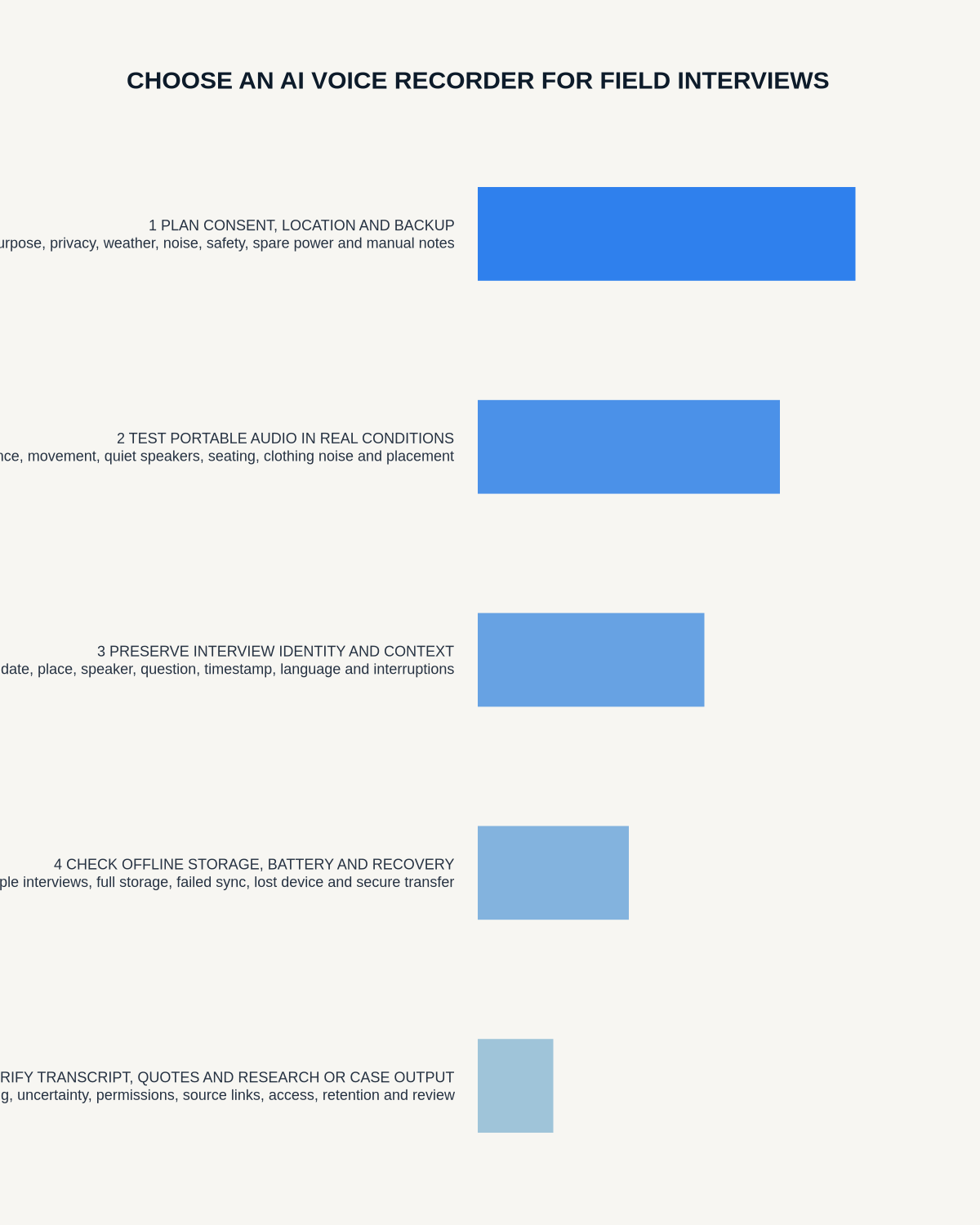
Visual map for AI Voice Recorder for Field Interviews: Audio, Consent and Offline Test
- Prepare the approved useDefine purpose, safe position, permission and the required formal record.
- Capture context firstState the case, asset, person, location or event identifier before detail.
- Human-verify evidenceCheck technical terms, units, names, dates, decisions and uncertainty.
- Complete the formal recordTransfer only verified information and apply access and retention controls.
On this page
Related guides
Check permission, retention and access before choosing hardware
Once the policy requirements in this guide are satisfied, compare Halo’s specifications, local storage, included services and current offer against your approved workflow.
Found an error or an out-of-date claim? Email support@neralvo.com with the article address and a supporting source.