Reviewed and updated: 21 July 2026.
The 60-second verdict
A meeting summary can be concise, fluent and wrong. The best AI voice recorder workflow does not merely shorten a transcript; it makes decisions, actions, risks and uncertainty easy to verify against the original conversation.
Decision focus: use the method below only where it produces a recoverable source, a verifiable output and a clear next action. If one of those fails, change the workflow rather than trusting a polished summary.
Quick verdict: define the required summary template, test it against a meeting with known ground truth, score decision and action accuracy separately and require source-linked human approval before distribution.
Evidence basis and limits
- Decision factors covered: Define the summary before testing; Create a ground-truth test meeting; Score summary quality.
- Evidence rule: Claims are weighted by consequence: capture failure, changed meaning, access and recovery matter more than polished wording.
- Boundary: Examples and workflow recommendations must be tested with representative recordings, the intended users and the actual approval process before rollout.
Define the summary before testing
A client consultation, project update, board meeting and workshop need different outputs. A general template may include:
- Purpose and attendees
- Relevant context
- Key facts
- Decisions made
- Actions with owners and deadlines
- Risks and dependencies
- Unresolved questions
- Information requiring verification
- Next meeting or review point
Do not judge a generic summary against an undefined idea of “good notes.”
Create a ground-truth test meeting
Record a short controlled discussion containing:
- One proposal that is rejected
- One agreement in principle with a condition
- One confirmed final decision
- Two actions with owners
- One action without a deadline
- One disputed number
- One unresolved question
- One correction later in the meeting
Write the correct answer key before processing the recording.
Score summary quality
| Area | Pass condition | Critical failure |
|---|---|---|
| Decision status | Proposal, conditional agreement and final decision remain distinct | Rejected idea presented as approved |
| Actions | Correct task, owner and stated deadline | Invented owner or date |
| Context | Important qualification remains visible | Condition removed |
| Uncertainty | Unknown or disputed facts are labelled | Plausible figure inserted as fact |
| Source access | Relevant audio is easy to replay | Claim cannot be traced |
| Editing | Corrections are simple and preserved | Draft must be rebuilt manually |
Test several meeting types
Run at least:
- Status meeting
- Client or customer conversation
- Brainstorming session
- Decision meeting
- Operational handover
One template rarely works for all. Check whether the system supports reusable structures without forcing every conversation into the same output.
Watch for confident failure
The dangerous errors are polished statements that:
- Invent agreement
- Assign the wrong owner
- Add an unstated deadline
- Remove a condition
- Merge two separate decisions
- Turn an opinion into fact
- Ignore a later correction
- Delete a minority objection
Review the source around every commitment before the summary is sent or stored as an official record.
Check source-linked verification
A practical workflow should allow the reviewer to:
- Search the transcript
- Jump to the matching timestamp
- Replay enough context
- Correct speaker labels
- Mark uncertainty
- Preserve edits
- Export the approved version
Separate the records
The following are not interchangeable:
- Raw audio
- Machine transcript
- AI summary
- Human-approved meeting note
- Formal minutes or decision register
The organisation should identify which output controls and how source files support verification.
Measure correction time
Record:
- Time to locate disputed sections
- Time to correct speakers
- Time to verify decisions and actions
- Time to remove sensitive information
- Time to export the final note
A slightly longer summary that needs little repair may outperform a fast draft with confident errors.
Test approval and distribution
- Generate the draft.
- Assign a named reviewer.
- Verify material statements.
- Remove inappropriate detail.
- Approve or return for correction.
- Store the final version in the normal system.
- Distribute only to authorised recipients.
- Apply retention rules to source files.
Review privacy and sensitivity
A summary should not automatically expose personal, commercial, legal or confidential detail to everyone who attended. Test whether the reviewer can create audience-specific versions and control the source transcript separately.
Calculate total value
Compare:
- Time saved
- Critical-error rate
- Human correction time
- Missed actions
- Recipient correction requests
- Subscription cost
- Integration and training burden
Where NERALVO Halo fits
Check whether NERALVO Halo fits this workflow provides NOTE mode, supported CALL mode, 64GB local storage, up to 35 hours of recording and Bluetooth synchronisation with DOWAY. DOWAY supports transcripts, summaries, templates, translations, mind maps and exports, with one year of DOWAY Max included.
Buyers should run the ground-truth test above and confirm that relevant audio remains accessible during review.
Meeting-summary buying checklist
- Required templates defined
- Ground-truth meeting recorded
- Decision status scored
- Actions and owners verified
- Unknown facts remain labelled
- Later corrections are preserved
- Source replay is fast
- Several meeting types tested
- Correction time measured
- Approval and export completed
- Sensitive access controlled
- Total value calculated
Workflow choice matrix for AI Meeting Summaries
Choose the method that protects the source and reduces downstream correction. The table makes the non-hardware options explicit.
| Condition | Preferred route | Why |
|---|---|---|
| High-risk or mixed work | Governed hybrid | Separate capture, review, approval and retention rather than trusting one tool. |
| Recording is refused, prohibited or unnecessary | Manual notes / no recording | Respecting the boundary is the correct workflow, not a product failure. |
| In-person, mobile or unreliable-connectivity work | Dedicated recorder | Independent capture and a recoverable local source are usually more resilient. |
| Repeatable remote work with approved integrations | Cloud software | Automation and central collaboration may outweigh device independence. |
Frequently asked questions
Can an AI summary replace formal minutes?
Only after the required human review and approval. An unverified draft is not the official record.
Should summaries include every comment?
No. Preserve outcomes and enough context to avoid changing meaning.
What is the biggest warning sign?
A polished statement that cannot be traced to the source or that hides uncertainty.
Which metric matters most?
Accurate decisions and actions with an acceptable time to approved output.
Choose verifiability over polish
The strongest summary workflow reduces reading time without removing evidence, context or human accountability.
Related guides
Workflow map
Visual map for AI Meeting Summaries: Choosing a Recorder You Can Verify
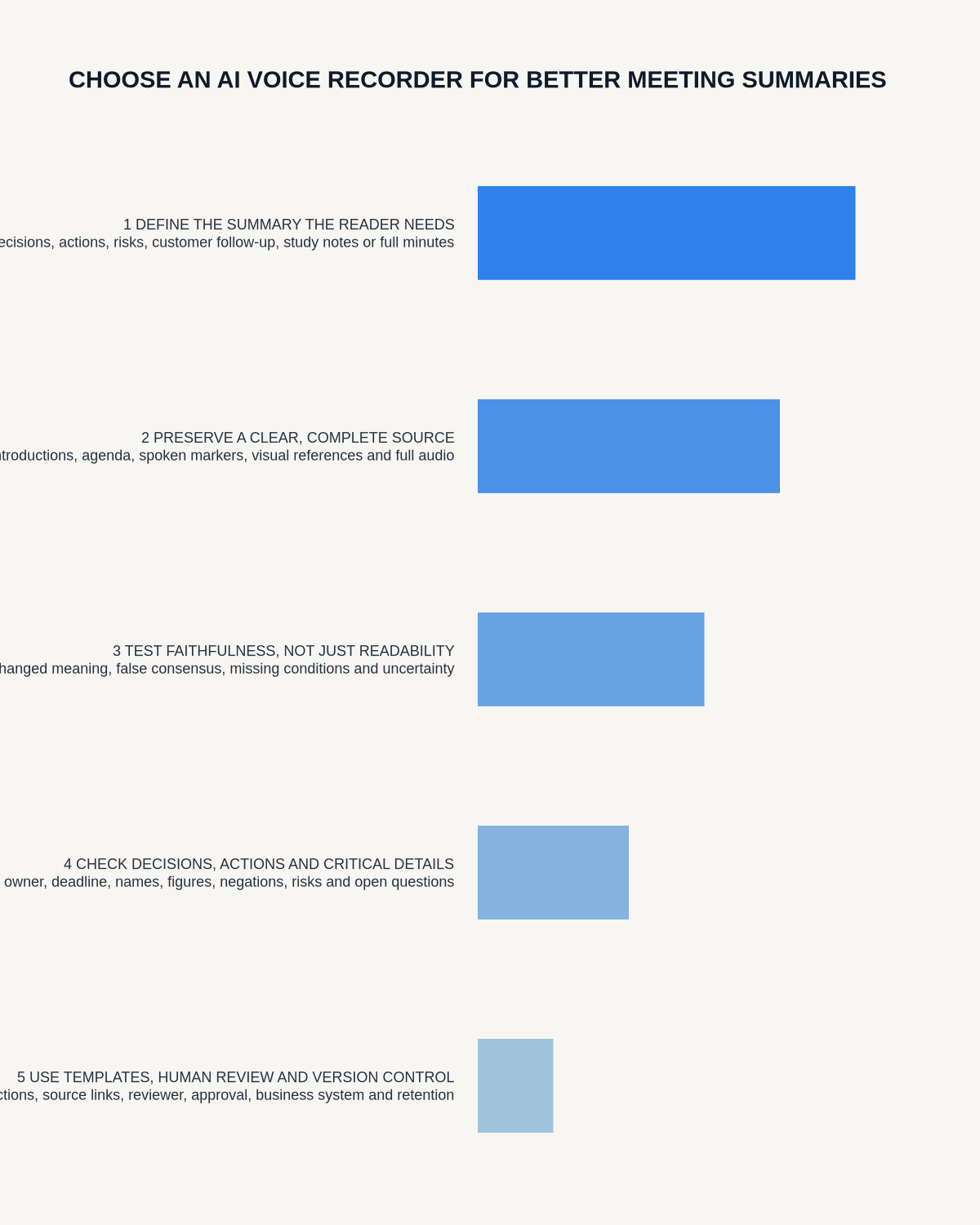
- Define the decisionState the question, required output and acceptance rule.
- Capture the sourceUse the approved route and preserve context, identity and limitations.
- Verify material detailsReplay or check names, numbers, negatives, decisions and actions.
- Move into the real recordAssign an owner, retain evidence and apply the deletion rule.
On this page
Related guides
See whether Halo fits this workflow
Review the NERALVO Halo specifications, included services, delivery information and current offer only after completing the guide.
Found an error or an out-of-date claim? Email support@neralvo.com with the article address and a supporting source.