The 60-second verdict
Quick answer: turn an AI transcript into a clear plain-English summary by correcting the source first, defining the audience and purpose, separating facts from reports and interpretations, preserving decisions, conditions and uncertainty, and tracing every material statement back to the recording or another reliable source.
Decision focus: use the method below only where it produces a recoverable source, a verifiable output and a clear next action. If one of those fails, change the workflow rather than trusting a polished summary.
Evidence basis and limits
- Decision factors covered: Define the audience and purpose; Classify content by status; Use a three-layer structure.
- Evidence rule: Claims are weighted by consequence: capture failure, changed meaning, access and recovery matter more than polished wording.
- Boundary: Examples and workflow recommendations must be tested with representative recordings, the intended users and the actual approval process before rollout.
Plain English should make the record easier to understand without making it more certain, more favourable or more complete than the evidence allows. AI can help organise the material, but a person remains responsible for checking meaning and approving the final version.

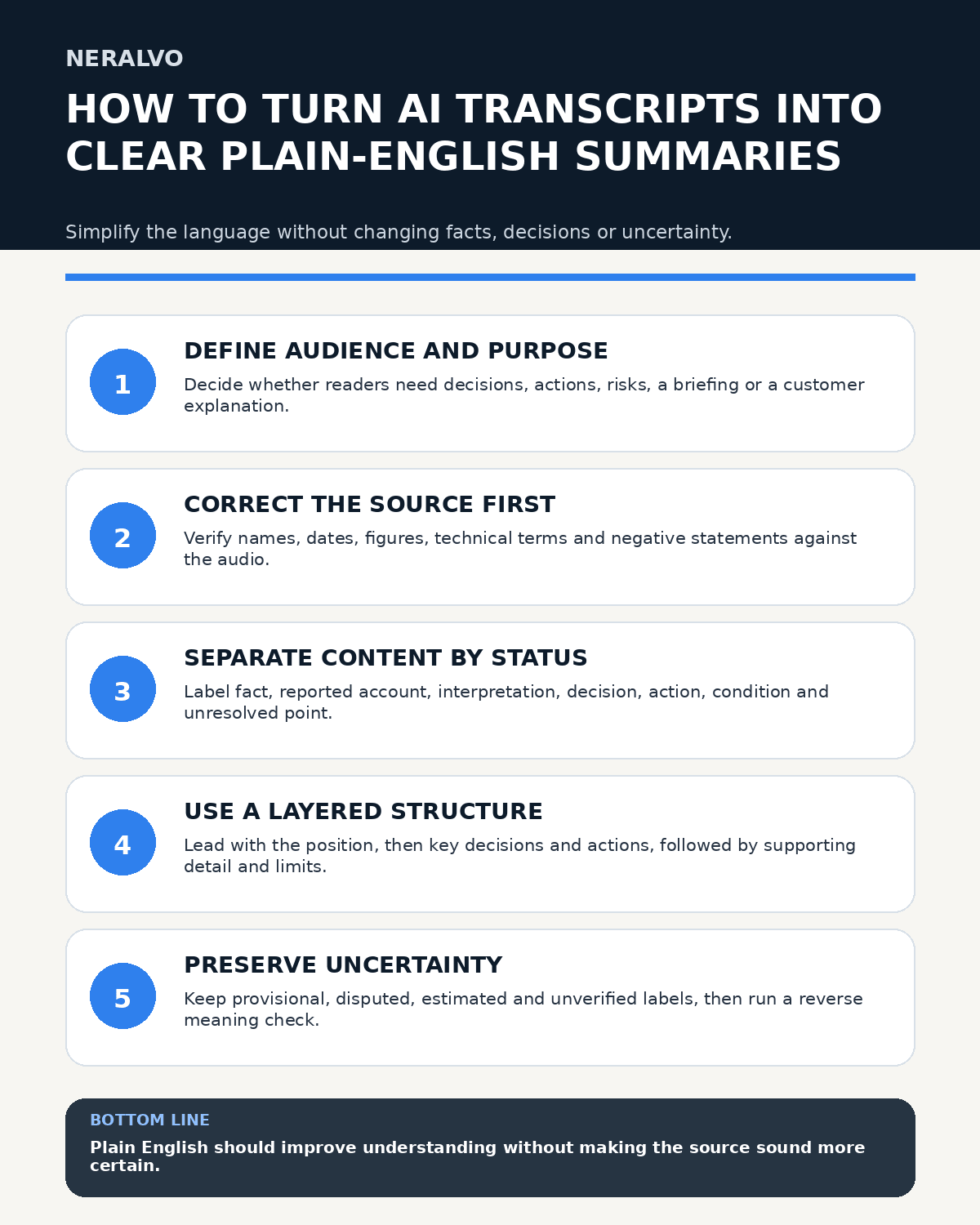
Define the audience and purpose
Identify who will read the summary and what they need to do with it. A senior manager may need decisions, risks and actions. A customer may need a clear explanation of an outcome. A project team may need owners, dates and dependencies.
State whether the output is a working summary, approved record, public explanation or internal briefing. This prevents a convenient draft from being mistaken for the official position.
Correct the source transcript first
Keep the source audio and first transcript as controlled material. Before simplifying anything, verify names, organisations, dates, times, amounts, percentages, measurements, reference numbers, deadlines, technical terms and negations such as “not,” “cannot” and “did not.”
Mark uncertain or inaudible passages. Do not turn incomplete source material into a definite statement.
Classify content by status
- Confirmed fact or evidence: supported by an identified source.
- Reported account: what a participant says happened.
- Interpretation: an opinion, explanation or working view.
- Decision: an outcome approved by an authorised person.
- Action: a task with an owner and, where possible, a deadline.
- Condition: something that must happen before an outcome applies.
- Unresolved point: a question, disagreement or evidence gap.
Status is part of meaning. Do not turn an idea into a decision, a report into a verified fact or an intention into a commitment.
Use a three-layer structure
- Headline position: one or two sentences explaining the purpose and overall outcome.
- Key points: decisions, actions, risks, conditions and open questions.
- Supporting detail: concise context, evidence and limitations.
Place actions in a separate section with task, owner, deadline, dependency and status. If an owner or date was not agreed, say so rather than inventing one.
Replace jargon without altering defined meaning
Use familiar words where possible, but retain terms with a specific legal, technical, contractual or scientific meaning. Explain the official term on first use instead of substituting a looser phrase that changes scope.
Do not simplify away exceptions, eligibility rules, tolerances, exclusions or dependencies.
Preserve uncertainty and boundaries
Use direct labels such as:
- confirmed by the available record;
- reported but not independently verified;
- provisional and subject to approval;
- estimated using stated assumptions;
- disputed by another participant;
- outside the scope of this meeting;
- awaiting further evidence.
Keep a condition close to the statement it controls. “Approved subject to budget confirmation” must not become “approved.”
Run a source-to-summary verification
For every material statement, ask:
- Where does this appear in the source?
- Has the level of certainty changed?
- Has a proposal become a decision?
- Has a condition, exception or disagreement disappeared?
- Are names, figures and dates exact?
- Does the wording imply a cause that the source did not establish?
Check omissions and unsupported additions
Use a required-information list covering decisions, actions, risks, conditions, objections and unresolved points. Then trace each material summary claim to the source. Remove invented owners, explanations or outcomes.
A short summary is not useful when it omits the information needed to act safely.
Perform a reverse check
Read only the summary and write down what a reasonable reader would believe. Compare that interpretation with the source. This catches misleading compression even when individual sentences look technically accurate.
Use a cold-reader test
Ask an authorised person who did not attend the meeting to explain the position, actions and open points after reading the summary. If they cannot tell what is confirmed, who owns the next step or what remains uncertain, revise the document.
Control approval and versions
Add source reference, owner, version, status and last-updated date. Mark drafts clearly. Obtain approval from the responsible person where the summary records a formal decision or professional outcome.
Restrict source audio and transcripts appropriately and delete unnecessary duplicate exports under the retention process.
Workflow choice matrix for How to Turn AI Transcripts into Clear Plain-English Summaries Without Losing Meaning
Choose the method that protects the source and reduces downstream correction. The table makes the non-hardware options explicit.
| Condition | Preferred route | Why |
|---|---|---|
| Repeatable remote work with approved integrations | Cloud software | Automation and central collaboration may outweigh device independence. |
| In-person, mobile or unreliable-connectivity work | Dedicated recorder | Independent capture and a recoverable local source are usually more resilient. |
| Recording is refused, prohibited or unnecessary | Manual notes / no recording | Respecting the boundary is the correct workflow, not a product failure. |
| High-risk or mixed work | Governed hybrid | Separate capture, review, approval and retention rather than trusting one tool. |
Frequently asked questions
Does plain English mean removing technical terms?
No. Explain necessary terms clearly and retain official wording where it has a defined meaning.
Can the AI summary be simplified without checking the transcript?
No. Correct the source first so transcription errors are not carried into a more authoritative-looking document.
Should uncertainty be removed to make the summary clearer?
No. Make uncertainty easier to understand rather than hiding it.
How short should the summary be?
As short as the audience can use without losing material decisions, conditions, actions, risks or evidence boundaries.
Useful resources
- GOV.UK guidance on clear content
- How to Audit AI Meeting Summaries for Missing Information
- Check whether NERALVO Halo fits this workflow
Plain-English summary checklist
- Audience and purpose defined
- Source corrected first
- Facts, reports, interpretations, decisions and actions separated
- Conditions and uncertainty preserved
- Jargon explained without altering meaning
- Material claims traced to source
- Omissions and unsupported additions checked
- Reverse and cold-reader checks completed
- Version and approval status clear
Related AI voice recorder guides
On this page
Related guides
See whether Halo fits this workflow
Review the NERALVO Halo specifications, included services, delivery information and current offer only after completing the guide.
Found an error or an out-of-date claim? Email support@neralvo.com with the article address and a supporting source.