The 60-second verdict
Quick answer: audit an AI meeting summary by defining the information it must contain, checking a reliable source, tracing every required item and material claim, and recording omissions, unsupported additions and changed meaning separately. Correct and approve one final version before professional use.
Decision focus: use the method below only where it produces a recoverable source, a verifiable output and a clear next action. If one of those fails, change the workflow rather than trusting a polished summary.
Evidence basis and limits
- Decision factors covered: Define the summary’s purpose; Create a required-information register; Measure omissions.
- Evidence rule: Claims are weighted by consequence: capture failure, changed meaning, access and recovery matter more than polished wording.
- Boundary: Examples and workflow recommendations must be tested with representative recordings, the intended users and the actual approval process before rollout.
A summary can sound fluent while dropping a condition, objection, deadline or risk. It can also add an unsupported explanation or owner. Readability is therefore not a sufficient quality measure.

Define the summary’s purpose
State whether the output is a quick internal brief, formal meeting note, action record, customer update or decision record. The required content and acceptable level of detail depend on the intended use.
Set audit rules before reading the generated summary. Decide which items are mandatory and which omissions or transformations automatically fail the review.
Secure and verify the source
Use the original audio, a checked transcript and any relevant agenda, slide deck, chat, document or decision log. Correct names, dates, amounts, technical terms, speaker identity and negations before treating the transcript as a reliable source.
Mark unclear or inaudible passages. An uncertain source does not support a definite summary claim.
Create a required-information register
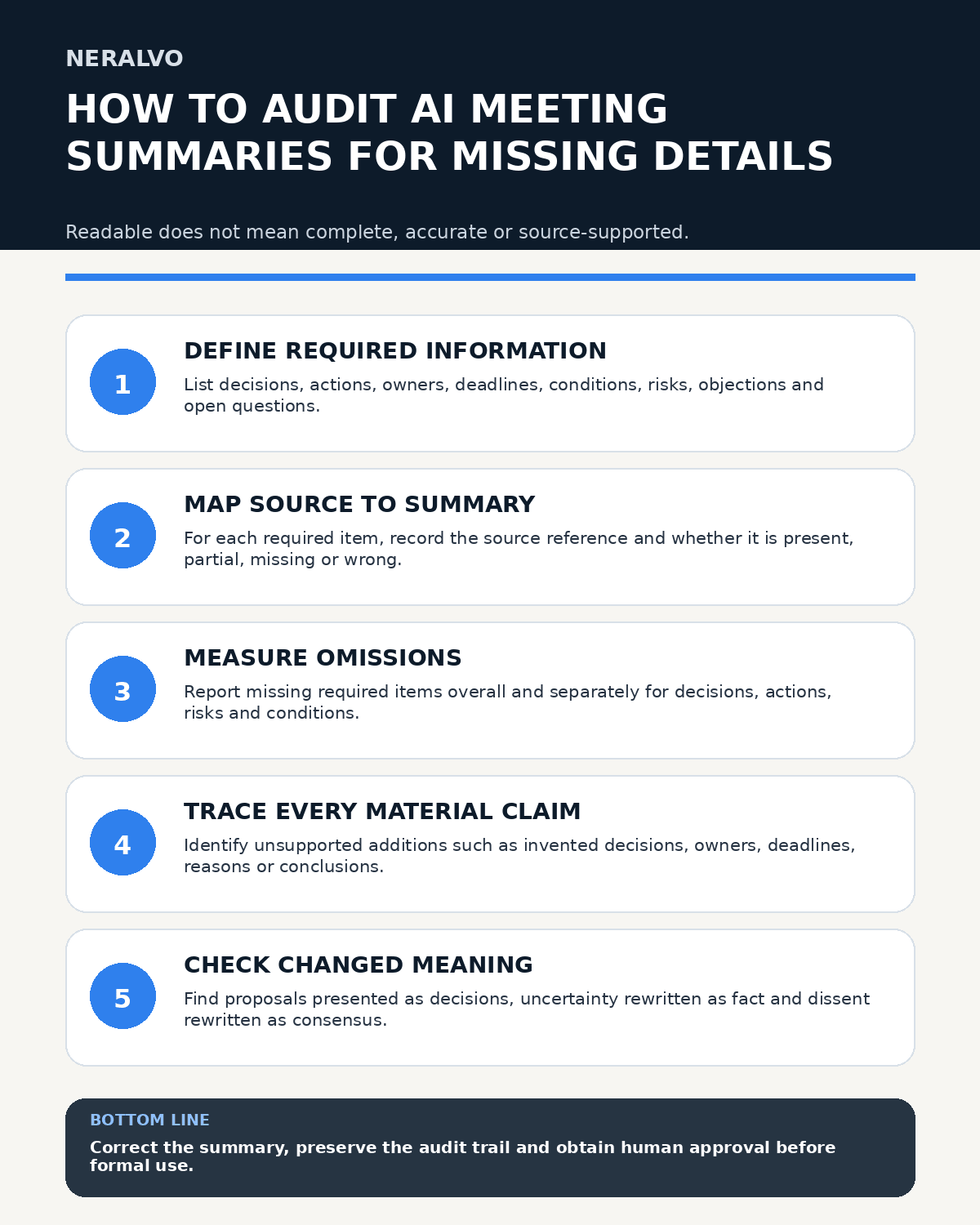
Before checking the summary, list the source items that should appear:
- confirmed decisions;
- actions, owners and deadlines;
- conditions and dependencies;
- risks, objections and dissent;
- open questions;
- evidence limitations;
- material figures, dates and references;
- follow-up and escalation routes.
Give every required item a stable identifier, category and severity so importance is not redefined after seeing the output.
Build a source-to-summary matrix
For each item, record:
- source ID and timestamp or document reference;
- source wording or controlled paraphrase;
- required category;
- whether the item is present, partial, missing or incorrect;
- the relevant summary passage;
- severity and reviewer note;
- the correction required.
This creates traceability and makes repeated audits comparable.
Measure omissions
Omission rate = missing required items ÷ total required items.
Always report the raw numerator and denominator. Separate decisions, actions, risks, conditions, dissent and evidence limitations because an acceptable overall rate can hide a serious category failure.
Do not count an item as present when its most important condition or limitation has disappeared.
Audit decisions carefully
Check whether the summary preserves:
- the approving person or body;
- decision status and date;
- conditions and dependencies;
- scope and exclusions;
- remaining evidence or approvals.
“Recommended subject to budget approval” must not become “approved.” That is a changed decision, not harmless compression.
Audit actions and ownership
For every action, check task, owner, deadline, dependency and status. Do not invent an owner or date. Separate external commitments, internal tasks, suggestions and unresolved responsibilities.
Audit risk, dissent and evidence boundaries
Check that safety concerns, legal or budget conditions, minority views, objections and unresolved evidence gaps remain visible. Do not turn silence into agreement or reported information into a verified fact.
Preserve labels such as provisional, estimated, disputed, reported, unverified and outside scope when they affect how the reader should use the information.
Measure unsupported additions
List each material assertion in the summary and trace it to the source.
Unsupported-addition rate = unsupported material assertions ÷ total material assertions.
Unsupported content can include invented decisions, reasons, actions, owners, evidence or conclusions. Define the assertion unit before auditing, such as a sentence-level claim, decision row or action row.
Measure changed meaning separately
Some failures are neither omission nor addition. The subject remains but its meaning changes. Track:
- proposal converted into decision;
- qualified statement converted into certainty;
- deadline or amount changed;
- dissent removed from a consensus statement;
- speaker or owner changed;
- cause asserted where only correlation was discussed;
- condition or exclusion removed.
Apply a consistent severity scale
- Low: minor context loss with no operational effect.
- Medium: creates confusion, extra work or weaker traceability.
- High: changes identity, obligation, amount, deadline, safety issue, decision status or evidence boundary.
A weighted score may help prioritisation, but publish the underlying counts. Aggregate scores must not hide high-risk defects.
Use independent review
Have two reviewers independently audit a representative subset. Record agreement, disputed classifications and adjudication. Where practical, hide the system or prompt version from reviewers.
Low reviewer agreement can indicate an unclear source, vague rules or an unsuitable unit of analysis.
Reconcile the full audit
The final table should show total required items; present, partial, missing and incorrect items; omission rates; category and severity counts; total material assertions; unsupported additions; changed meanings; reviewer disagreements; corrections and approval status.
Sample ongoing use responsibly
For routine governance, select a risk-based sample across teams, meeting types, lengths, speakers and operating conditions. Include complaints, incidents, unusual outputs and recent changes rather than selecting only easy meetings.
Correct and approve the final record
Update the summary, preserve the audit trail and obtain approval from the responsible person where the note supports formal decisions or actions. Label drafts and superseded versions clearly. Restrict source access and delete unnecessary copies according to the approved retention process.
Workflow choice matrix for How to Audit AI Meeting Summaries for Missing Details, Hallucinations and Changed Meaning
Choose the method that protects the source and reduces downstream correction. The table makes the non-hardware options explicit.
| Condition | Preferred route | Why |
|---|---|---|
| Repeatable remote work with approved integrations | Cloud software | Automation and central collaboration may outweigh device independence. |
| In-person, mobile or unreliable-connectivity work | Dedicated recorder | Independent capture and a recoverable local source are usually more resilient. |
| Recording is refused, prohibited or unnecessary | Manual notes / no recording | Respecting the boundary is the correct workflow, not a product failure. |
| High-risk or mixed work | Governed hybrid | Separate capture, review, approval and retention rather than trusting one tool. |
Frequently asked questions
What is the difference between omission and changed meaning?
An omission removes required information. Changed meaning retains the topic but alters its status, owner, amount, condition or certainty.
Should every sentence be traced to the recording?
Every material claim should be traceable. Minor connective text may not need a timestamp, but decisions, actions, risks and conclusions should.
Can one percentage represent summary quality?
No. Report omissions, unsupported additions, changed meaning and high-severity errors separately.
How often should summaries be sampled?
Use a risk-based schedule and increase sampling after model, application, prompt, template or workflow changes.
Useful resources
- NIST AI Risk Management Framework
- How to Compare Two AI Transcription Systems Fairly
- Check whether NERALVO Halo fits this workflow
Audit checklist
- Summary purpose defined
- Reliable source prepared
- Required-information register created first
- Source-to-summary matrix completed
- Omissions reported with raw counts
- Unsupported additions traced
- Changed meaning checked separately
- Severity and reviewer disagreement visible
- Corrected version approved and controlled
Related AI voice recorder guides
On this page
Related guides
See whether Halo fits this workflow
Review the NERALVO Halo specifications, included services, delivery information and current offer only after completing the guide.
Found an error or an out-of-date claim? Email support@neralvo.com with the article address and a supporting source.