The 60-second verdict
Quick answer: business analysts can use an AI voice recorder to preserve authorised stakeholder language and workshop decisions, but the transcript must be converted into validated requirements, business rules, process maps, assumptions and decision records rather than published as analysis.
Best fit: Business Analysts who need recoverable audio and human-verified notes in an authorised workflow. Use another method when: recording is prohibited, a participant declines or the approved process requires manual notes.
Evidence basis and limits
- Decision factors covered: Before the workshop: define the analytical job; Use verbal markers that survive transcription; One statement can contain four different things.
- Evidence rule: Claims are weighted by consequence: capture failure, changed meaning, access and recovery matter more than polished wording.
- Boundary: Examples and workflow recommendations must be tested with representative recordings, the intended users and the actual approval process before rollout.
Business analysts do not need a perfect transcript of a workshop. They need a reliable route from conversation to validated requirements, process rules and decisions. Those outputs are different from what stakeholders say in the room.
An AI voice recorder can reduce the pressure to type continuously, but it can also make weak analysis look complete. The transcript must be treated as source material to question, not a requirements document to publish.
Before the workshop: define the analytical job
Write down the decision or deliverable the session must enable. Examples include:
- understanding the current claims process;
- defining approval rules for a new system;
- identifying exceptions in customer onboarding;
- agreeing the minimum data needed at handover;
- resolving ownership between two teams.
If the purpose is vague, the recording will preserve a vague conversation.
Use verbal markers that survive transcription
During facilitation, label important material aloud:
- “This is a current-state step.”
- “This sounds like an exception.”
- “That is a proposed solution, not yet a requirement.”
- “We have a disagreement to validate.”
- “Decision: finance owns approval above the threshold.”
- “Open question: who maintains the customer category?”
These anchors make the output easier to process and force the group to distinguish discussion from agreement.
One statement can contain four different things
A stakeholder says: “We need a dashboard because managers cannot see overdue cases and they spend Friday afternoon chasing updates.”
The analyst should separate:
| Layer | Extracted meaning |
|---|---|
| Problem | Managers lack timely visibility of overdue cases. |
| Impact | Manual chasing consumes management time each week. |
| Proposed solution | A dashboard. |
| Requirement still to define | Which users need which overdue-case information, how current it must be and what action they must take. |
An AI summary may jump directly to “build a dashboard.” Good business analysis keeps the need open until the requirement is understood.
Convert the transcript into six controlled outputs
- Process map: actors, steps, systems, handoffs and exceptions.
- Requirement list: clear, testable statements with source and owner.
- Business rules: conditions, thresholds and outcomes.
- Decision log: wording, authority, rationale and date.
- Assumption register: unverified beliefs that affect design.
- Question and evidence list: gaps requiring documents, data or another stakeholder.
No single summary can replace all six.
How to write a testable requirement
A weak requirement says: “The system must be user-friendly.”
A stronger version might say: “A service adviser must be able to locate an active customer case by reference number and view its current owner, status and next due action without opening more than one additional screen.”
The exact test will depend on the project, but the statement identifies a user, need and observable result. The analyst must validate it with the relevant stakeholders.
Preserve disagreement instead of manufacturing consensus
If operations wants automatic approval while risk requires manual review, do not let an AI summary combine the positions into a compromise nobody accepted. Record:
- each position and owner;
- evidence or policy behind it;
- impact of each option;
- decision authority;
- date or condition for resolution.
End every workshop with a live read-back
Before participants leave, read back the decisions, actions, disputed points and evidence requests. Ask for corrections. This improves the source material and reduces later arguments over what the transcript meant.
Review priorities after transcription
Do not polish every sentence. Check the elements that can change design or governance:
- speaker attribution where authority matters;
- numbers, thresholds and dates;
- negation and conditional language;
- system, field and role names;
- decisions, owners and deadlines;
- statements presented as fact without evidence.
NERALVO Halo in a workshop workflow
Check whether NERALVO Halo fits business analysts work provides 64GB local recording and syncs by Bluetooth to DOWAY for transcripts, summaries, speaker-separated notes and mind maps. It may help an analyst facilitate without staring at a laptop.
Its output should feed the existing analysis repository, not become a new system of record.
The analyst’s standard
A recorder is useful when it preserves stakeholder language and frees attention for better questions. The professional work begins afterwards: separating need from solution, checking evidence, resolving conflict and turning the conversation into artefacts that can be reviewed and tested.
Cloud software, a dedicated recorder or manual notes?
For Business Analysts, the right answer changes with the setting. This matrix deliberately gives each method a situation where it can be the strongest choice.
| Situation | Best starting point | Reason |
|---|---|---|
| scheduled remote meetings | Cloud meeting software | Calendar automation and shared integrations are usually the strongest advantage. |
| in-person or mobile work | Dedicated recorder | Independent capture reduces reliance on an active phone or laptop. |
| recording is refused or prohibited | Manual notes or an approved alternative | The boundary takes priority over convenience. |
| mixed online and offline work | Governed hybrid | Use each method only in the setting it actually fits. |
Related guides
Profession workflow
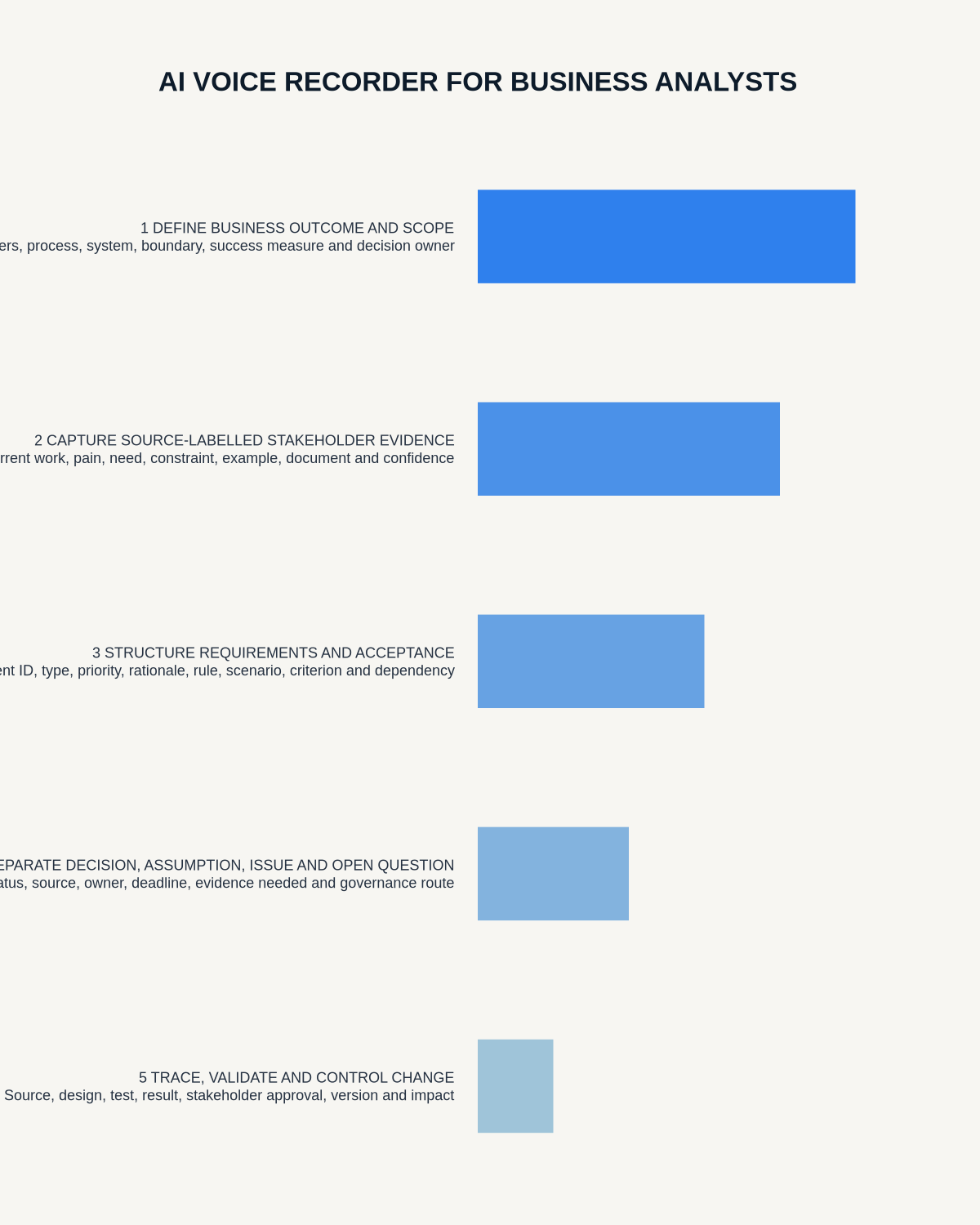
Visual map for AI Voice Recorder for Business Analysts: Better Discovery, Requirements and Decisions
- Prepare the approved useDefine purpose, safe position, permission and the required formal record.
- Capture context firstState the case, asset, person, location or event identifier before detail.
- Human-verify evidenceCheck technical terms, units, names, dates, decisions and uncertainty.
- Complete the formal recordTransfer only verified information and apply access and retention controls.
On this page
Related guides
See whether Halo fits this workflow
Review the NERALVO Halo specifications, included services, delivery information and current offer only after completing the guide.
Found an error or an out-of-date claim? Email support@neralvo.com with the article address and a supporting source.