The 60-second verdict
Quick answer: cybersecurity teams can use an AI voice recorder for authorised tabletop exercises, retrospective interviews and controlled incident debriefs, but live-response recording must be designed in advance, exclude secrets, preserve fact-versus-hypothesis status and feed the approved incident system rather than create a new uncontrolled evidence store.
Best fit: Cybersecurity Teams who need recoverable audio and human-verified notes in an authorised workflow. Use another method when: recording is prohibited, a participant declines or the approved process requires manual notes.
Evidence basis and limits
- Decision factors covered: The incident-recording decision tree; Use spoken labels to protect the timeline; A 30-minute incident example.
- Evidence rule: A claim earns weight only when the source, date, configuration and limitation are clear enough for a reader to check.
- Boundary: Examples and workflow recommendations must be tested with representative recordings, the intended users and the actual approval process before rollout.
During a cyber incident, the team needs a trustworthy record of what was known, what was suspected, what was decided and what happened next. A recording can help reconstruct that timeline. It can also create a high-risk file containing vulnerabilities, personal data, internal architecture and potentially credentials.
That tension means cybersecurity teams should not improvise voice recording during an incident. The workflow must be designed before the bridge opens.
The incident-recording decision tree
- Is recording authorised for this incident channel? If not, use the approved scribe and ticketing process.
- Can the discussion avoid secrets and unnecessary personal data? If not, do not create an uncontrolled audio copy.
- Is the device, app, storage and processing path approved? Local capture alone does not answer what happens during transcription.
- Is someone responsible for the source file, transcript and deletion? If ownership is unclear, the recording becomes another unmanaged incident artefact.
Use spoken labels to protect the timeline
- Confirmed fact: supported by logs, system evidence or an accountable source.
- Working hypothesis: plausible explanation not yet confirmed.
- Decision: authorised choice made at a stated time.
- Action: task, owner and expected completion.
- Risk accepted: known consequence accepted by the named decision-maker.
- Next review: time when the position will be reassessed.
These labels prevent an early theory from becoming a false final narrative.
A 30-minute incident example
At 09:10, the monitoring team reports unusual outbound traffic. At 09:16, credential compromise is raised as a hypothesis. At 09:22, endpoint evidence points instead to a misconfigured integration. At 09:24, access is restricted as precautionary containment. At 09:28, the integration owner begins configuration review.
The reviewed record should preserve that sequence and state clearly that credential compromise remained unconfirmed.
What must never be spoken casually
Passwords, access tokens, private keys, recovery codes and exploitable details should not be read into a general recording. Use secure references instead. If sensitive material is captured unexpectedly, restrict access immediately and follow the incident’s evidence, privacy and legal procedures.
Recording is not the system of record
Confirmed actions belong in the incident platform, ticketing system or approved log. Notifications, regulatory assessments, legal decisions and customer communications require their own governed records.
Use the transcript to locate decision points, contradictions and missing actions—not as a replacement for operational documentation.
Build the post-incident review from four sources
- the recorded discussion;
- technical logs and alerts;
- tickets, messages and change records;
- the recollections of people involved.
Where sources conflict, preserve and resolve the conflict. Do not allow a fluent transcript to override stronger technical evidence.
Questions the review should answer
- What information was available at each major decision?
- Which assumptions proved wrong?
- Were ownership and escalation clear?
- Which containment action reduced impact?
- What delayed detection, decision or recovery?
- Which control, process or training change is required?
- How will effectiveness be tested?
Use a controlled incident evidence table
| Field | Required detail |
|---|---|
| Timestamp | Event or decision time and time zone |
| Status | Fact, hypothesis, decision, action or accepted risk |
| Source | Log, system, person or document |
| Owner | Person accountable for action or verification |
| Evidence link | Ticket, alert, log query or change record |
| Review point | When the status will be reassessed |
How NERALVO Halo could fit—and where it should not
Assess Halo against the cybersecurity teams workflow matrix records locally to 64GB and can later sync to DOWAY for transcripts and summaries. That may support an authorised tabletop exercise, retrospective interview or controlled incident debrief. It should not be introduced into a live response merely because it is convenient.
The security team must assess the entire data path, including app processing, account access, export, deletion and incident-response implications.
Security principle
A cyber-incident recording should reduce uncertainty, not create another exposure. Design the process in advance, keep secrets out of the audio, label facts and hypotheses, and transfer every important decision into the authorised incident record.
Cloud software, a dedicated recorder or manual notes?
For Cybersecurity Teams, the right answer changes with the setting. This matrix deliberately gives each method a situation where it can be the strongest choice.
| Situation | Best starting point | Reason |
|---|---|---|
| scheduled remote meetings | Cloud meeting software | Auto-join and central collaboration can remove routine admin. |
| in-person or mobile work | Dedicated recorder | Dedicated hardware suits movement, variable rooms and offline source capture. |
| recording is refused or prohibited | Manual notes or an approved alternative | A clear alternative respects policy and participant choice. |
| mixed online and offline work | Governed hybrid | One governed process prevents gaps between desk and field work. |
Related guides
Profession workflow
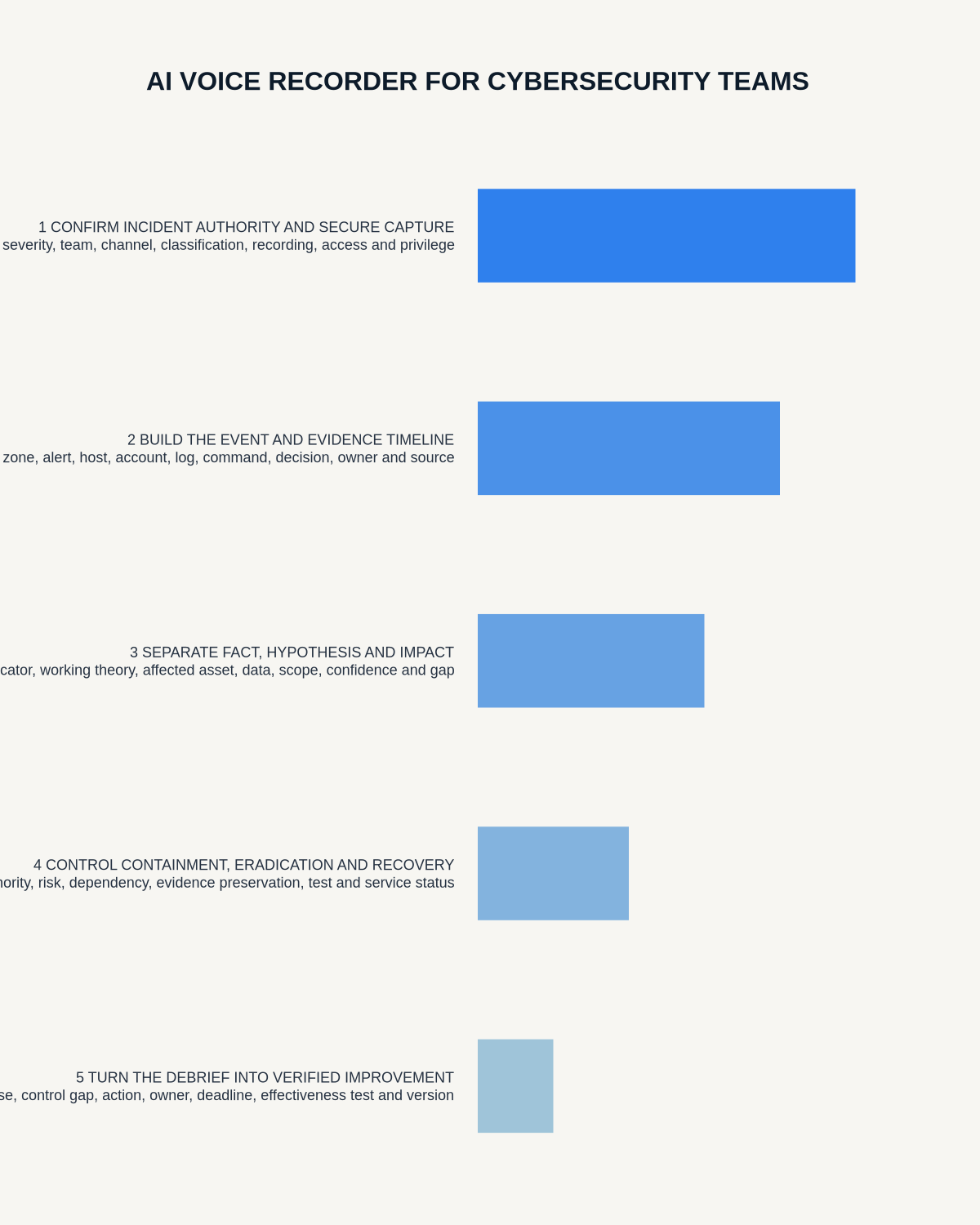
Visual map for AI Voice Recorder for Cybersecurity Teams: Better Incident Evidence and Lessons Learned
- Prepare the approved useDefine purpose, safe position, permission and the required formal record.
- Capture context firstState the case, asset, person, location or event identifier before detail.
- Human-verify evidenceCheck technical terms, units, names, dates, decisions and uncertainty.
- Complete the formal recordTransfer only verified information and apply access and retention controls.
On this page
Related guides
See whether Halo fits this workflow
Review the NERALVO Halo specifications, included services, delivery information and current offer only after completing the guide.
Found an error or an out-of-date claim? Email support@neralvo.com with the article address and a supporting source.