The 60-second verdict
Quick answer: an AI voice recorder can help change managers capture authorised stakeholder interviews, workshops and readiness reviews without losing important detail. The useful output is a source-labelled map of how work, roles, systems, workload and behaviour will change—not a generic sentiment summary.
Best fit: Change Managers who need recoverable audio and human-verified notes in an authorised workflow. Use another method when: recording is prohibited, a participant declines or the approved process requires manual notes.
Evidence basis and limits
- Decision factors covered: Define the decision the interview should inform; Interview for changes in work; Use an evidence-status label.
- Evidence rule: A claim earns weight only when the source, date, configuration and limitation are clear enough for a reader to check.
- Boundary: Examples and workflow recommendations must be tested with representative recordings, the intended users and the actual approval process before rollout.
Change programmes fail when the official design and the lived reality of work are treated as the same thing. Leaders describe intent, process owners describe the target state and employees describe the interruptions, workarounds and dependencies that determine whether adoption is possible.
The strongest workflow turns attributed evidence into a change-impact map, decision log and measurable adoption plan while protecting psychological safety.
Define the decision the interview should inform
Before recording, identify whether the session is intended to inform:
- change-impact assessment
- stakeholder analysis
- training design
- communication planning
- readiness assessment
- resistance or risk review
- post-launch learning
A broad request for feedback produces broad opinions. A defined decision produces evidence that can change the plan.
Interview for changes in work
Move from general sentiment to specific impact. Ask what changes in:
- task
- process sequence
- system or data entry
- decision authority
- role boundary
- skill or knowledge
- performance measure
- customer interaction
- handover or dependency
- time and workload
Record the current state, future state and gap separately. “The new system is difficult” is less actionable than identifying which task takes longer, why and for whom.
Use an evidence-status label
| Status | Meaning |
|---|---|
| Individual experience | One stakeholder’s direct account |
| Observed process | Seen in a walkthrough, demonstration or work sample |
| Repeated pattern | Reported independently across multiple sources |
| Documented requirement | Supported by approved design or process material |
| Assumption | Believed but not yet tested |
| Open question | Requires evidence or a decision |
An AI summary may turn an individual concern into a universal conclusion. Keep the evidence status visible.
Protect candid participation
Before capture, explain:
- why the interview is being recorded
- how comments will be attributed
- who will receive the transcript or summary
- whether anonymous thematic reporting is possible
- how the recording will be stored and deleted
- which subjects should be discussed off record
Some interviews should not be recorded. Psychological safety may be more valuable than a verbatim source file.
Build a change-impact record
For every material impact, record:
- stakeholder group
- current activity
- future activity
- change in behaviour or decision
- system, process or role dependency
- likely disruption
- support required
- risk if unresolved
- owner and decision needed
Where different groups experience the same change differently, create separate entries rather than averaging them into one generic impact.
Separate concern, resistance and design defect
Not every negative response is resistance. A stakeholder may be identifying:
- a genuine process defect
- missing information
- loss of control or status
- additional workload
- conflict with another priority
- insufficient capability
- previous change fatigue
- reasonable uncertainty
Record the underlying cause before selecting communication or training as the solution.
Preserve minority and frontline evidence
A concern raised by one role may still reveal a serious operational failure. Record:
- issue
- role affected
- evidence offered
- frequency or scale known
- consequence
- test required
- decision owner
Do not discard the point merely because it is not yet a common theme.
Turn themes into testable adoption hypotheses
Instead of “people need more communication,” write a hypothesis such as:
If team leaders can demonstrate the new approval route using real cases before launch, then avoidable escalations should reduce during the first month.
For each hypothesis, record:
- affected group
- barrier
- intervention
- expected behaviour
- measure
- owner
- review date
This makes adoption activity measurable rather than decorative.
Training needs should come from task gaps
Use interview evidence to distinguish:
- knowledge gap
- skill gap
- process ambiguity
- system usability problem
- lack of authority
- lack of time or capacity
- missing support material
Training cannot fix a design or workload problem. The record should direct each issue to the correct owner.
Use post-launch interviews to compare prediction and reality
After implementation, review:
- which impacts occurred as expected
- which were overestimated
- which were missed
- workarounds created
- support requests
- behaviour changes observed
- benefits or harm emerging
- decisions required now
Keep pre-launch assumptions visible so the programme can learn rather than rewriting history.
An interview-to-adoption workflow
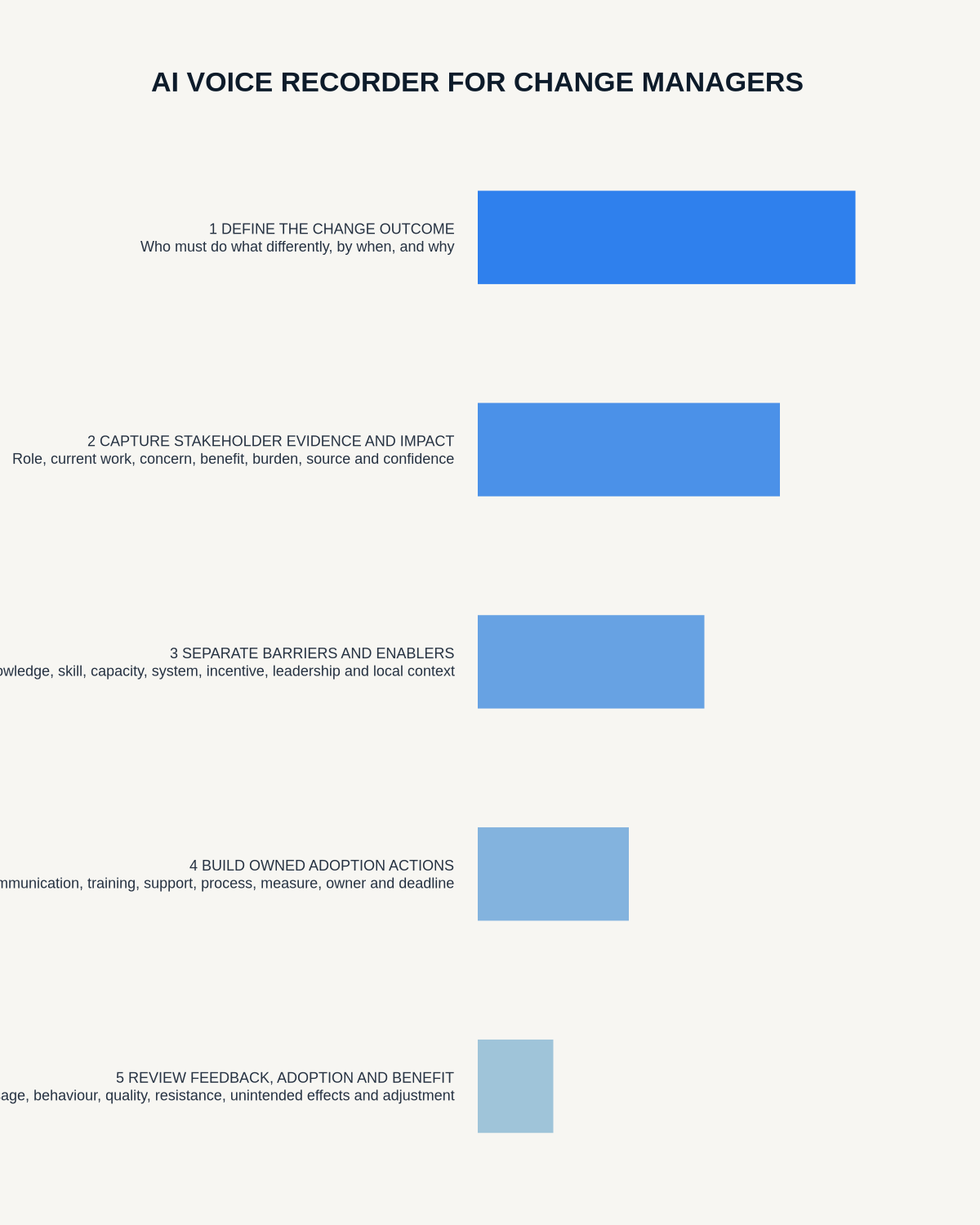
- Define the decision and stakeholder group.
- Agree recording, attribution and confidentiality rules.
- Interview for specific work impacts.
- Label evidence status and uncertainty.
- Build the impact record.
- Separate design defects from capability and communication gaps.
- Preserve minority concerns and assign tests.
- Create adoption hypotheses, owners and measures.
- Return findings to decision-makers.
- Review predicted impacts after launch.
How NERALVO Halo may support approved change research
Assess Halo against the change managers workflow matrix provides portable NOTE recording, supported CALL capture, 64GB local storage and DOWAY transcription, summaries and structured-note tools. It may support approved stakeholder interviews, workshops and change-team debriefs.
Change teams should approve attribution, access, app processing, export and deletion before capture. Test multi-speaker workshops and verify every role, action and theme against the source.
Cloud software, a dedicated recorder or manual notes?
For Change Managers, the right answer changes with the setting. This matrix deliberately gives each method a situation where it can be the strongest choice.
| Situation | Best starting point | Reason |
|---|---|---|
| scheduled remote client meetings | Cloud meeting software | Auto-join and central collaboration can remove routine admin. |
| in-person visits and travel | Dedicated recorder | Dedicated hardware suits movement, variable rooms and offline source capture. |
| a client declines or policy requires manual notes | Manual notes or an approved alternative | A clear alternative respects policy and participant choice. |
| mixed CRM and field work | Governed hybrid | One governed process prevents gaps between desk and field work. |
Frequently asked questions
Is every negative comment resistance?
No. It may reveal a genuine design, workload, authority or capability problem.
Can AI measure stakeholder sentiment accurately?
Do not rely on inferred emotion. Use attributed evidence, direct statements and observable behaviour.
Should every stakeholder interview be recorded?
No. Choose the method that best protects candour and meets governance requirements.
Can the transcript replace the impact assessment?
No. It is source material that must be interpreted, checked and structured by the accountable change team.
Change-evidence check
- Was the decision the interview should inform clear?
- Are current state, future state and gap separated?
- Are individual views distinguished from patterns?
- Were attribution and psychological-safety rules explained?
- Are design defects separated from training needs?
- Were minority concerns preserved?
- Does every adoption action have a hypothesis and measure?
- Will predicted impacts be reviewed after launch?
An AI voice recorder can help change managers hear more of the organisation without losing context. Adoption improves when checked evidence changes design, support and decisions—not when interviews are used to validate a plan that was already fixed.
Related guides
Profession workflow
Visual map for AI Voice Recorder for Change Managers: Better Stakeholder Evidence and Adoption Plans
- Prepare the approved useDefine purpose, safe position, permission and the required formal record.
- Capture context firstState the case, asset, person, location or event identifier before detail.
- Human-verify evidenceCheck technical terms, units, names, dates, decisions and uncertainty.
- Complete the formal recordTransfer only verified information and apply access and retention controls.
On this page
Related guides
See whether Halo fits this workflow
Review the NERALVO Halo specifications, included services, delivery information and current offer only after completing the guide.
Found an error or an out-of-date claim? Email support@neralvo.com with the article address and a supporting source.