The 60-second verdict
The best AI voice recorder is the one that reliably captures your hardest normal conversation, produces a checked output and lets you export the result without creating more administration than it removes.
Best fit: buyers willing to test the complete capture-to-export workflow. Avoid: choosing from price, advertised accuracy or AI features without checking allowance, correction effort and exit options.
Evidence basis and limits
- Decision factors covered: 1. Define the job; 2. Choose the right product type; 3. Test the hardest room.
- Evidence rule: The decision is based on the complete capture-to-action workflow, not a single feature or marketing accuracy percentage.
- Boundary: Examples and workflow recommendations must be tested with representative recordings, the intended users and the actual approval process before rollout.
1. Define the job
State the required outcome in one sentence: draft attendance notes, searchable interviews, lecture revision notes or project decisions and actions.
2. Choose the right product type
| Type | Best for | Watch for |
|---|---|---|
| Dedicated recorder | Rooms, interviews, calls and mobile work | Extra hardware and app dependence |
| Phone app | Occasional low-cost capture | Battery, permissions and call restrictions |
| Meeting bot | Scheduled online meetings | Platform limits |
| Laptop software | Desk calls and webinars | Poor field fit |
| Wearable | Hands-free observations | Movement noise and recording visibility |
3. Test the hardest room
Use the largest normal room, quietest distant speaker, ordinary interruptions, background noise and real specialist terms. Listen to the source audio before reading the transcript.
4. Verify call compatibility
Test ordinary mobile calls, internet calls and business platforms separately. A pass requires both voices, complete recording, balanced volume, exportable audio and repeatable operation.
5. Choose local, cloud or hybrid storage
- Can recording continue without internet?
- Can source audio be accessed without a paid plan?
- Does syncing create another copy?
- Can every copy be deleted?
- What happens after cancellation?
6. Calculate storage from real files
Record one hour using the actual setting, multiply file size by hours between transfers and add a safety margin.
7. Plan battery for the longest session
Use the longest realistic event plus setup, delay and at least a 30% margin. Check charging time, low-battery warning, safe file saving and power-bank compatibility.
8. Judge transcription by critical details
Test names, figures, dates, technical terms, speakers, missing sections and correction time.
9. Treat summaries as drafts
Review proposals presented as decisions, wrong owners, missing deadlines, omitted objections and invented certainty.
10. Check speaker identification
Test short interjections, similar voices and overlap. Verify quotations and commitments against audio.
11. Export before buying
Export original audio, editable text and a summary. Open them elsewhere and move them into the actual work destination.
12. Calculate full cost
- device price
- AI plan
- usage limits
- team licences
- accessories
- replacement risk
- correction and filing time
13. Understand the included plan
Confirm future price, allowances, features that remain free, basic recording after expiry and export access.
14. Review governance
Define permitted uses, participant information, reviewer, authoritative destination, source retention and account control.
15. Run a seven-day pilot
| Measure | Why it matters |
|---|---|
| Capture success | Missing audio invalidates later features |
| Correction time | Shows true administration cost |
| Critical errors | Measures real risk |
| Destination | Confirms output creates action |
| User attention | Shows whether participation improved |
| Total cost | Supports fair ROI comparison |
Red flags
- No clear source-audio export
- Universal call claims without device-specific tests
- Accuracy claims based only on ideal conditions
- Unclear subscription and cancellation terms
- Speaker labels treated as identity
- Summaries presented as automatically final
Where NERALVO Halo fits
View Halo specifications and verify the buying gates is a compact dedicated recorder with 64GB local storage, NOTE and supported CALL modes, up to 35 hours of recording and Bluetooth transfer to DOWAY. Verify the latest app allowance, export formats and exact call route before purchase.
Workflow choice matrix for AI Voice Recorder Buying Checklist
Choose the method that protects the source and reduces downstream correction. The table makes the non-hardware options explicit.
| Condition | Preferred route | Why |
|---|---|---|
| High-risk or mixed work | Governed hybrid | Separate capture, review, approval and retention rather than trusting one tool. |
| Recording is refused, prohibited or unnecessary | Manual notes / no recording | Respecting the boundary is the correct workflow, not a product failure. |
| In-person, mobile or unreliable-connectivity work | Dedicated recorder | Independent capture and a recoverable local source are usually more resilient. |
| Repeatable remote work with approved integrations | Cloud software | Automation and central collaboration may outweigh device independence. |
Final checklist
- Use case is specific
- Hardest room tested
- Exact call route tested
- Battery and storage fit
- Critical details easy to verify
- Audio and editable text export
- Ongoing app cost understood
- File storage and deletion clear
- Final note reaches the right system
Buy the workflow, not the feature list.
Related AI voice recorder guides
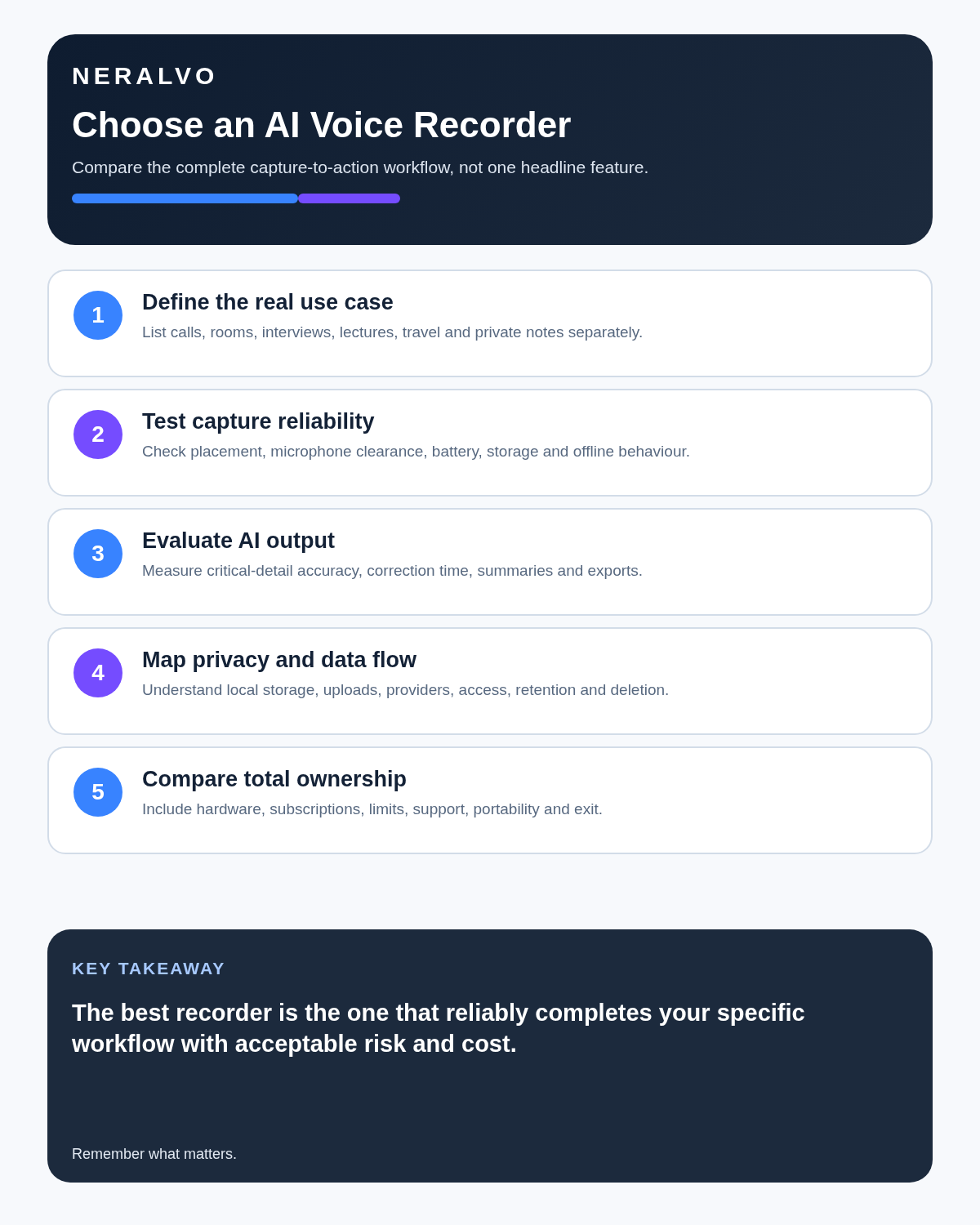
Fair comparison flow
Visual map for AI Voice Recorder Buying Checklist: 15 Tests Before You Buy
- Set must-have gatesDefine capture, privacy, recovery, compatibility and cost requirements.
- Use the same evidenceCompare identical recordings, settings, dates and decision criteria.
- Expose trade-offsShow where each option wins, fails or remains unverified.
- Choose for the workflowSelect only after deal-breakers and total ownership cost are clear.
On this page
Related guides
See whether Halo fits this workflow
Review the NERALVO Halo specifications, included services, delivery information and current offer only after completing the guide.
Found an error or an out-of-date claim? Email support@neralvo.com with the article address and a supporting source.