The 60-second verdict
Quick answer: employment lawyers can use an authorised AI voice recorder to preserve a client’s first account and reduce interruptions during interview. The transcript remains a source for a reviewed attendance note; it must not convert allegations into established facts or replace legal analysis and deadline checks.
Best fit: Employment Lawyers who need recoverable audio and human-verified notes in an authorised workflow. Use another method when: recording is prohibited, a participant declines or the approved process requires manual notes.
Evidence basis and limits
- Decision factors covered: Build two chronologies; Use a fact-status matrix; Preserve exact wording and context.
- Evidence rule: Claims are weighted by consequence: capture failure, changed meaning, access and recovery matter more than polished wording.
- Boundary: Examples and workflow recommendations must be tested with representative recordings, the intended users and the actual approval process before rollout.

Clients rarely present events in chronological order. They describe meetings, messages, performance concerns, sickness absence, grievances and decisions in the order those experiences affected them. Recording can preserve detail while the lawyer listens, but the output requires disciplined review.
Build two chronologies
- Event chronology: what happened, when, who was present and what evidence may exist.
- Process chronology: grievance, capability, disciplinary, consultation, appeal and other formal steps with deadlines.
The two timelines expose gaps between informal events and later formal process.
Use a fact-status matrix
| Status | Meaning |
|---|---|
| Client recollection | What the client remembers |
| Document-supported | Email, letter, policy, payslip or record reviewed |
| Third-party account | Information attributed to another person |
| Disputed | Another source gives a different version |
| To verify | Date, wording, reason or decision requiring evidence |
| Legal interpretation | Professional analysis kept separate from fact |
Preserve exact wording and context
For each material conversation, capture date or period, place or channel, people present, exact words remembered, events immediately before and after, supporting document or witness and the client’s confidence in the wording. Automatic punctuation can make interrupted speech appear complete.
Separate impact from allegation and legal issue
- Work and career impact.
- Income and benefit impact.
- Relevant health or wellbeing information.
- Job-search or mitigation activity.
- Documents required.
- Legal questions for analysis.
Use a controlled client-interview workflow
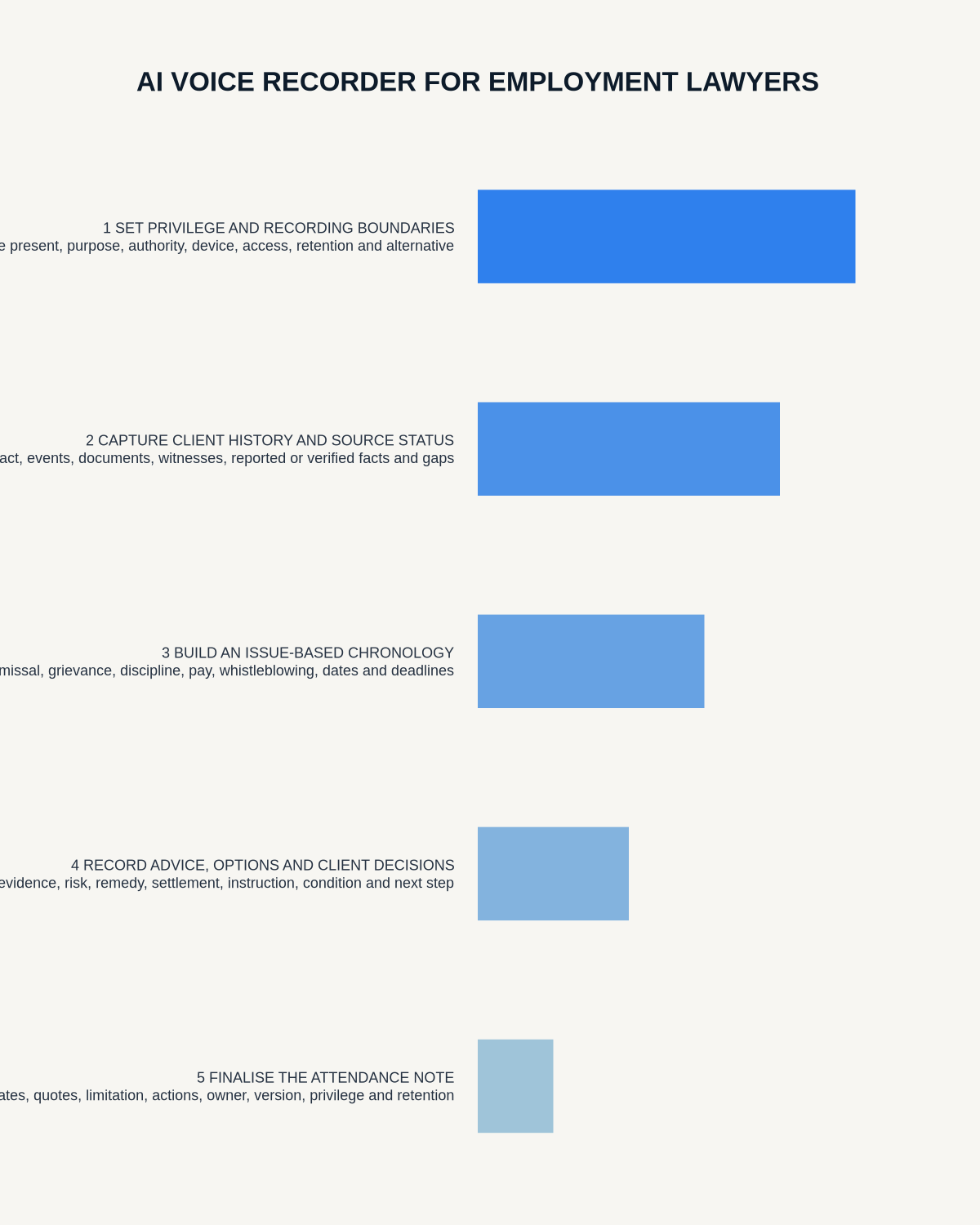
- Confirm the firm’s recording process and explain purpose.
- Allow a short uninterrupted overview.
- Map key people and employment dates.
- Rebuild event and process chronologies.
- Mark evidence, witnesses and contradictions.
- Repeat critical dates and wording.
- Generate and review the transcript.
- Create the attendance note, evidence list and action plan.
- Check limitation and procedural deadlines independently.
- Apply privilege, access and retention controls.
Do not encourage unreviewed covert recording
A client asking whether to record workplace conversations needs case-specific legal and practical advice. A device’s technical capability does not establish that recording is appropriate or how material may be used.
Protect privilege and confidentiality
Use firm-approved devices, accounts and processing routes. Restrict source audio, downloads and sharing. Move the final attendance note into the matter-management system and retain audio only for the defined purpose.
Where NERALVO Halo fits
Check whether NERALVO Halo fits employment lawyers work can support firm-approved client interviews and solicitor dictation with NOTE mode, supported CALL capture, 64GB local storage and DOWAY transcription. Test employment terminology, names and telephone routes before reliance.
Cloud software, a dedicated recorder or manual notes?
For Employment Lawyers, the right answer changes with the setting. This matrix deliberately gives each method a situation where it can be the strongest choice.
| Situation | Best starting point | Reason |
|---|---|---|
| scheduled remote case meetings | Cloud meeting software | Calendar automation and shared integrations are usually the strongest advantage. |
| authorised interviews or field discussions | Dedicated recorder | Independent capture reduces reliance on an active phone or laptop. |
| privilege, procedure or an objection prevents recording | Manual notes or an approved alternative | The boundary takes priority over convenience. |
| mixed casework | Governed hybrid | Use each method only in the setting it actually fits. |
Frequently asked questions
Can the transcript become the attendance note?
It can support drafting, but the attendance note requires professional review, attribution and minimisation.
Should allegations be written as facts?
No. Attribute them to the client or source until supported.
Can AI calculate legal deadlines?
Do not rely on it. Verify deadlines independently using the applicable rules and facts.
Should exact quotations always be included?
Only where material, and after checking the source audio and context.
Can a client secretly record a workplace meeting?
That requires case-specific advice; do not treat a general article or device feature as permission.
Related reading
- AI Voice Recorder for Contract Managers
- AI Voice Recorder for Criminal Defence Solicitors
- AI Voice Recorder for Personal Injury Solicitors
Final attendance-note checklist
- Event and process chronologies separated
- Allegations attributed
- Material wording checked
- Documents and witnesses listed
- Deadlines verified independently
- Legal analysis separated from client account
- Unnecessary sensitive information removed
On this page
Related guides
Check permission, retention and access before choosing hardware
Once the policy requirements in this guide are satisfied, compare Halo’s specifications, local storage, included services and current offer against your approved workflow.
Found an error or an out-of-date claim? Email support@neralvo.com with the article address and a supporting source.