The 60-second verdict
Quick answer: contract managers can use an authorised AI voice recorder to preserve negotiations, supplier reviews and change discussions, but every material statement must be labelled as discussion, proposal, conditional position, internal approval or contractually effective change.
Best fit: Contract Managers who need recoverable audio and human-verified notes in an authorised workflow. Use another method when: recording is prohibited, a participant declines or the approved process requires manual notes.
Evidence basis and limits
- Decision factors covered: Give every statement a contract status; Prepare negotiations around obligations; Preserve exact qualifications and conditions.
- Evidence rule: The decision is based on the complete capture-to-action workflow, not a single feature or marketing accuracy percentage.
- Boundary: Examples and workflow recommendations must be tested with representative recordings, the intended users and the actual approval process before rollout.

Contract management depends on distinctions ordinary notes often lose. A supplier may acknowledge a problem without accepting liability, a concession may be discussed without approval, or a team may believe a change is agreed even though the contract requires notice, approval or signature.
Give every statement a contract status
| Status | Meaning |
|---|---|
| Discussion | Issue or option explored without commitment |
| Proposal | One party put forward a position |
| Conditional | Depends on approval, evidence or another event |
| Agreed in principle | Commercial direction aligned but formal steps remain |
| Formally approved | Required internal authority obtained |
| Contractually effective | Required notice, signature or variation route completed |
AI summaries tend to compress these stages into “agreed.” Keep the status visible beside every material point.
Prepare negotiations around obligations
For each issue, capture:
- clause, schedule or specification reference;
- current requirement;
- evidence of performance or non-performance;
- each party’s position;
- commercial and operational impact;
- remedy or concession proposed;
- authority needed;
- formal next step.
This creates an obligation-led note rather than a conversational summary.
Preserve exact qualifications and conditions
Terms such as subject to, without prejudice, provided that, for this instance only and pending review can change the commercial meaning.
- Retain the timestamp.
- Check the source audio.
- Quote only the minimum necessary wording.
- Record the speaker and context.
- Confirm the position through the formal written channel.
A recording may help resolve memory disputes, but it should not replace the contractual communication route.
Build a negotiation decision matrix
- issue and opening position;
- current position and movement made;
- reason for movement;
- remaining gap;
- approval limit;
- escalation or walk-away point;
- next owner and deadline.
This helps teams avoid reopening settled points or offering the same concession twice.
Change control needs a formal record
Capture:
- change reference;
- requesting party;
- business reason;
- scope affected;
- deliverables and acceptance criteria;
- price or payment impact;
- programme impact;
- risk and dependencies;
- security or regulatory implications;
- approvals;
- notice and signature requirements;
- effective date.
The transcript supports the request and rationale; it is not the variation itself.
Connect performance reviews to obligations
Record:
- metric and target;
- actual result and period;
- data source;
- exception or trend;
- cause proposed by each party;
- remedy or service-credit position;
- corrective action;
- evidence required for closure.
An agreement to investigate is not automatically an admission of breach. Distinguish a root-cause hypothesis from accepted responsibility.
Maintain an obligations register
Transfer confirmed obligations with:
- obligation owner;
- counterparty dependency;
- due date or trigger;
- completion evidence;
- consequence of failure;
- review frequency.
Do not create an obligation solely because someone described a preferred practice. Check the contract and approved change record.
Disputes require a source-controlled chronology
Where disagreement escalates, build the chronology from documents and systems first, then use authorised recordings to explain context. Label:
- contract fact;
- documented communication;
- system or delivery evidence;
- participant recollection;
- legal or commercial interpretation;
- open issue.
An AI summary should not decide liability. The accountable legal and commercial teams must review the evidence through the appropriate process.
Protect negotiation strategy
Define:
- which sessions may be recorded;
- participant notification;
- source-audio access;
- transcription and storage route;
- internal-caucus exclusions;
- summary distribution;
- retention and deletion;
- which record becomes official.
Pause or stop recording when the meeting moves into restricted internal discussion.
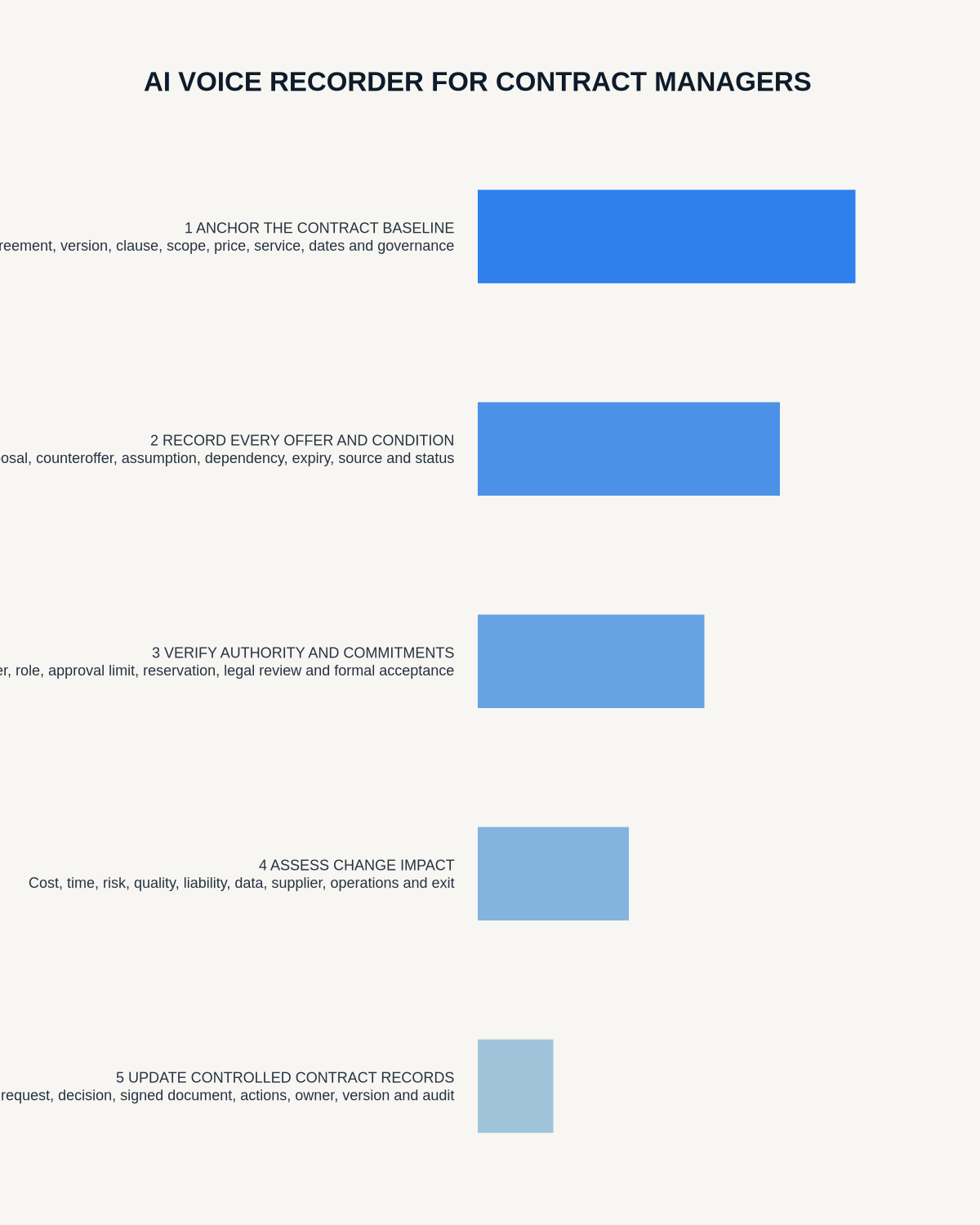
Use a meeting-to-contract workflow
- Identify obligations and decisions expected.
- Approve recording and confidentiality controls.
- Use clause, change and performance references.
- Mark proposals, conditions and approval status.
- Verify exact wording where material.
- Extract evidence requests and formal notices.
- Draft the meeting record and decision matrix.
- Complete internal approvals.
- Issue the required contractual communication.
- Update obligations, change and risk registers.
Where NERALVO Halo fits
View Halo specifications for contract managers use can support approved supplier negotiations, performance reviews and change discussions with NOTE mode, supported CALL capture, 64GB local storage and DOWAY structured notes. It supports the record; it does not replace formal contract governance.
Cloud software, a dedicated recorder or manual notes?
For Contract Managers, the right answer changes with the setting. This matrix deliberately gives each method a situation where it can be the strongest choice.
| Situation | Best starting point | Reason |
|---|---|---|
| scheduled remote client meetings | Cloud meeting software | Native remote-meeting workflows can be more efficient here. |
| in-person visits and travel | Dedicated recorder | A separate battery and recoverable local source improve resilience. |
| a client declines or policy requires manual notes | Manual notes or an approved alternative | Manual notes are the correct control when recording is unavailable. |
| mixed CRM and field work | Governed hybrid | A hybrid can combine automation with reliable physical capture. |
Frequently asked questions
Can a recorded agreement change the contract?
Not automatically. Follow the contract’s required authority, notice and variation process.
What wording requires special checking?
Conditions, reservations, qualifications, amounts, dates, liability statements and approval limits.
Does agreeing to investigate admit breach?
No. Preserve the exact position and evidence status.
Can an AI summary update the obligations register automatically?
Only after a human verifies that the obligation exists and is formally effective.
Should internal negotiation limits be recorded with the counterparty present?
No. Restricted internal strategy should follow a separate controlled process.
Final contract-record checklist
- Every point linked to an obligation or change
- Discussion separated from agreement
- Conditions and qualifications preserved
- Approval status visible
- Performance claims linked to evidence
- Dispute chronology source-controlled
- Formal notice or variation completed
- Negotiation strategy access-controlled
Bottom line: an AI voice recorder can improve negotiation memory and obligation tracking. The defensible outcome is a checked record that preserves commercial nuance while directing every commitment through the contract’s formal approval and change process.
Related guides
On this page
Related guides
See whether Halo fits this workflow
Review the NERALVO Halo specifications, included services, delivery information and current offer only after completing the guide.
Found an error or an out-of-date claim? Email support@neralvo.com with the article address and a supporting source.