The 60-second verdict
Pharmacy students need to connect a medicine with the individual person, complete calculations accurately and communicate information safely. A recorder can support approved teaching and simulation, but it cannot perform a clinical check or turn a remembered dose into reliable advice.
Best fit: Pharmacy Students who need recoverable audio and human-verified notes in an authorised workflow. Use another method when: recording is prohibited, a participant declines or the approved process requires manual notes.
Evidence basis and limits
- Decision factors covered: The medicine → patient factors → calculation → counselling check workflow; Use a hard placement boundary; Stage 1: Identify the medicine correctly.
- Evidence rule: A claim earns weight only when the source, date, configuration and limitation are clear enough for a reader to check.
- Boundary: Examples and workflow recommendations must be tested with representative recordings, the intended users and the actual approval process before rollout.
An AI voice recorder for pharmacy students can support permitted lectures, consenting simulated consultations and private revision. It cannot prescribe, supply, diagnose or replace supervised professional judgement.
The medicine → patient factors → calculation → counselling check workflow
| Stage | Pharmacy-learning question | Output |
|---|---|---|
| Medicine | What product, indication and therapeutic objective are being considered? | Correct medicine context |
| Patient factors | What individual information changes safety or suitability? | Person-centred check |
| Calculation | Are dose, concentration, quantity and units correct? | Reproducible workings |
| Counselling check | What must the person understand, monitor and do next? | Clear simulated communication |
This workflow prevents a fluent medicine summary from being detached from the patient, the arithmetic or the professional decision.
Use a hard placement boundary
Do not record patient consultations, prescriptions, dispensing discussions, handovers or health records on a personal consumer device unless both the university and placement provider have expressly authorised the complete arrangement.
GPhC standards require pharmacy professionals to use professional judgement and respect confidentiality and privacy. A student should follow the pharmacy’s standard operating procedures, information-governance controls and supervisor instructions.
See the GPhC’s Standards for Pharmacy Professionals.
Stage 1: Identify the medicine correctly
Before explaining or calculating anything, verify:
- Generic name.
- Brand name where clinically relevant.
- Formulation and release characteristics.
- Strength or concentration.
- Route.
- Indication and therapeutic objective.
- Legal classification where relevant.
- Current authoritative source.
Speech recognition may confuse similar medicine names, modified-release products and concentrations. Do not allow the AI transcript to silently substitute a plausible alternative.
Stage 2: Add the patient factors
A medicine cannot be assessed in isolation. In an approved fictional or simulated case, check:
| Patient factor | Why it may matter |
|---|---|
| Age and weight | Dose, formulation and monitoring |
| Pregnancy or breastfeeding | Risk, evidence and referral |
| Renal or hepatic function | Accumulation, dose and suitability |
| Allergy and adverse reaction | Avoidance and documentation |
| Current medicines | Interaction, duplication and adherence |
| Symptoms and red flags | Urgency, referral and scope |
| Communication need | Accessible counselling and informed choice |
| Monitoring and follow-up | Effectiveness and safety |
AI should not infer missing patient factors or decide that a medicine is suitable. The student must recognise uncertainty and seek authorised supervision.
Stage 3: Complete the calculation independently
A spoken explanation can expose the method, but numerical competence requires written workings. Use a consistent process:
- Write the required answer and unit.
- List the known values with units.
- Select the formula or proportional method.
- Convert units before calculation where necessary.
- Complete the arithmetic.
- Check decimal placement.
- Estimate whether the result is plausible.
- Use an independent reverse or alternative check.
Pay particular attention to micrograms and milligrams, millilitres and litres, percentages, ratios, concentrations and decimal zeros. A transcript cannot prove the calculation is safe.
Separate calculation from clinical appropriateness
A mathematically correct dose may still be clinically unsuitable. After calculating, ask:
- Is the result within the expected range?
- Is the formulation available and appropriate?
- Does the patient factor require adjustment or referral?
- Is the frequency or maximum dose correct?
- Is monitoring required?
- Does the legal or professional context permit the action?
In real practice, the authorised professional and approved systems remain responsible for the clinical decision.
Stage 4: Build a counselling check
In a consenting simulated consultation, structure the explanation around:
- Purpose of the medicine.
- How and when to use it.
- Duration and missed-dose advice where relevant.
- Important common or serious adverse effects.
- Interactions, precautions and activities to avoid.
- Monitoring.
- Red flags and when to seek help.
- Storage, disposal and practical use.
- Checking the person’s understanding.
Do not memorise an AI-generated script. Adapt language to the simulated person and verify every clinical point.
Practise red-flag and referral decisions
For each educational scenario, identify:
- Information still required.
- Red flag or exclusion criterion.
- Immediate action.
- Appropriate referral route.
- Information to communicate.
- Follow-up or safety net.
A recorder cannot recognise deterioration or safeguarding risk reliably. In placement, urgent concerns must be escalated immediately—not left for transcript processing.
Use the current GPhC AI position
The GPhC’s April 2026 position covers AI in pharmacy practice, revalidation and education. It warns about over-reliance, loss of core skills and biased or inaccurate outputs. Learners should understand the benefits and risks, use AI ethically and safely, meet GPhC learning outcomes and preserve assessment authenticity.
See the GPhC position statement on AI in pharmacy.
The statement does not authorise a student to record real patients or placement information through a personal consumer workflow.
Protect patient information
Do not dictate or upload:
- Names, addresses or contact information.
- Prescription details.
- Medication histories.
- Medical conditions.
- Consultation recordings.
- Patient-identifiable incidents.
- Payment or account information.
Removing a name may not anonymise a distinctive case. Use fictional cases or the programme’s approved simulation data for revision.
Maintain authentic assessment
AI must not fabricate:
- Patient encounters.
- Prescriptions.
- Medicine histories.
- Calculations.
- Legal requirements.
- References.
- Supervisor feedback.
The student should be able to reproduce every calculation, explain every recommendation and disclose assistance where the programme requires it.
A concise pharmacy-study voice-note script
- Medicine: state generic name, form, strength and indication.
- Patient factors: identify the information that changes suitability.
- Calculation: state the required unit and method.
- Safety check: name contraindication, interaction, monitoring or red flag.
- Counselling: state the three most important points.
- Authority: identify the current approved source.
- Practice: define the next calculation or simulated consultation.
How NERALVO Halo can support pharmacy study
Assess Halo against the pharmacy students workflow matrix can support permitted lectures, consenting simulated consultations and private revision. It includes NOTE mode, supported CALL capture, 64GB local storage, up to 35 hours of recording and Bluetooth sync with DOWAY. DOWAY can create transcripts, summaries, speaker-separated notes, templates, translations, mind maps and exportable files, with one year of DOWAY Max included from activation.
These features do not make Halo or DOWAY approved for prescriptions, patient information or placement records. The university and pharmacy provider control the permitted hardware, accounts and processing route.
Pharmacy-study quality check
- Was recording limited to approved teaching, simulation or private revision?
- Was all real patient and placement information excluded?
- Were medicine name, formulation and strength verified?
- Were patient factors considered?
- Can the calculation be reproduced independently?
- Was clinical suitability checked separately from arithmetic?
- Is counselling clear, accurate and person-centred?
- Were red flags and referral needs recognised?
- Is assessed work authentic and attributable?
A strong pharmacy-student recording workflow links the right medicine to the right patient factors, proves the calculation and ends with checked communication.
Cloud software, a dedicated recorder or manual notes?
For Pharmacy Students, the right answer changes with the setting. This matrix deliberately gives each method a situation where it can be the strongest choice.
| Situation | Best starting point | Reason |
|---|---|---|
| scheduled remote consultations | Cloud meeting software | Auto-join and central collaboration can remove routine admin. |
| in-person consultations or ward handovers | Dedicated recorder | Dedicated hardware suits movement, variable rooms and offline source capture. |
| a patient declines or policy prohibits recording | Manual notes or an approved alternative | A clear alternative respects policy and participant choice. |
| mixed remote and clinical work | Governed hybrid | One governed process prevents gaps between desk and field work. |
Related AI voice recorder guides
See the guides for pharmacists, medical students, nursing students and dental students.
Related guides
Profession workflow
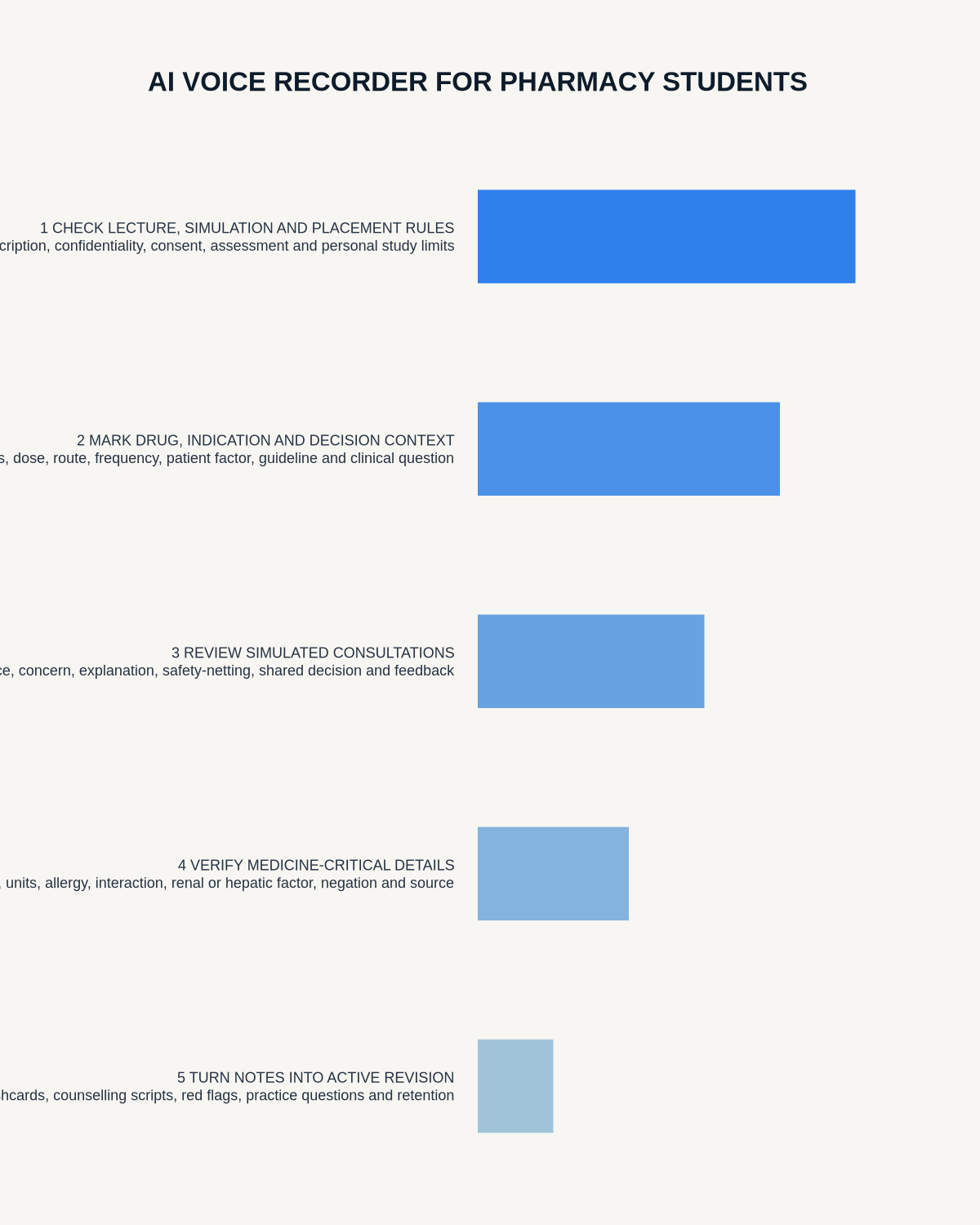
Visual map for AI Voice Recorder for Pharmacy Students: Lectures, Simulated Consultations and Revision
- Prepare the approved useDefine purpose, safe position, permission and the required formal record.
- Capture context firstState the case, asset, person, location or event identifier before detail.
- Human-verify evidenceCheck technical terms, units, names, dates, decisions and uncertainty.
- Complete the formal recordTransfer only verified information and apply access and retention controls.
On this page
Related guides
See whether Halo fits long-form study capture
After checking permission and your institution’s rules, compare Halo’s stated battery, storage and export workflow with the way you actually study.
Found an error or an out-of-date claim? Email support@neralvo.com with the article address and a supporting source.