The 60-second verdict
Private tutors learn most from how a learner approaches a question: what they notice, which method they choose, where reasoning changes direction and whether they can apply the idea independently. A useful record should preserve that thinking rather than reducing the lesson to right and wrong answers.
Best fit: Private Tutors who need recoverable audio and human-verified notes in an authorised workflow. Use another method when: recording is prohibited, a participant declines or the approved process requires manual notes.
Evidence basis and limits
- Decision factors covered: Preserve the learner’s reasoning; Classify the difficulty before teaching again; Teach the smallest useful next step.
- Evidence rule: Claims are weighted by consequence: capture failure, changed meaning, access and recovery matter more than polished wording.
- Boundary: Examples and workflow recommendations must be tested with representative recordings, the intended users and the actual approval process before rollout.
An AI voice recorder for private tutors can support permitted short explanation tasks and private post-lesson notes. It cannot assess a learner independently, safeguard a child, diagnose a learning need, complete assessed work or replace the tutor’s progress record.
The question → reasoning → misconception → transfer workflow
| Stage | Tutor question | Output |
|---|---|---|
| Question | What exactly was the learner asked to do? | Clear task evidence |
| Reasoning | How did the learner explain or solve it? | Visible thought process |
| Misconception | Where did understanding, recall or procedure break down? | Focused teaching need |
| Transfer | Can the learner apply the idea to a new task without copying? | Independent evidence |
This structure distinguishes genuine understanding from repetition of the tutor’s explanation.
Start with a defined question
Record only where the spoken reasoning will add value. The task should be clear enough that another reviewer could understand what the learner was trying to do.
Capture:
- Subject, topic and level.
- The exact question or task type.
- Resources or prompts available.
- Whether the learner had seen a similar example.
- The intended skill or knowledge.
A vague note such as “struggled with algebra” is less useful than “could expand a single bracket but did not recognise when the same method applied inside an equation.”
Preserve the learner’s reasoning
Ask the learner to explain:
- What they know first.
- Which method they selected.
- Why they chose it.
- Where they became uncertain.
- How they checked the answer.
Automatic summaries can polish hesitant speech and make reasoning appear more complete than it was. Compare the transcript with the original audio and task before writing the progress note.
Classify the difficulty before teaching again
| Difficulty type | Example | Possible response |
|---|---|---|
| Missing prerequisite | Cannot manipulate fractions needed for the new topic | Return to the prerequisite |
| Conceptual misconception | Believes a larger denominator means a larger fraction | Use representation and contrast |
| Procedural error | Knows the idea but reverses two steps | Practise the sequence |
| Retrieval gap | Understands when prompted but cannot recall independently | Use spaced retrieval |
| Communication barrier | Understands but cannot express the answer in the required form | Model subject language |
| Careless slip | One-off copying or sign error | Teach checking routine |
AI should not diagnose dyslexia, ADHD, autism or another condition from lesson speech. Record observable learning evidence and use the appropriate school, family or professional route where support needs require further consideration.
Teach the smallest useful next step
Once the difficulty is classified, choose a focused intervention:
- Model one example.
- Ask the learner to explain the key decision.
- Complete a similar task with reduced support.
- Use a contrasting example that exposes the misconception.
- Check a new task after a short delay.
Do not allow AI to generate an enormous revision list from one mistake. The next action should match the evidence and available study time.
Test transfer—not imitation
A learner may repeat the tutor’s wording without understanding. Use a new question with a changed surface feature, representation or context.
Record:
- What support was removed.
- Whether the learner selected the method independently.
- Which part transferred successfully.
- What still depended on prompting.
- When the concept will be checked again.
This creates stronger progress evidence than a polished transcript of the original explanation.
Build a realistic revision plan
Connect revision to:
- Assessment dates.
- Current evidence by topic.
- Available time and other commitments.
- Retrieval and practice methods suited to the subject.
- Reasonable rest and accessibility needs.
- A clear review schedule.
Prioritise the gaps that unlock other content. Avoid timetables that look comprehensive but are impossible to follow.
Protect academic integrity
AI may support explanation, organisation or practice questions where the school, awarding body and tutor permit it. It must not replace the learner’s own assessed homework, coursework, personal statement or examination work.
Keep a clear boundary between:
- Teaching and explanation.
- Scaffolded practice.
- Feedback on the learner’s attempt.
- Work that must be independently produced.
Where AI use is allowed, follow the relevant disclosure and referencing expectations.
Safeguard children and remote learners
Tutors working through schools or colleges should follow the setting’s policies and the version of Keeping Children Safe in Education currently in force. Independent tutors should maintain suitable safer-working, parental or carer, communication and reporting arrangements.
Remote tuition may capture bedrooms, family members, account information and private conversations. Use secure accounts, suitable backgrounds and a limited recording purpose. The Department for Education’s remote-education safeguarding guidance provides relevant considerations.
A safeguarding disclosure should be acted on immediately through the appropriate route—not left inside an ordinary lesson transcript.
Share progress without oversharing
Agree what will be communicated to parents, carers or schools. A useful update may include:
- Current objective.
- Evidence of understanding.
- Priority misconception or gap.
- Practice action.
- Attendance or engagement concern requiring action.
- Next review point.
Do not share raw recordings by default or disclose every personal conversation simply because another adult pays for tuition.
A concise post-lesson voice-note script
- Task: state the exact question or skill.
- Reasoning: record the learner’s method in their own terms.
- Difficulty: classify the gap without diagnosing.
- Teaching response: state what explanation or example helped.
- Transfer: describe the independent follow-up task.
- Revision: give one focused action and review date.
- Safeguarding or support: move restricted matters to the correct route.
How NERALVO Halo can support private tutoring
Check whether NERALVO Halo fits private tutors work can support permitted short explanation tasks, progress reviews and private tutor notes. It includes NOTE mode, supported CALL capture, 64GB local storage, up to 35 hours of recording and Bluetooth sync with DOWAY. DOWAY can create transcripts, summaries, speaker-separated notes, templates, translations, mind maps and exportable files, with one year of DOWAY Max included from activation.
Halo is not an assessment platform, safeguarding system or substitute for the learner’s own work. Tutors remain responsible for consent, teaching quality, record accuracy and data handling.
Tutoring-note quality check
- Was the task clearly defined?
- Does the note preserve the learner’s reasoning rather than only the answer?
- Was the difficulty classified from evidence without diagnosing?
- Did the next teaching step target the actual gap?
- Was understanding checked through a new independent task?
- Is the revision plan realistic and prioritised?
- Are academic-integrity boundaries clear?
- Were child, remote-learning and safeguarding arrangements followed?
- Has source audio been handled under the agreed policy?
A strong private-tutoring record identifies the learner’s reasoning, locates the real gap and tests whether the new understanding transfers independently.
Cloud software, a dedicated recorder or manual notes?
For Private Tutors, the right answer changes with the setting. This matrix deliberately gives each method a situation where it can be the strongest choice.
| Situation | Best starting point | Reason |
|---|---|---|
| scheduled online lessons or staff meetings | Cloud meeting software | Calendar automation and shared integrations are usually the strongest advantage. |
| classroom, lecture or campus discussions | Dedicated recorder | Independent capture reduces reliance on an active phone or laptop. |
| recording is not permitted or a learner objects | Manual notes or an approved alternative | The boundary takes priority over convenience. |
| mixed teaching and administrative work | Governed hybrid | Use each method only in the setting it actually fits. |
Related AI voice recorder guides
See the guides for language tutors, music teachers, SENCOs and university lecturers.
Related guides
Profession workflow
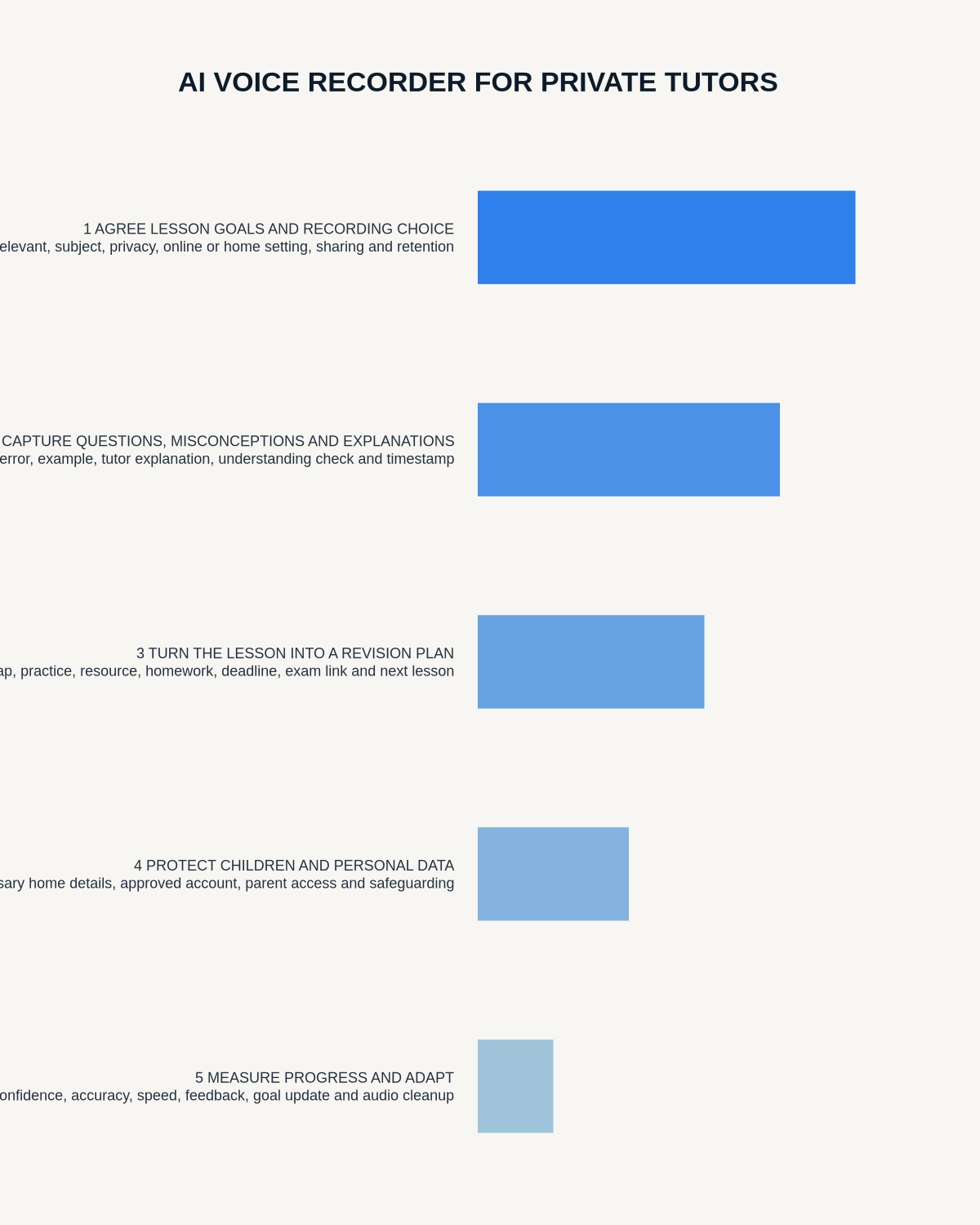
Visual map for AI Voice Recorder for Private Tutors: Lesson Questions, Revision Plans and Progress Notes
- Prepare the approved useDefine purpose, safe position, permission and the required formal record.
- Capture context firstState the case, asset, person, location or event identifier before detail.
- Human-verify evidenceCheck technical terms, units, names, dates, decisions and uncertainty.
- Complete the formal recordTransfer only verified information and apply access and retention controls.
On this page
Related guides
See whether Halo fits long-form study capture
After checking permission and your institution’s rules, compare Halo’s stated battery, storage and export workflow with the way you actually study.
Found an error or an out-of-date claim? Email support@neralvo.com with the article address and a supporting source.