The 60-second verdict
Physiotherapy records need to connect the person’s functional problem, clinical findings, goals, intervention and response over time. A generated note can look complete while still confusing left and right, changing an exercise dose or overstating improvement.
Best fit: Physiotherapists who need recoverable audio and human-verified notes in an authorised workflow. Use another method when: recording is prohibited, a participant declines or the approved process requires manual notes.
Evidence basis and limits
- Decision factors covered: Use a function-first assessment map; Separate patient report from observed performance; Create a red-flag retention check.
- Evidence rule: Claims are weighted by consequence: capture failure, changed meaning, access and recovery matter more than polished wording.
- Boundary: Examples and workflow recommendations must be tested with representative recordings, the intended users and the actual approval process before rollout.
An AI voice recorder for physiotherapists may support an organisation-approved assessment workflow or a private post-session draft. It cannot assess movement, identify red flags, select exercises or replace objective measures and the authorised clinical record.
Use a function-first assessment map
| Layer | What to preserve |
|---|---|
| Meaningful activity | What the person wants or needs to do |
| Current limitation | Task, distance, duration, confidence or participation restriction |
| Clinical evidence | History, observation, examination and outcome measure |
| Contributing factor | Strength, mobility, pain, endurance, environment or behaviour |
| Intervention | Treatment, education, exercise and self-management |
| Progress measure | How change will be tested at review |
This keeps the note centred on function rather than producing a generic list of impairments.
Separate patient report from observed performance
Use explicit source labels:
- Patient reported: symptoms, confidence, activity and goals.
- Observed: movement or task performance seen by the clinician.
- Measured: checked value, method, side and unit.
- Clinical interpretation: the physiotherapist’s reasoning and uncertainty.
- Agreed plan: intervention, advice and review.
A summary must not turn “reports weakness” into “weakness confirmed” without examination.
Create a red-flag retention check
Review whether the draft preserved material neurological, vascular, respiratory, cardiac, trauma, infection, cancer, safeguarding and deterioration information relevant to the presentation. Record referral, escalation and urgency accurately.
AI must not decide that a person is safe for treatment.
Verify every side, value and test method
Manually check:
- left and right
- body region and movement
- degrees, distance, time, repetitions and load
- strength or functional test method
- walking aid or assistance level
- outcome-measure name, version and score
- baseline and comparison date
The transcript is not the measurement source.
Use an exercise prescription card
| Field | Required detail |
|---|---|
| Exercise | Exact movement and starting position |
| Dosage | Repetitions, sets, frequency, hold, rest and load |
| Quality | Technique cue and acceptable symptom response |
| Precaution | When to stop, reduce or contact the service |
| Progression | Defined change and criteria |
| Review | Date and outcome to reassess |
AI must not invent or alter exercise dosage. Use reviewed written, image or video instructions where available.
Record intervention and response separately
State what was actually delivered, the dosage or assistance, the immediate response and any adverse effect. A treatment discussed but not performed should not appear as completed.
Create a progress-evidence loop
- Define a meaningful goal.
- Record a verified baseline.
- Deliver the agreed intervention.
- Document adherence and barriers.
- Repeat the same relevant measure.
- Decide whether to continue, progress, modify or refer.
“Improving” should be linked to observable or measured change.
Protect privacy and recording choice
Use recording only through an approved organisational process. Explain the purpose, processing, access, retention and alternative. Pause or avoid recording where clothing, sensitive history, companions or shared clinical spaces make it inappropriate.
How NERALVO Halo may fit a governed physiotherapy workflow
Check whether NERALVO Halo fits physiotherapists work provides 64GB local storage, up to 35 hours of recording and Bluetooth sync with DOWAY. DOWAY can create transcripts, summaries, templates, translations, mind maps and exports, with one year of DOWAY Max included from activation.
Halo is a consumer AI voice recorder. Clinical use would require organisational assessment of the device, application, data flow, privacy, clinical risk and patient-facing process before use.
Clinical-note release check
- Is the person’s functional goal visible?
- Are reported symptoms separated from findings?
- Are side, measurements and outcome scores verified?
- Are red flags and referral decisions preserved?
- Does the exercise plan show exact reviewed dosage?
- Are treatment and response recorded separately?
- Is progress linked to repeat evidence?
- Has the final note entered the authorised clinical system?
The best use of recording in physiotherapy is preserving the reasoning between function, evidence and progression while the clinician watches the person move. It should improve documentation without turning transcription into assessment.
Cloud software, a dedicated recorder or manual notes?
For Physiotherapists, the right answer changes with the setting. This matrix deliberately gives each method a situation where it can be the strongest choice.
| Situation | Best starting point | Reason |
|---|---|---|
| scheduled remote consultations | Cloud meeting software | Calendar automation and shared integrations are usually the strongest advantage. |
| in-person consultations or ward handovers | Dedicated recorder | Independent capture reduces reliance on an active phone or laptop. |
| a patient declines or policy prohibits recording | Manual notes or an approved alternative | The boundary takes priority over convenience. |
| mixed remote and clinical work | Governed hybrid | Use each method only in the setting it actually fits. |
Related rehabilitation guides
See occupational-therapy assessments, nursing handovers and GP consultation records.
Source check: Where physiotherapy work falls within HCPC standards, records should be full, clear and accurate. Treat an AI transcript as a draft aid: review it, correct it and transfer only appropriate information into the approved clinical record. Read the official HCPC record-keeping guidance.
Related guides
Profession workflow
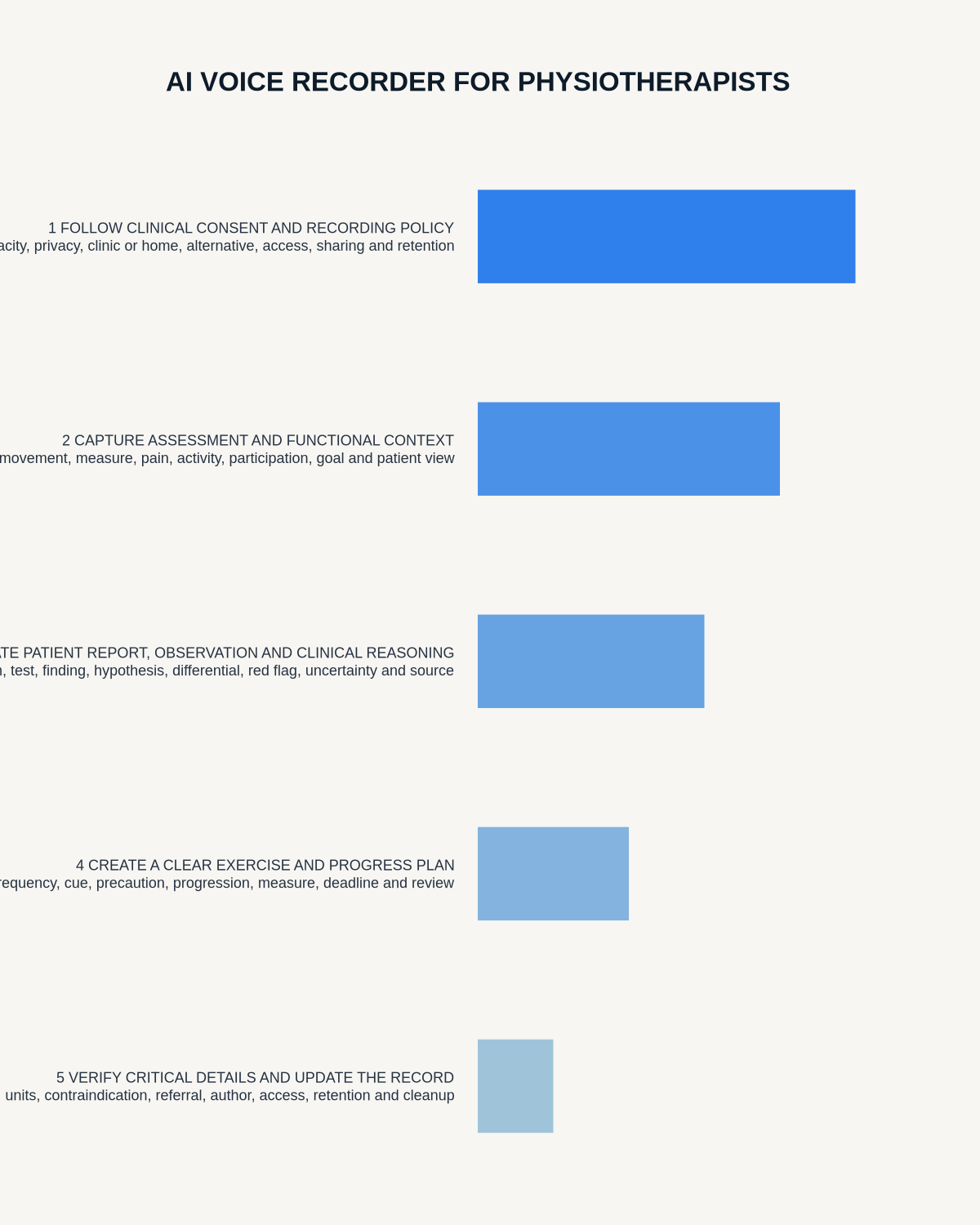
Visual map for AI Voice Recorder for Physiotherapists: Assessments, Exercise Plans and Progress Notes
- Prepare the approved useDefine purpose, safe position, permission and the required formal record.
- Capture context firstState the case, asset, person, location or event identifier before detail.
- Human-verify evidenceCheck technical terms, units, names, dates, decisions and uncertainty.
- Complete the formal recordTransfer only verified information and apply access and retention controls.
On this page
Related guides
See whether Halo fits this workflow
Review the NERALVO Halo specifications, included services, delivery information and current offer only after completing the guide.
Found an error or an out-of-date claim? Email support@neralvo.com with the article address and a supporting source.