The 60-second verdict
Quick answer: researchers can use an AI voice recorder to accelerate transcription and organise interviews, but the research record must show how the original source became a corrected transcript, code, theme and claim. Raw AI output should never silently become the dataset.
Best fit: Researchers who need recoverable audio and human-verified notes in an authorised workflow. Use another method when: recording is prohibited, a participant declines or the approved process requires manual notes.
Evidence basis and limits
- Decision factors covered: Why polished outputs can damage reproducibility; Build a provenance record; Keep analytical stages separate.
- Evidence rule: Claims are weighted by consequence: capture failure, changed meaning, access and recovery matter more than polished wording.
- Boundary: Examples and workflow recommendations must be tested with representative recordings, the intended users and the actual approval process before rollout.

Check whether NERALVO Halo fits researchers work can support approved qualitative interviews, field notes and research debriefs. It does not provide ethics approval, valid consent or methodological rigour.
Why polished outputs can damage reproducibility
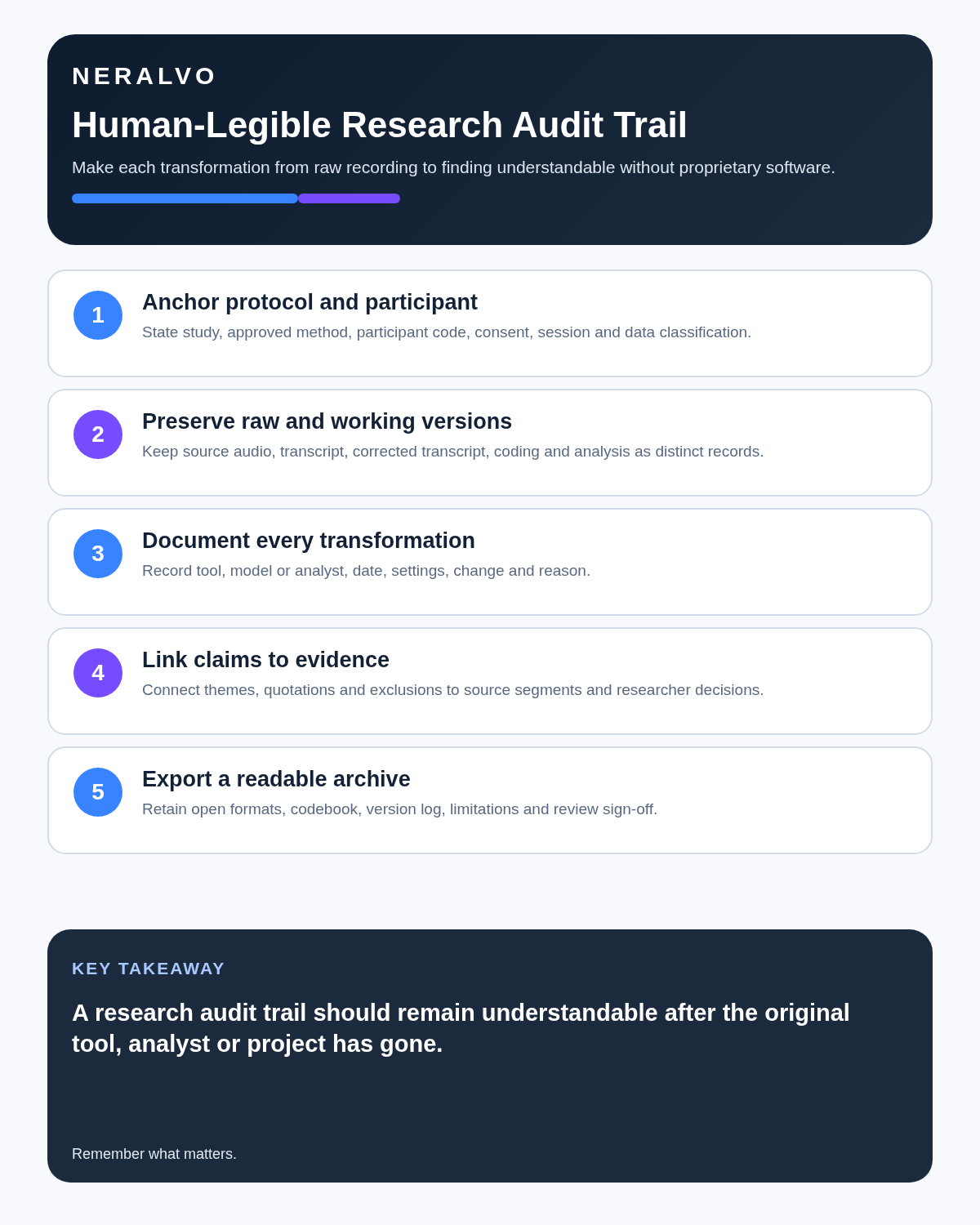
AI can remove hesitations, merge speakers, normalise language and generate themes. Those changes may appear helpful while obscuring uncertainty and researcher choices. A credible project keeps source, correction and interpretation distinct.
The protocol → source → correction → coding → analysis → claim → archive workflow
| Stage | Required record |
|---|---|
| Protocol | Purpose, sample, approved method and consent route |
| Source | File ID, participant code, date, setting and device |
| Correction | Transcript version, changes and reviewer |
| Coding | Codebook, coded extracts and version history |
| Analysis | Theme development, contradictions and decisions |
| Claim | Evidence links, scope and confidence |
| Archive | Retention, access, de-identification and deletion |
Build a provenance record
- Project and participant code.
- Recruitment and consent version.
- Date, setting and interview mode.
- Recorder, application and processing supplier.
- Source-file identifier and checksum where used.
- Raw transcript version.
- Correction owner and date.
- De-identification status.
- Retention and access category.
Keep analytical stages separate
| Layer | Purpose |
|---|---|
| Source audio | Original evidence |
| Raw transcript | Machine output retained as generated |
| Corrected transcript | Verified wording and speaker labels |
| De-identified transcript | Working research version |
| Coded data | Extracts classified using the codebook |
| Analytical memo | Researcher interpretation and questions |
| Finding | Evidence-supported conclusion with limits |
Document AI assistance explicitly
Record which tool performed transcription, summarisation, translation, coding suggestions or theme generation; the settings or prompt where material; the output reviewed; what the researcher accepted or rejected; and the reason.
Preserve contradiction and negative cases
Do not let theme frequency erase minority or opposing accounts. Record disconfirming evidence, sample gaps, alternative explanations and changes to the analytical framework.
Protect participants from re-identification
Pseudonyms do not guarantee anonymity. Voice, rare experiences, occupation, location and combinations of facts may identify a participant. Restrict re-identification keys and assess contextual disclosure before quotation or data sharing.
Verify translations and specialist terms
Machine translation can alter meaning, politeness, uncertainty and culturally specific language. Use a competent reviewer for consequential analysis and retain the original language where the protocol requires it.
Link claims to evidence
Every material finding should identify the relevant participants or sources, supporting extracts, contradictory evidence, analytical memo, sample boundary and confidence. Avoid reporting AI-generated themes as if they emerged without researcher judgement.
Ethical agreement and lawful basis are separate decisions
A participant may agree ethically to take part and to be recorded while the research organisation relies on a lawful basis such as public task or legitimate interests for personal-data processing. The project must document these as separate decisions rather than treating consent to participate as the complete data-protection analysis.
- Why participation and recording are ethically acceptable.
- The lawful basis for processing personal data.
- The applicable condition for special-category or criminal-offence data.
- What withdrawal means before and after anonymisation, analysis or publication.
- Whether future reuse, sharing or archiving is covered.
Review the ICO’s current research provisions guidance and the institution’s approved research-governance process.
Treat the AI service as part of the research method
Replacing approved local transcription with a cloud AI service can change the processor, data location, subprocessors, retention, model-training use, support access and deletion process. That change may require institutional, sponsor, data-protection or ethics review before files are uploaded.
Confirm:
- The service is approved for the project.
- A suitable processing agreement and security assessment exist.
- Processing and storage locations are understood.
- Subprocessors and support-access arrangements are known.
- Research content is not reused beyond the approved purpose.
- Audio, transcripts, backups and derived outputs can be deleted as required.
- Files can be exported in durable, usable formats.
- Workspace permissions and account ownership are controlled.
Choose the transcription convention before correction
A transcript is shaped by decisions about pauses, false starts, dialect, grammar, laughter, overlap and non-verbal events. Choose a convention that fits the research question and apply it consistently across the dataset.
- Verbatim: preserves repetitions, hesitations and speech patterns.
- Intelligent verbatim: removes some disfluency while preserving meaning.
- Conversation-focused: records overlap, pauses and interaction detail.
- Content-focused: prioritises substantive meaning over delivery.
Record any later change to the convention and its effect on already processed interviews. The UK Data Service provides practical research transcription guidance.
Use a quotation provenance card
Every quotation considered for publication should retain:
- Participant code.
- Interview and timestamp reference.
- Verified wording.
- Relevant question and surrounding context.
- Anonymisation or editing changes.
- Analytical code or theme.
- Reason for selection.
- Disclosure and deductive-identification risk check.
This prevents a memorable phrase from becoming detached from the participant’s intended meaning or the conditions under which it was said.
Add focus-group speaker and confidentiality controls
Focus groups need participant codes, a seating plan and moderator notes because overlap and unequal microphone distance make automatic speaker labels unreliable. Check attribution manually before coding or quoting a contribution.
Participant information should also explain that the researcher can control the project’s handling of the recording but cannot guarantee that other group participants will keep everything confidential outside the session.
Apply retention by data type
Do not assign one automatic deletion date to every research artefact. The approved plan may distinguish:
- Original audio.
- Machine transcript.
- Corrected transcript.
- Identity or re-identification key.
- De-identified analysis dataset.
- Codebook and analytical memos.
- Publication quotations.
- Archival or shared version.
Keep each item only for its justified verification, research, funder, legal or archival purpose and record its final disposition.
How NERALVO Halo fits researchers
NERALVO Halo includes NOTE mode, supported CALL mode, 64GB local storage, up to 35 hours of recording and Bluetooth sync with DOWAY. DOWAY provides transcripts, summaries, speaker-separated notes, templates, translations, mind maps and exports, with one year of DOWAY Max included. The institution and approved protocol determine whether this workflow is permitted.
Cloud software, a dedicated recorder or manual notes?
For Researchers, the right answer changes with the setting. This matrix deliberately gives each method a situation where it can be the strongest choice.
| Situation | Best starting point | Reason |
|---|---|---|
| scheduled remote meetings | Cloud meeting software | Calendar automation and shared integrations are usually the strongest advantage. |
| in-person or mobile work | Dedicated recorder | Independent capture reduces reliance on an active phone or laptop. |
| recording is refused or prohibited | Manual notes or an approved alternative | The boundary takes priority over convenience. |
| mixed online and offline work | Governed hybrid | Use each method only in the setting it actually fits. |
Frequently asked questions
Can an AI summary replace a transcript?
No. A summary removes detail and should not become the primary dataset.
Can AI code interviews automatically?
It can suggest codes, but researchers must document and review the analytical decisions.
Does pseudonymisation make audio anonymous?
No. Voices and contextual details can remain identifying.
Final research checklist
- Protocol and participant information cover the complete workflow.
- Ethical participation, lawful basis and any special-category condition are documented separately.
- Source provenance is complete.
- The recorder, AI service and processing route are approved.
- The transcription convention is defined and applied consistently.
- Raw and corrected versions are preserved distinctly.
- AI transformations are documented.
- Codebook and analytical decisions are versioned.
- Contradictions and negative cases are retained.
- Quotations are source-checked and carry a provenance record.
- Focus-group attribution and confidentiality limits are controlled.
- Claims are traceable to evidence.
- Access, retention and deletion are defined by data type.
Bottom line: AI recording strengthens research only when another authorised person can understand every transformation from source conversation to published claim.
Related guides
See the guides for journalists, UX researchers and university students.
On this page
Related guides
See whether Halo fits this workflow
Review the NERALVO Halo specifications, included services, delivery information and current offer only after completing the guide.
Found an error or an out-of-date claim? Email support@neralvo.com with the article address and a supporting source.