The 60-second verdict
Midwifery communication can involve urgent clinical handover, complex family information and reflective learning. An AI voice recorder may support approved staff debriefs or private dictation, but it must never delay care, replace the clinical record or become an informal way to capture women, babies or families.
Best fit: Midwives who need recoverable audio and human-verified notes in an authorised workflow. Use another method when: recording is prohibited, a participant declines or the approved process requires manual notes.
Evidence basis and limits
- Decision factors covered: Start with the safest use cases; Clinical handover must remain structured; Do not rely on transcription for critical clinical details.
- Evidence rule: Claims are weighted by consequence: capture failure, changed meaning, access and recovery matter more than polished wording.
- Boundary: Examples and workflow recommendations must be tested with representative recordings, the intended users and the actual approval process before rollout.
Start with the safest use cases
- private post-shift reflective dictation
- approved education or simulation debrief
- preparation for supervision
- non-clinical service-improvement meetings
- drafting a structured note from information already documented through approved systems
Direct recording during care requires the organisation’s specific clinical-governance, consent and information-handling process.
Clinical handover must remain structured
Where a recorder is approved as part of staff preparation, the final handover should follow the service’s established format. A general example includes:
- current situation
- relevant background
- assessment and observations already documented
- risks or concerns
- plan and escalation
- outstanding results or actions
The AI should not create clinical observations, risk levels or a plan.
Do not rely on transcription for critical clinical details
Names, medicines, doses, times, measurements and clinical terminology can be transcribed incorrectly. Verify critical information against the approved record and direct clinical communication.
A source recording is not a substitute for required contemporaneous documentation.
Reflection versus clinical record
| Reflective note | Clinical record |
|---|---|
| Focuses on learning and professional development | Records care, assessment, communication and decisions |
| Should minimise identifiable information | Uses the authorised patient record |
| May identify questions for supervision | Must meet service documentation requirements |
| Does not replace incident or safeguarding reporting | Links to required escalation and care pathways |
A safe reflective workflow
- Move to a private approved environment.
- Use a case reference or de-identify wherever possible.
- State the learning question.
- Separate facts already documented from personal reflection.
- Record uncertainty and supervision needs.
- Generate a short draft.
- Remove unnecessary identifiable information.
- Complete any clinical, incident or safeguarding record separately.
- Store or delete the reflection according to policy.
Simulation and training
Recorded debriefs can help identify communication, escalation and teamwork themes. The output should focus on learning objectives rather than creating a judgemental transcript of individual performance.
Safeguarding and urgent concerns
Follow the service’s safeguarding and escalation process immediately. Do not wait for AI processing or ask the system to assess risk, credibility or required action.
Family conversations
These can be highly sensitive and emotionally charged. Recording should never be assumed appropriate. Where a service has an authorised process, the purpose, access and retention must be clear to everyone involved.
Where NERALVO Halo fits
Check whether NERALVO Halo fits midwives work can support approved private dictation, staff debriefs and training review. Its current specification includes 64GB local storage, NOTE and CALL modes, up to 35 hours of recording and Bluetooth transfer to DOWAY.
DOWAY can create transcripts, summaries, speaker-separated notes, templates, translations and mind maps. These outputs are administrative aids, not clinical decision tools.
Quality check
- Did recording avoid interfering with care?
- Is the approved clinical record complete?
- Are critical details verified independently?
- Is reflection separated from fact?
- Were safeguarding and incidents handled through the proper route?
- Is identifiable information minimised?
Bottom line
For midwives, the safest AI recorder use is controlled staff reflection, education and service-improvement work. Clinical care, handover, safeguarding and documentation remain governed by direct professional communication and approved health-record systems.
Cloud software, a dedicated recorder or manual notes?
For Midwives, the right answer changes with the setting. This matrix deliberately gives each method a situation where it can be the strongest choice.
| Situation | Best starting point | Reason |
|---|---|---|
| scheduled remote meetings | Cloud meeting software | Calendar automation and shared integrations are usually the strongest advantage. |
| in-person or mobile work | Dedicated recorder | Independent capture reduces reliance on an active phone or laptop. |
| recording is refused or prohibited | Manual notes or an approved alternative | The boundary takes priority over convenience. |
| mixed online and offline work | Governed hybrid | Use each method only in the setting it actually fits. |
Related AI voice recorder guides
Profession workflow
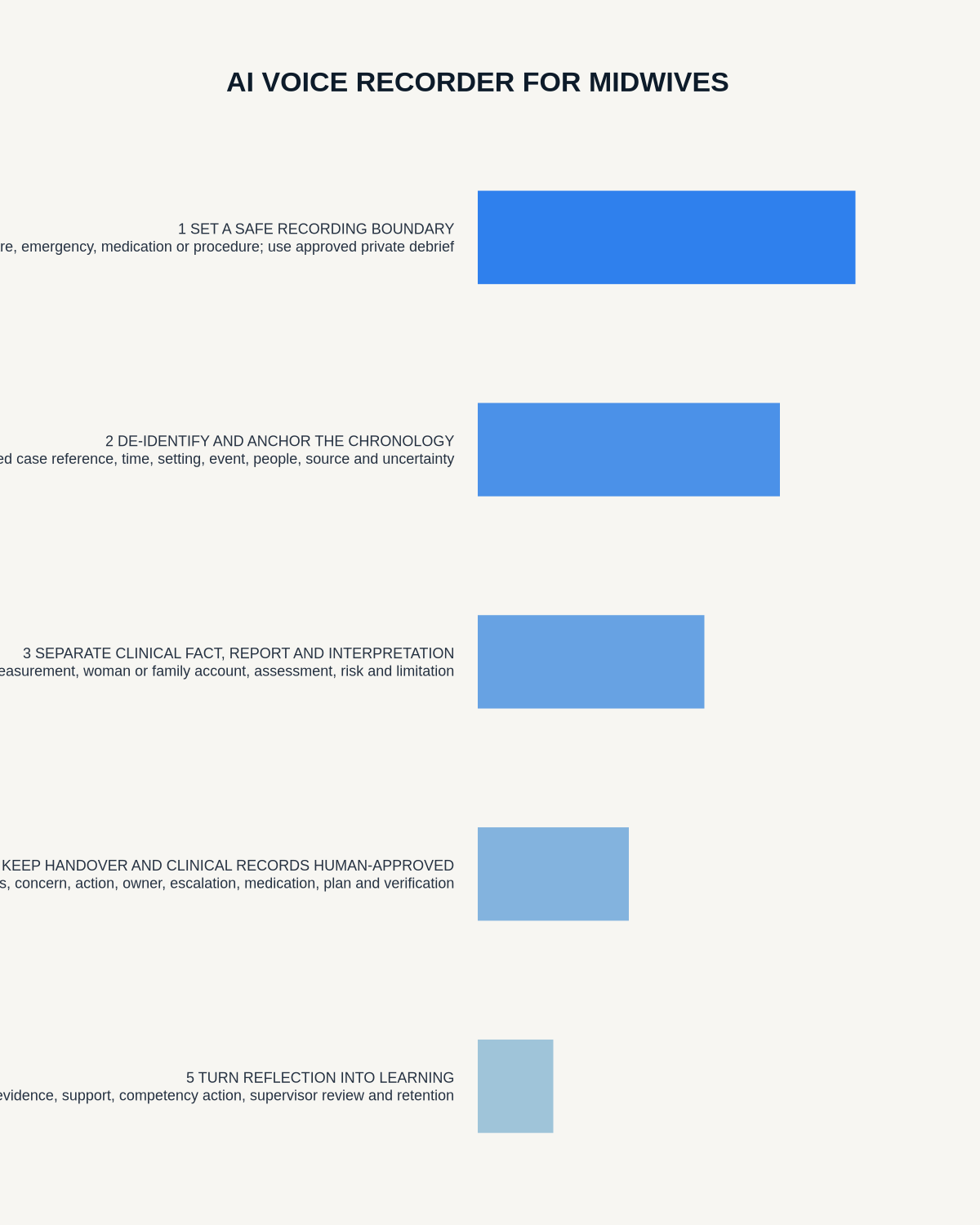
Visual map for AI Voice Recorder for Midwives: Safer Reflection, Handover and Clinical Notes
- Prepare the approved useDefine purpose, safe position, permission and the required formal record.
- Capture context firstState the case, asset, person, location or event identifier before detail.
- Human-verify evidenceCheck technical terms, units, names, dates, decisions and uncertainty.
- Complete the formal recordTransfer only verified information and apply access and retention controls.
On this page
Related guides
See whether Halo fits this workflow
Review the NERALVO Halo specifications, included services, delivery information and current offer only after completing the guide.
Found an error or an out-of-date claim? Email support@neralvo.com with the article address and a supporting source.