The 60-second verdict
Paramedics work in noisy, time-critical environments where recording must never compete with patient care, scene safety or direct handover. An AI voice recorder can support approved post-incident debriefs and reflective notes, but it is not a substitute for clinical documentation or verbal handover.
Best fit: Paramedics who need recoverable audio and human-verified notes in an authorised workflow. Use another method when: recording is prohibited, a participant declines or the approved process requires manual notes.
Evidence basis and limits
- Decision factors covered: Use after the event, not instead of action; Debrief structure; Clinical handover remains direct.
- Evidence rule: The decision is based on the complete capture-to-action workflow, not a single feature or marketing accuracy percentage.
- Boundary: Examples and workflow recommendations must be tested with representative recordings, the intended users and the actual approval process before rollout.
Use after the event, not instead of action
The safest uses include:
- private post-job reflective dictation
- approved operational debrief
- simulation review
- preparation for supervision
- service-improvement meetings
Direct scene recording may capture patients, bystanders, radio traffic and sensitive information. It requires explicit organisational approval and must not be an informal personal practice.
Debrief structure
| Section | Content |
|---|---|
| Context | De-identified incident type and operational setting |
| What happened | Factual sequence already documented |
| What worked | Communication, teamwork and resources |
| What was difficult | Access, information, equipment or coordination |
| Learning | Questions and improvement themes |
| Action | Training, escalation or review route |
AI should not infer clinical error, blame or causation.
Clinical handover remains direct
Handover must use the service’s established structure and authorised systems. Critical details—identity, observations, medicines, times and interventions—must be verified and communicated directly.
Do not rely on a transcript generated after the event for information required during immediate transfer of care.
Reflective practice
A reflective voice note can help a clinician remember learning points after the approved record is complete. Minimise identifiers and separate facts, personal response, uncertainty, evidence or guidance to review and supervision questions.
Major-incident and multi-agency debriefs
Recording may assist an authorised debrief, but the arrangement should define who controls the recording, participants and purpose, distribution, confidential or operationally sensitive material, the official action log, retention and deletion.
An AI summary should preserve disagreement and uncertainty rather than creating a single neat narrative.
A safe workflow
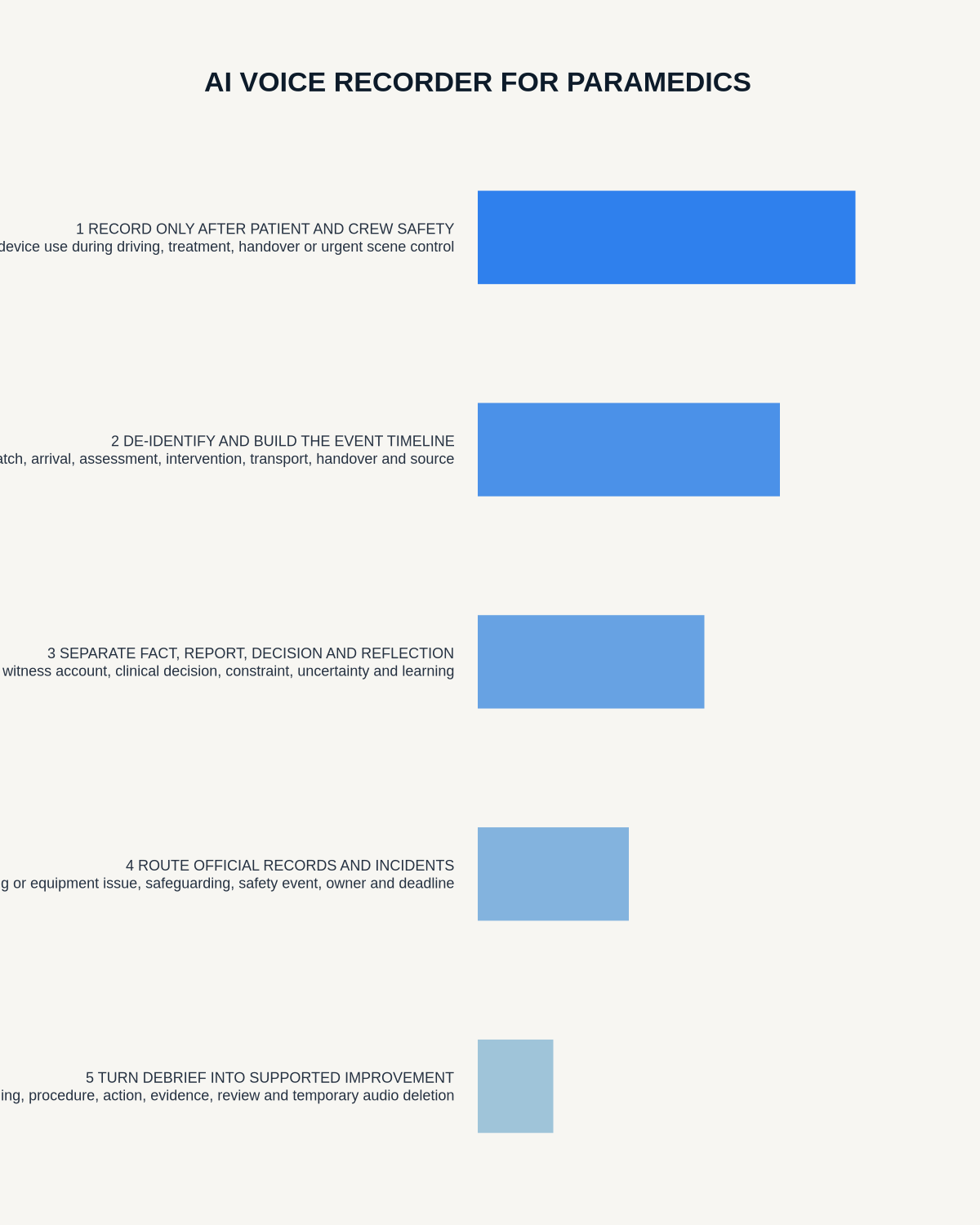
- Complete patient care and required documentation first.
- Move to a private approved environment.
- Use a de-identified reference where possible.
- State the reflective or operational purpose.
- Generate a concise draft.
- Remove unnecessary sensitive detail.
- Complete incident, safeguarding or clinical escalation separately.
- Store only through the approved system.
- Delete temporary audio according to policy.
What AI must not do
- create clinical observations
- assess patient risk
- judge whether care was appropriate
- replace incident reporting
- identify a patient from voice
- determine professional accountability
Where NERALVO Halo fits
View Halo specifications for paramedics use can support approved private debriefs, reflective dictation and training review. Its current specification includes 64GB local storage, NOTE and CALL modes, up to 35 hours of recording and Bluetooth transfer to DOWAY.
DOWAY can create transcripts, summaries, speaker-separated notes, templates, translations and mind maps. These are drafting and organisation tools, not emergency-care systems.
Debrief quality check
- Was care and documentation completed first?
- Is the note de-identified where possible?
- Are facts separated from reflection?
- Were incidents and safeguarding handled through proper routes?
- Are learning actions assigned?
- Has temporary audio been secured or deleted?
Bottom line
For paramedics, AI recording is most defensible after the event: reflection, simulation and authorised debrief. It should never distract from care, replace handover or become an uncontrolled record of patients and scenes.
Cloud software, a dedicated recorder or manual notes?
For Paramedics, the right answer changes with the setting. This matrix deliberately gives each method a situation where it can be the strongest choice.
| Situation | Best starting point | Reason |
|---|---|---|
| scheduled remote meetings | Cloud meeting software | Native remote-meeting workflows can be more efficient here. |
| in-person or mobile work | Dedicated recorder | A separate battery and recoverable local source improve resilience. |
| recording is refused or prohibited | Manual notes or an approved alternative | Manual notes are the correct control when recording is unavailable. |
| mixed online and offline work | Governed hybrid | A hybrid can combine automation with reliable physical capture. |
Related AI voice recorder guides
Profession workflow
Visual map for AI Voice Recorder for Paramedics: Better Debriefs and Reflective Notes
- Prepare the approved useDefine purpose, safe position, permission and the required formal record.
- Capture context firstState the case, asset, person, location or event identifier before detail.
- Human-verify evidenceCheck technical terms, units, names, dates, decisions and uncertainty.
- Complete the formal recordTransfer only verified information and apply access and retention controls.
On this page
Related guides
See whether Halo fits this workflow
Review the NERALVO Halo specifications, included services, delivery information and current offer only after completing the guide.
Found an error or an out-of-date claim? Email support@neralvo.com with the article address and a supporting source.