The 60-second verdict
Quick answer: personal injury solicitors can use an authorised AI voice recording to build four separate timelines: the accident, medical treatment, functional impact and financial loss. The transcript does not prove diagnosis, causation or value; material points must be checked against records, witnesses, experts and verified figures.
Best fit: Personal Injury Solicitors who need recoverable audio and human-verified notes in an authorised workflow. Use another method when: recording is prohibited, a participant declines or the approved process requires manual notes.
Evidence basis and limits
- Decision factors covered: Build four separate timelines; Confirm the recording process; Take the uninterrupted account first.
- Evidence rule: Claims are weighted by consequence: capture failure, changed meaning, access and recovery matter more than polished wording.
- Boundary: Examples and workflow recommendations must be tested with representative recordings, the intended users and the actual approval process before rollout.

Personal injury instructions span several different histories. A single narrative can mix a later diagnosis into the original symptoms or blend estimated losses with documented expenditure. Linked timelines keep the source and status of each point visible.
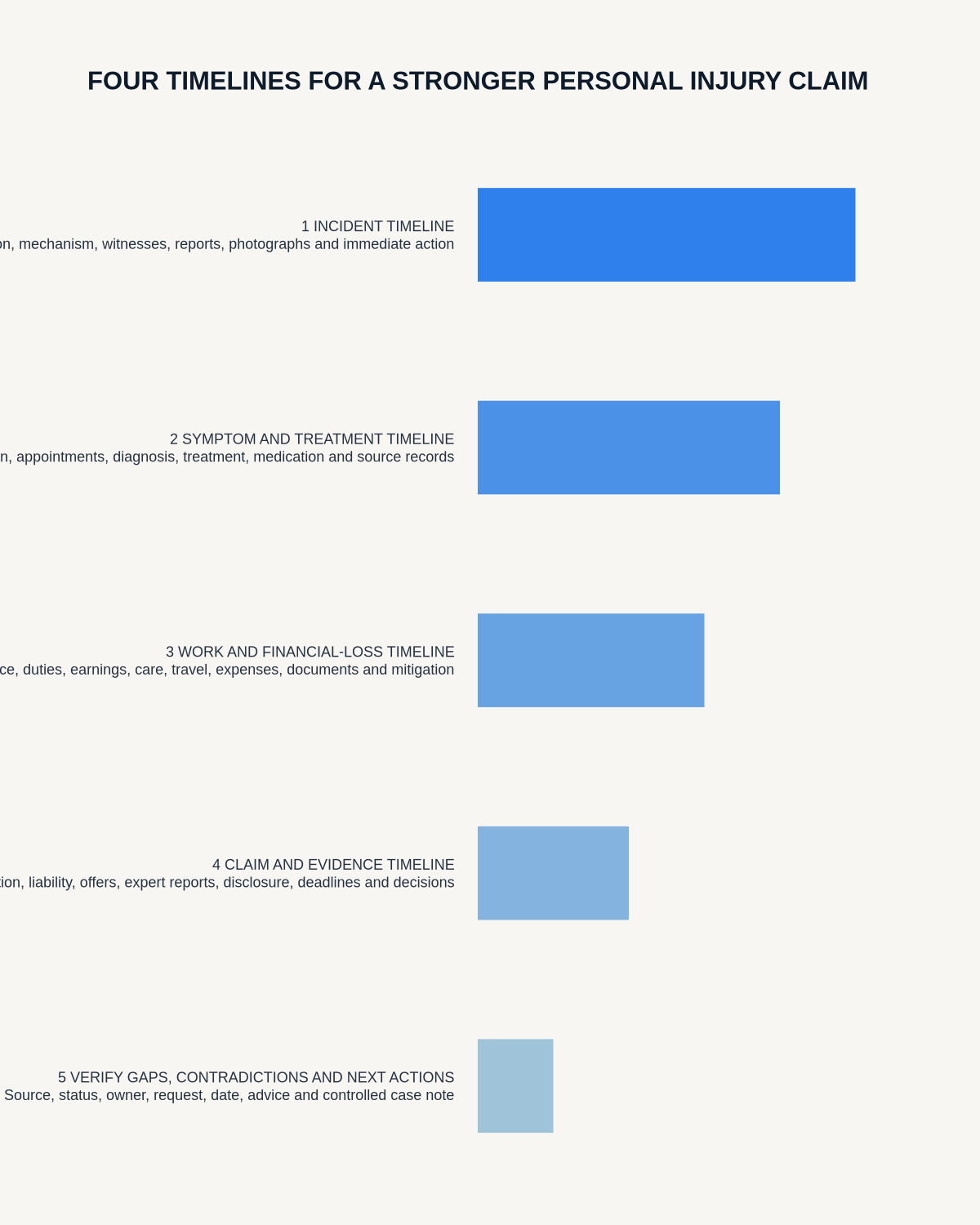
Build four separate timelines
- Accident: events before, during and immediately after the incident.
- Medical: symptoms, attendance, diagnosis, investigation, treatment and prognosis.
- Functional: changes in work, mobility, sleep, care, travel, family life and activities.
- Loss: earnings, expenses, services, equipment and future consequences.
Confirm the recording process
Explain purpose, access, AI processing, option to decline, third-party presence and source-audio retention. Identify urgent limitation, treatment or evidence-preservation issues independently of the transcript.
Take the uninterrupted account first
Allow the client to explain the incident before detailed questions. Then clarify location, conditions, people, movement, timing, sensory observations, immediate symptoms, assistance, photographs, CCTV, witnesses and reports. Label times and distances as exact, estimated or reconstructed.
Apply evidence-status labels
| Source | Treatment |
|---|---|
| Client recollection | Attribute and preserve confidence or uncertainty |
| Contemporaneous document | Check date, author and context |
| Medical record | Use formal terminology from the source |
| Witness account | Keep attributed |
| Expert opinion | Keep within the expert’s remit |
| To verify | Create an evidence action |
Verify medical language
Record symptoms in the client’s own words, provider, period, treatment and record required. Do not convert a symptom description into a diagnosis. Check medication, anatomy, laterality, procedures, clinician names and dates manually.
Make treatment gaps and changing symptoms visible
Record referrals, waits, investigations, therapy, improvement, deterioration, missed appointments and reasons treatment changed or stopped. If the account changes after records arrive, preserve both material versions and the explanation.
Capture functional impact with examples
Explore work duties and hours, walking, standing, lifting, driving, sleep, concentration, personal care, childcare, household tasks, hobbies and assistance. Record frequency, duration and the pre-accident comparison.
Build the loss schedule beside the interview
For each loss, record type, amount or method, period, documentary source, payment status, whether it continues, possible duplication and any future assumption needing expert or financial input.
Create a document-and-witness matrix
Link each issue to the client account, supporting record, witness, expert, opposing evidence, action owner, deadline and result. The transcript identifies work; it is not proof of the claim.
Use a first-interview-to-evidence workflow
- Explain and confirm the approved recording process.
- Take the uninterrupted account.
- Build the four timelines.
- Label sources and confidence.
- Mark medical terms, dates and amounts for checking.
- Extract witnesses, documents and losses.
- Generate and review the transcript.
- Create the attendance note, chronology and action matrix.
- Update as medical and financial evidence arrives.
Where NERALVO Halo fits
Check whether NERALVO Halo fits personal injury solicitors work can support firm-approved first interviews, follow-up reviews and solicitor dictation with NOTE mode, supported CALL capture, 64GB local storage and structured DOWAY notes. Firms should approve handling of privileged, health and financial information before use.
Cloud software, a dedicated recorder or manual notes?
For Personal Injury Solicitors, the right answer changes with the setting. This matrix deliberately gives each method a situation where it can be the strongest choice.
| Situation | Best starting point | Reason |
|---|---|---|
| scheduled remote case meetings | Cloud meeting software | Calendar automation and shared integrations are usually the strongest advantage. |
| authorised interviews or field discussions | Dedicated recorder | Independent capture reduces reliance on an active phone or laptop. |
| privilege, procedure or an objection prevents recording | Manual notes or an approved alternative | The boundary takes priority over convenience. |
| mixed casework | Governed hybrid | Use each method only in the setting it actually fits. |
Frequently asked questions
Can the transcript prove a loss?
No. It can identify the alleged loss and evidence required.
Can AI diagnose an injury?
No. Diagnosis and prognosis require appropriate clinical and expert evidence.
What if the client’s account changes?
Preserve material versions, record the explanation and identify evidence that may resolve the difference.
Does sequence prove causation?
No. Chronology and causation must be assessed separately.
Can the transcript replace the attendance note?
No. The solicitor must approve the structured matter record.
Authoritative guidance and related reading
- Civil Procedure Rules Part 35
- AI Voice Recorder for Occupational Health Advisers
- AI Voice Recorder for Criminal Defence Solicitors
Final claim checklist
- Four timelines remain separate
- Sources and uncertainty labelled
- Medical terms and dates checked
- Functional examples specific
- Each loss has an evidence plan
- Corrections visible
- Actions owned and dated
On this page
Related guides
Check permission, retention and access before choosing hardware
Once the policy requirements in this guide are satisfied, compare Halo’s specifications, local storage, included services and current offer against your approved workflow.
Found an error or an out-of-date claim? Email support@neralvo.com with the article address and a supporting source.