The 60-second verdict
Quick answer: recruitment consultants can use an AI voice recorder for approved client briefs and candidate interviews, but the final record must separate candidate evidence, consultant assessment and irrelevant personal information. The tool must not infer personality, honesty, health or future performance from voice or make automated hiring decisions.
Best fit: Recruitment Consultants who need recoverable audio and human-verified notes in an authorised workflow. Use another method when: recording is prohibited, a participant declines or the approved process requires manual notes.
Evidence basis and limits
- Decision factors covered: Why recruitment conversations are hard to document; Be transparent before recording; Capture a complete client role briefing.
- Evidence rule: The decision is based on the complete capture-to-action workflow, not a single feature or marketing accuracy percentage.
- Boundary: Examples and workflow recommendations must be tested with representative recordings, the intended users and the actual approval process before rollout.

View Halo specifications for recruitment consultants use can support authorised calls and briefings while the ATS, CRM, identity, eligibility and hiring systems remain authoritative.
Why recruitment conversations are hard to document
Recruitment calls contain facts, examples, preferences, questions and consultant interpretation in quick succession. Weak notes may:
- Mix the candidate’s words with the consultant’s opinion.
- Omit the evidence behind a claimed achievement.
- Record salary, notice or availability incorrectly.
- Use vague labels that introduce bias.
- Fail to capture the client’s real decision criteria.
- Leave promised updates unclear.
A transcript offers a fuller source, but only relevant checked information should enter the recruitment record.
Be transparent before recording
Explain whether the call is recorded, why, how the information will be used, who can access it, how long source files remain and what alternative note-taking route exists. Follow the firm’s approved privacy and retention process.
- The call type is approved.
- The participant receives the required explanation.
- The device, account and transcription service are approved.
- Only relevant recruitment information enters the ATS or CRM.
- Sensitive or unnecessary details are not retained simply because they appear in audio.
If a candidate is uncomfortable, continue fairly using ordinary notes where the process permits.
Capture a complete client role briefing
A job description rarely provides enough evidence for consistent assessment. Extract:
- Reason the role exists.
- Expected outcomes at 3, 6 and 12 months.
- Essential and desirable capabilities.
- Evidence the client wants to see.
- Team structure and reporting line.
- Working pattern, location and travel.
- Salary range and approval status.
- Interview stages and decision makers.
- Reasons previous searches or hires struggled.
- Likely candidate objections.
Ask the client to distinguish genuine requirements from preferences and challenge unnecessary criteria through the appropriate process.
Turn the brief into an assessment scorecard
Define job-relevant criteria before interviews begin. A useful scorecard may include:
- Required experience and level.
- Role-specific knowledge.
- Evidence of relevant outcomes.
- Problem-solving examples.
- Stakeholder or leadership capability.
- Motivation for the role.
- Practical requirements such as location and availability.
Define what good evidence looks like. “Strong communicator” is subjective; “can explain a complex change to non-technical stakeholders and provides a verified example” is more assessable.
Run structured candidate interviews
- Confirm current context and search motivation.
- Explain the role and check initial interest.
- Explore relevant career history.
- Ask evidence-based questions linked to the scorecard.
- Clarify individual contribution within team achievements.
- Discuss practical requirements and constraints.
- Invite candidate questions and concerns.
- Confirm next steps and communication timing.
Recording should not make the interview an interrogation. Allow thinking time and use brief markers for material claims and follow-up.
Separate candidate evidence from consultant assessment
Candidate evidence
Record relevant facts, examples and direct statements with verification status.
Consultant assessment
Explain how the evidence maps to the agreed scorecard. Avoid unsupported personality labels. “Not strategic” is weaker than “gave strong delivery examples but did not yet provide evidence of setting multi-year direction.”
Reduce bias in AI-assisted notes
- Use the same core questions and scorecard.
- Exclude protected or irrelevant information from assessment.
- Do not infer personality, honesty, health, emotion or future performance from voice.
- Require evidence for every rating.
- Allow candidates to clarify material inaccuracies.
- Keep a human decision-maker accountable.
AI output may favour polished language or infer traits that were never assessed. The recorder should improve factual recall, not automate hiring.
Create accurate candidate submissions
Include:
- Concise career context.
- Evidence against essential criteria.
- Relevant quantified achievements, checked carefully.
- Motivation and role interest.
- Availability and agreed practical details.
- Questions or concerns the client should address.
- Consultant assessment with clear reasoning.
Check quotations, numbers, employers, dates and role titles against the source and CV. Do not embellish examples to make the candidate easier to market.
Control salary, notice and offer information
Verify figure, currency, basis, package components and whether it is current, expected or minimum acceptable. Separate:
- Candidate statement.
- Consultant interpretation.
- Client budget or range.
- Proposed package.
- Authorised formal offer.
- Accepted terms.
Formal terms must follow the approved offer and contract process.
Protect identity and personal information
Recruitment recordings may contain contact details, employment history, compensation, reasons for leaving and sensitive personal information. Apply data minimisation, role-based access and controlled exports.
Do not send raw candidate transcripts to clients when a concise checked submission is sufficient. Delete source files under the approved schedule and do not assume one vacancy automatically authorises reuse for another.
Move actions into the ATS or CRM
At the end of each call, confirm:
- CV or portfolio update required.
- Client question to resolve.
- Interview availability.
- Reference or eligibility check stage.
- Salary or package clarification.
- Feedback deadline.
- Next contact commitment.
Every action needs an owner and date. Do not leave follow-up inside the transcript.
Use a controlled recruitment-call workflow
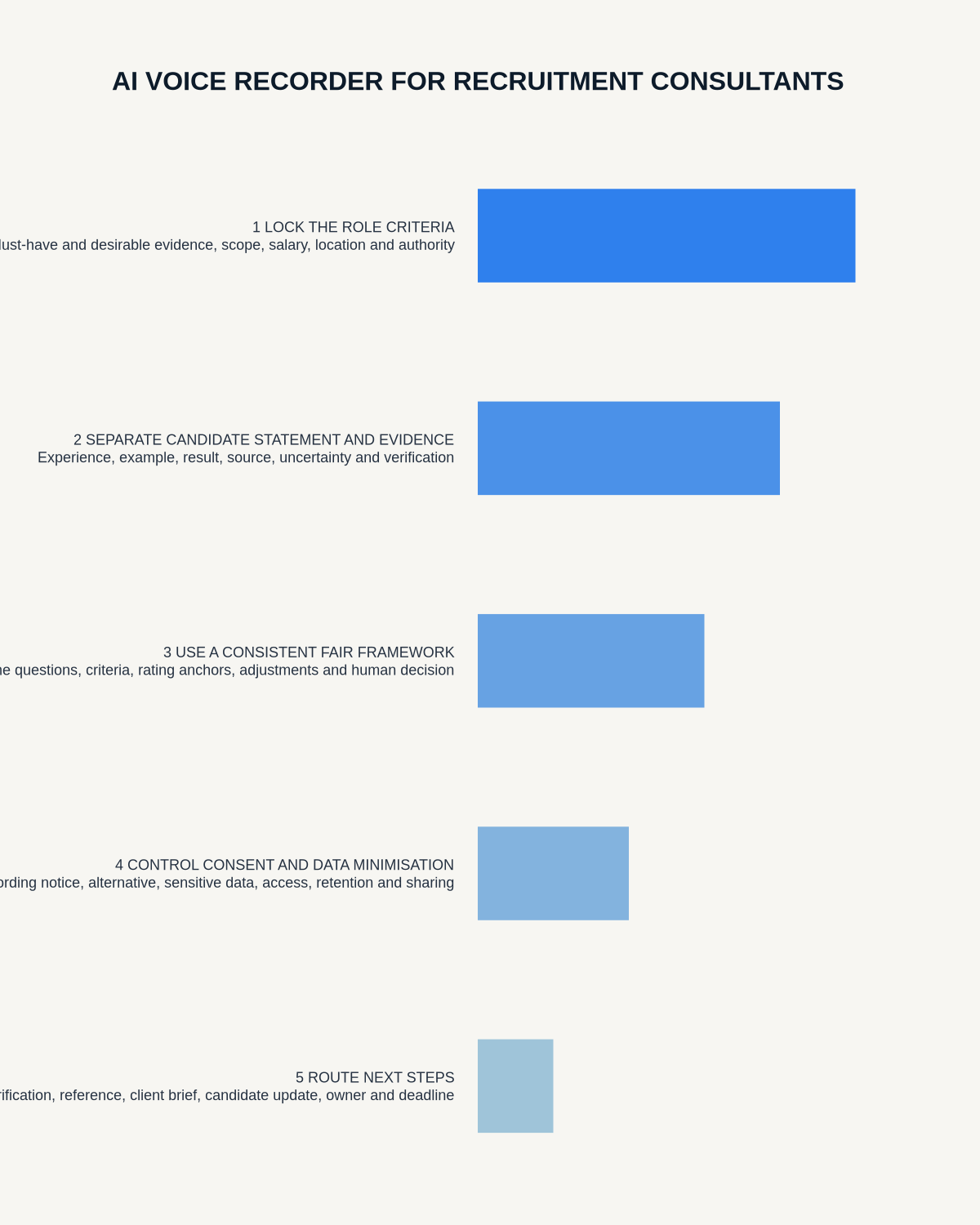
- Confirm approved use and participant transparency.
- Capture the client brief or candidate interview against a defined structure.
- Generate and correct the transcript.
- Separate evidence from assessment.
- Verify names, employers, dates, achievements and compensation.
- Create the relevant ATS or CRM record.
- Assign next actions and promised updates.
- Share only the minimum checked information required.
- Delete unnecessary source material.
Use recordings to improve the process
Across appropriately controlled placements, recurring patterns may reveal unclear briefs, avoidable candidate objections, slow feedback or interview questions that fail to test the required capability. Use aggregated insight to improve templates, scorecards, candidate preparation, communication and consultant coaching without reusing identifiable candidate information for an unrelated purpose.
How NERALVO Halo fits recruitment consulting
NERALVO Halo includes NOTE mode, supported CALL mode, 64GB local storage, up to 35 hours of recording and Bluetooth sync with DOWAY. DOWAY can create transcripts, summaries, speaker-separated notes, templates, translations, mind maps and exports, with one year of DOWAY Max included.
Before deployment, define approved notice wording, data flow, ATS fields and deletion. Test names, employers, job titles, salary figures and specialist terminology.
Cloud software, a dedicated recorder or manual notes?
For Recruitment Consultants, the right answer changes with the setting. This matrix deliberately gives each method a situation where it can be the strongest choice.
| Situation | Best starting point | Reason |
|---|---|---|
| scheduled remote client meetings | Cloud meeting software | Native remote-meeting workflows can be more efficient here. |
| in-person visits and travel | Dedicated recorder | A separate battery and recoverable local source improve resilience. |
| a client declines or policy requires manual notes | Manual notes or an approved alternative | Manual notes are the correct control when recording is unavailable. |
| mixed CRM and field work | Governed hybrid | A hybrid can combine automation with reliable physical capture. |
Frequently asked questions
Can AI score candidates automatically?
It may organise job-related evidence, but shortlisting and hiring decisions must remain fair, explainable and human-reviewed.
Should clients receive full transcripts?
Usually no. Share only relevant, checked information required for the recruitment purpose.
Can recordings be reused for future roles?
Only where the candidate has been informed and the firm has an appropriate purpose, basis and retention process.
What if a transcript misstates an answer?
Correct the record against the source, preserve uncertainty and provide a fair route to clarify material information.
Final recruitment checklist
- Recording transparent and approved.
- Role outcome and evidence criteria defined.
- Consistent scorecard used.
- Candidate evidence separated from judgement.
- Automated trait inferences excluded.
- Critical facts and compensation verified.
- Submission relevant and accurate.
- Actions transferred to ATS or CRM.
- Personal data minimised.
- Human accountability preserved.
Bottom line: AI recording can improve recruitment evidence and follow-up, but fairness depends on transparent capture, consistent criteria, source-checked facts and accountable human assessment.
Authoritative guidance and related reading
On this page
Related guides
See whether Halo fits this workflow
Review the NERALVO Halo specifications, included services, delivery information and current offer only after completing the guide.
Found an error or an out-of-date claim? Email support@neralvo.com with the article address and a supporting source.