The 60-second verdict
Quick answer: management consultants can use an AI voice recorder to preserve authorised stakeholder interviews, workshops, steering meetings and expert briefings, but the final deliverable must keep facts, examples, perceptions, assumptions, hypotheses, decisions and recommendations separate. A fluent transcript is source material—not validated consulting evidence.
Best fit: Management Consultants who need recoverable audio and human-verified notes in an authorised workflow. Use another method when: recording is prohibited, a participant declines or the approved process requires manual notes.
Evidence basis and limits
- Decision factors covered: Why consulting conversations lose valuable evidence; Choose conversations with a defined output; Set permission, purpose and boundaries.
- Evidence rule: A claim earns weight only when the source, date, configuration and limitation are clear enough for a reader to check.
- Boundary: Examples and workflow recommendations must be tested with representative recordings, the intended users and the actual approval process before rollout.

Assess Halo against the management consultants workflow matrix can support approved interviews, workshops and post-meeting debriefs. The client’s project, governance, data and decision systems remain authoritative.
Why consulting conversations lose valuable evidence
Consulting projects often involve many stakeholders, competing narratives, specialist terminology and tight deadlines. A process exception may appear halfway through an interview, a workshop participant may explain why a previous change failed and a sponsor may approve a direction verbally while leaving conditions unclear.
Recording can preserve those details, but only when the engagement defines the purpose, permission, access, processing route and retention. Recording every meeting creates more review work and risk without necessarily improving the deliverable.
Choose conversations with a defined output
Potentially useful cases include:
- Discovery and diagnostic interviews.
- Current-state process workshops.
- Operating-model and organisation-design sessions.
- Customer or employee research interviews.
- Steering meetings and decision reviews.
- Expert and subject-matter briefings.
- Proposal discovery calls and bid workshops.
- Post-implementation and lessons-learned reviews.
Before recording, state the exact output required: evidence memo, decision record, process map, action log, research finding, proposal input or approved meeting note.
Set permission, purpose and boundaries
- Client and participant approval is confirmed.
- The device, account and processing route are approved.
- Restricted topics or sections are identified.
- Participants know who can access the source and derived files.
- A named reviewer owns correction and transfer.
- The authoritative project destination is defined.
- Retention and deletion rules are documented.
- Conventional notes remain available where recording is unsuitable.
If permission or suitability is uncertain, use normal notes. The recorder must not damage client trust or create an uncontrolled confidentiality risk.
Use a six-part consulting capture framework
- Stated facts: volumes, timings, roles, systems, process steps and constraints, with verification status.
- Examples and evidence: incidents, documents, metrics, customer examples and observed behaviour.
- Perceptions and concerns: attributed stakeholder experiences and interpretations.
- Decisions and commitments: exact wording, authority, conditions, effective date and unresolved points.
- Actions and dependencies: one owner, clear output, due date, preceding input and completion evidence.
- Hypotheses and open questions: consultant interpretation, confidence and evidence still required.
A useful note might say: “Working hypothesis: delayed approvals may be caused by unclear authority levels. Evidence still required from finance and operations.” It should not present the hypothesis as a verified finding.
Manual notes and AI-assisted capture
| Consulting task | Recorder advantage | Human control still required |
|---|---|---|
| Stakeholder interview | Important wording, examples and qualifications can be revisited | Verify speaker, facts and context |
| Workshop decision | Decision wording and conditions can be recovered | Transfer approval into the formal decision log |
| Evidence synthesis | Themes, contradictions and repeated examples are easier to locate | Separate frequency from scale and causation |
| Recommendation | Supporting sources can be traced more efficiently | Accountable consulting judgement remains human |
Run stronger discovery interviews
Recording does not improve a poorly designed interview. Move deliberately through:
- Context: role, responsibility and relationship to the subject.
- Current state: what happens from start to finish.
- Exceptions: where normal work breaks down.
- Evidence: documents, data and recent examples.
- Impact: time, cost, risk, quality or customer effect.
- Previous attempts: what has already been tried and with what result.
- Future state: what a workable improvement would look like.
- Follow-up: people, records and questions needed next.
Ask one question at a time, allow silence and challenge vague statements neutrally. At the end, confirm names, figures, documents requested, attribution and next actions.
Create a one-page evidence memo
Do not circulate a raw transcript as the interview output. Create a concise memo containing:
- Interview purpose and participant role.
- Verified facts and source references.
- Material examples and quotations.
- Attributed perceptions.
- Contradictions and uncertainties.
- Working hypotheses.
- Documents requested.
- Follow-up interviews and owners.
Turn workshops into usable outputs
Workshops often create apparent agreement that disappears afterwards. Display the question being solved and the decision rules. At the end of each section, read back:
- What the group agrees is true.
- What remains disputed.
- What decision has been made.
- What evidence is missing.
- Who owns each next action.
Spoken confirmation improves facilitation and gives the transcript clear anchors. It also reduces the risk that a suggestion is misclassified as a decision.
Separate evidence, interpretation and recommendation
| Layer | Meaning | Quality control |
|---|---|---|
| Evidence | What participants, documents and data actually show | Source, date and verification status recorded |
| Interpretation | The team’s explanation of patterns, causes and implications | Alternatives, uncertainty and counter-evidence tested |
| Recommendation | The proposed action based on the evidence and interpretation | Benefits, risks, dependencies, owner and decision authority stated |
AI-generated summaries may combine several comments into a statement nobody made, remove dissent or imply causation where only correlation exists. Every major finding should link to interviews, documents, metrics and counter-evidence.
Create a reliable decision log
Each material decision should include:
- Decision ID and date.
- Exact wording.
- Decision maker or approving forum.
- Options considered.
- Reason and evidence.
- Conditions and assumptions.
- Affected workstreams.
- Review or reversal trigger.
- Source reference.
Discussion does not become governance until the decision reaches the client’s approved register.
Create accountable actions
Each action needs one owner, a specific deliverable, due date, dependency, status and completion evidence. “Team to review” is not an action. “Priya to confirm baseline headcount with HR by 24 July” is.
Check transcript details that change the deliverable
Prioritise review of:
- Numbers, percentages, dates and financial values.
- Names, roles and speaker attribution.
- Negations such as can, cannot, approved and not approved.
- Technical terms and client acronyms.
- Decisions, risks, assumptions and deadlines.
- Quotations intended for reports.
Maintain a project glossary before a large interview programme. Correct recurring terms consistently and compare material claims with documents and data.
Handle contradictory accounts correctly
Do not average incompatible stakeholder accounts into a false consensus. Preserve who said what, the context, the conflicting point and the evidence that could resolve it.
Repeated opinion may identify a theme, but it does not automatically establish scale, root cause or organisational prevalence.
Protect confidential client information
Consulting recordings may contain strategy, pricing, employee information, customer data, legal advice, security details or acquisition discussions. Use approved devices and accounts, narrow access, controlled exports and a defined deletion schedule.
Do not copy complete transcripts into multiple tools merely because they provide convenient summarisation. Remove or restrict material outside the agreed purpose as soon as the project process allows.
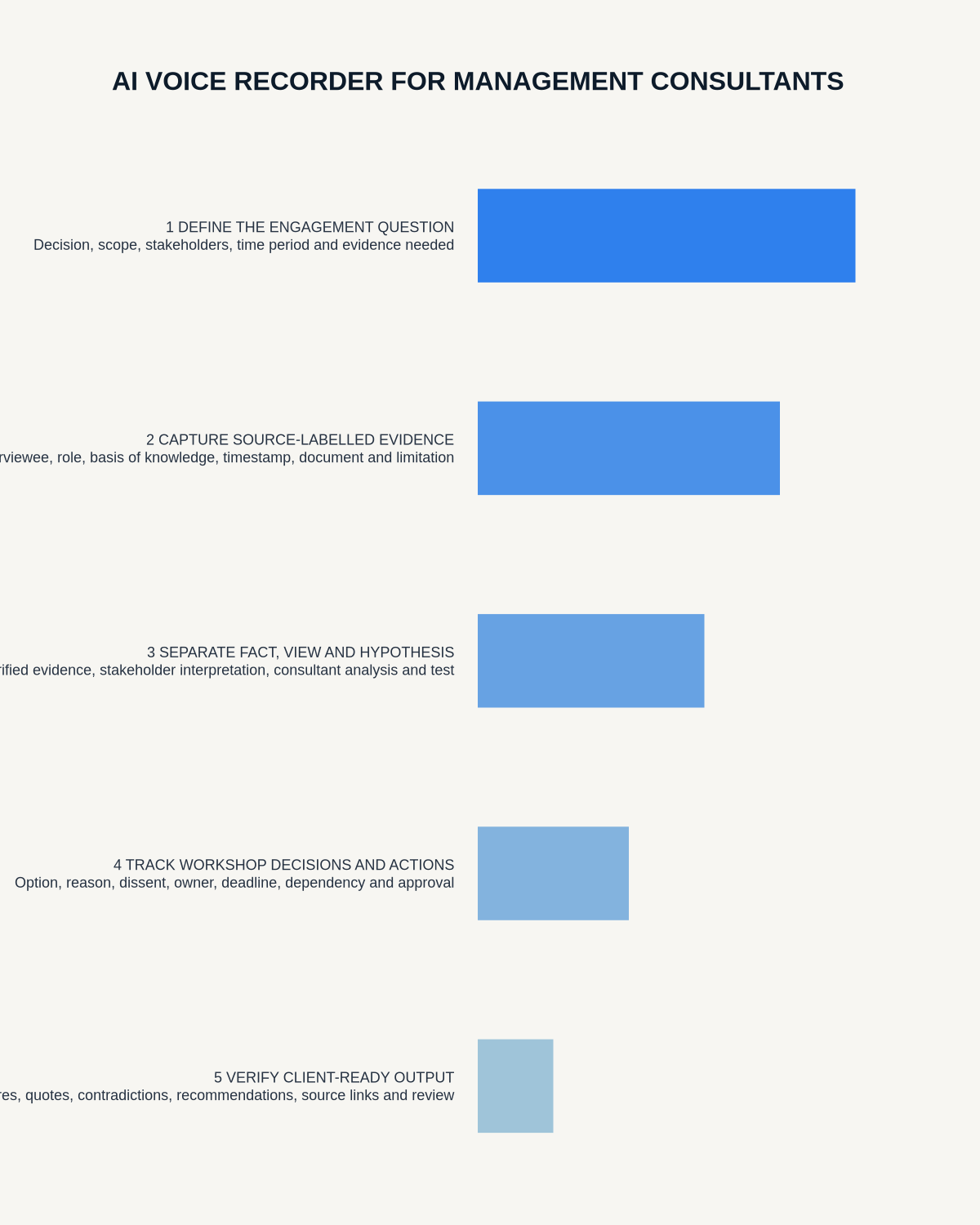
Use a controlled recording-to-deliverable workflow
- Confirm purpose, permission and data route.
- Capture using the interview or workshop structure.
- Save and label the recording by project, date and meeting type.
- Generate the transcript in the approved environment.
- Correct critical terms, attribution, figures and decisions.
- Extract evidence, perceptions, hypotheses, decisions, actions and open questions.
- Compare claims with documents, metrics, workshop boards and counter-evidence.
- Transfer formal items into controlled project systems.
- Confirm material decisions with participants where appropriate.
- Delete temporary copies under the retention plan.
How NERALVO Halo fits management consulting
NERALVO Halo includes NOTE mode, supported CALL mode, 64GB local storage, up to 35 hours of recording and Bluetooth sync with DOWAY. DOWAY can create transcripts, summaries, speaker-separated notes, templates, translations, mind maps and exports, with one year of DOWAY Max included.
Test audio in the actual client environment, verify the complete data flow and confirm export and deletion before deployment. Halo cannot validate evidence or generate an accountable recommendation.
Common mistakes
- Recording everything: capture only where a defined purpose justifies it.
- Trusting the first summary: conditions, dissent and contradictory evidence may be lost.
- Using transcripts as minutes: formal records still need accountable review.
- Mixing observation with judgement: keep evidence, interpretation and recommendation distinct.
- Ignoring attribution: a correct sentence assigned to the wrong person can distort governance.
- Leaving actions vague: require one owner, output and date.
- Keeping files indefinitely: follow contractual and project retention requirements.
Cloud software, a dedicated recorder or manual notes?
For Management Consultants, the right answer changes with the setting. This matrix deliberately gives each method a situation where it can be the strongest choice.
| Situation | Best starting point | Reason |
|---|---|---|
| scheduled remote client meetings | Cloud meeting software | Auto-join and central collaboration can remove routine admin. |
| in-person visits and travel | Dedicated recorder | Dedicated hardware suits movement, variable rooms and offline source capture. |
| a client declines or policy requires manual notes | Manual notes or an approved alternative | A clear alternative respects policy and participant choice. |
| mixed CRM and field work | Governed hybrid | One governed process prevents gaps between desk and field work. |
Frequently asked questions
Can consultants record client interviews?
Only when the client, participants and project rules permit it and the processing route is approved.
Can an AI transcript become the formal meeting record?
It may support the record, but it must be reviewed and transferred into the client’s approved format.
Can AI generate the recommendation?
It can organise source material. Accountable consulting judgement remains human.
How should contradictory stakeholder accounts be handled?
Preserve attribution, show the conflict and define the evidence or authority needed to resolve it.
Final consulting checklist
- Recording authorised and purposeful.
- Facts, examples, perceptions and hypotheses separated.
- Material claims checked against documents and data.
- Dissent and uncertainty preserved.
- Evidence, interpretation and recommendation visibly distinct.
- Decisions and actions transferred to controlled systems.
- Client data, access and retention controlled.
- Final deliverable traceable to its evidence base.
Bottom line: recording improves consulting only when it creates a traceable route from authorised conversation to verified evidence, accountable decision and defensible recommendation.
Related guides
See the guides for business analysts, change managers and corporate development.
On this page
More in this topic: Management and business workflows
Show 9 closely related guides
- AI Voice Recorder for Account Managers: Clearer Client Commitments and CRM Notes
- AI Voice Recorder for Operations Directors: Better Reviews, Incidents and Action Closure
- AI Voice Recorder for Corporate Development: Controlled Diligence and Deal Decisions
- AI Voice Recorder for Programme Managers: Stronger Governance and Dependencies
- AI Voice Recorder for Bid Managers: Better Win Themes and Review Actions
- AI Voice Recorder for Sustainability Managers: Better Audits, Claims and Action Plans
- All-Day AI Voice Recorder: Battery, Storage and Workflow Test
- AI Voice Recorder for Retail Managers: Close Every Store-Walk Action
- AI Voice Recorder for Small Business Owners: Clear the Voice Inbox Daily
Related guides
See whether Halo fits this workflow
Review the NERALVO Halo specifications, included services, delivery information and current offer only after completing the guide.
Found an error or an out-of-date claim? Email support@neralvo.com with the article address and a supporting source.