The 60-second verdict
Quick answer: renewable-energy consultants can use an AI voice recorder to preserve authorised site observations, client objectives and working assumptions, but calculations, feasibility conclusions, financial claims and recommendations must remain tied to verified source data and professional review.
Best fit: Renewable Energy Consultants who need recoverable audio and human-verified notes in an authorised workflow. Use another method when: recording is prohibited, a participant declines or the approved process requires manual notes.
Evidence basis and limits
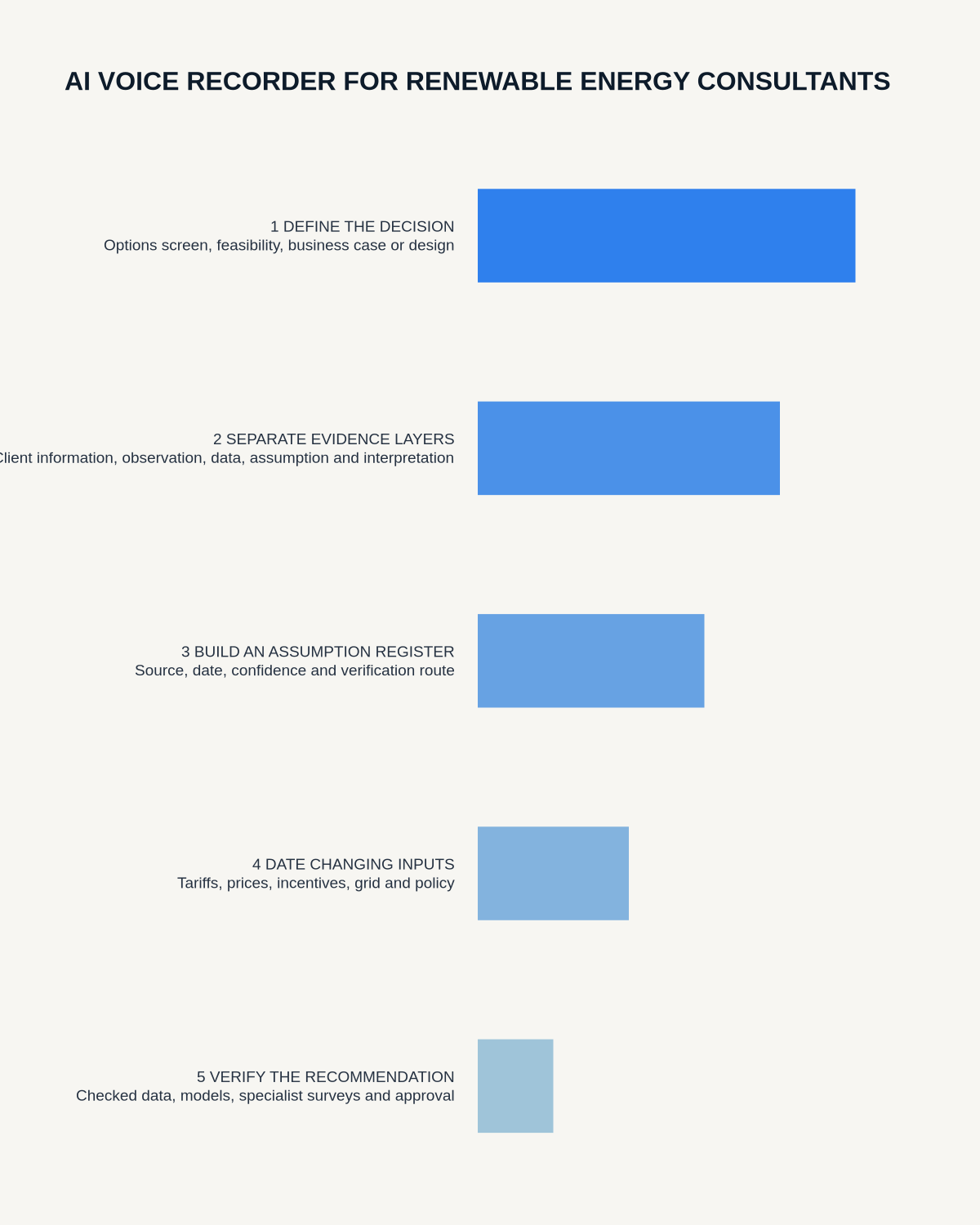
- Decision factors covered: Define the decision the survey must support; Separate six evidence layers; Maintain an assumption register.
- Evidence rule: A claim earns weight only when the source, date, configuration and limitation are clear enough for a reader to check.
- Boundary: Examples and workflow recommendations must be tested with representative recordings, the intended users and the actual approval process before rollout.
Renewable-energy surveys combine building condition, meter information, operating patterns, access restrictions, policy inputs and several technology options. A polished transcript can still confuse what the client reported, what was directly observed and what remains an assumption.

Define the decision the survey must support
State whether the visit supports an options screen, feasibility study, business case or detailed-design input. Record the project reference, site area, client objective, date and access limitations.
The required evidence should match the decision. An initial visual visit should not be presented as a completed structural, electrical or commercial assessment.
Separate six evidence layers
- Client information: operating hours, objectives, constraints and supplied records.
- Direct observation: visible site, plant, roof, electrical and access conditions.
- Measured or documented data: demand records, dimensions, drawings and meter data.
- Working assumption: an input still awaiting confirmation.
- Professional interpretation: what the evidence may mean.
- Recommendation: a reviewed conclusion supported by checked analysis.
Maintain an assumption register
For every material assumption, record its source, date, confidence and verification route. Typical examples include demand profiles, tariffs, grid capacity, structural suitability, planning constraints, equipment performance and future expansion.
Keep assumptions visibly provisional until confirmed by documents, modelling, specialist survey or authorised client approval.
Record the limits of the survey
State which areas were inspected, which were inaccessible, whether systems were operating normally and which weather or access conditions affected the visit. Link photographs, drawings and measurement files by reference.
Compare options consistently
For solar, storage, heat pumps or other measures, record the objective addressed, supporting site evidence, key assumptions, dependencies, required surveys, commercial inputs and reason for retaining or rejecting the option.
Control changing inputs
Tariffs, equipment prices, incentives, policy and grid information can change. Date and source every material input. Do not publish AI-generated payback, savings or performance figures unless they have been checked against the approved model.
Survey-to-report workflow
- Confirm recording authority and information controls.
- State the decision purpose, site zone and access limits.
- Label each point by evidence type.
- Reference photographs, drawings and source files.
- Correct technical terms, dimensions, units and identifiers.
- Move unverified items into the assumption register.
- Complete modelling and specialist checks separately.
- Review recommendations against verified evidence.
- Transfer the approved result into the project record.
- Delete temporary audio under the retention rule.
Cloud software, a dedicated recorder or manual notes?
For Renewable Energy Consultants, the right answer changes with the setting. This matrix deliberately gives each method a situation where it can be the strongest choice.
| Situation | Best starting point | Reason |
|---|---|---|
| scheduled remote client meetings | Cloud meeting software | Auto-join and central collaboration can remove routine admin. |
| in-person visits and travel | Dedicated recorder | Dedicated hardware suits movement, variable rooms and offline source capture. |
| a client declines or policy requires manual notes | Manual notes or an approved alternative | A clear alternative respects policy and participant choice. |
| mixed CRM and field work | Governed hybrid | One governed process prevents gaps between desk and field work. |
Frequently asked questions
Can AI decide which renewable technology is best?
No. Suitability depends on verified technical, operational, commercial and approval evidence.
Can preliminary savings appear in the final report?
Only after the source data, assumptions and calculation method have been checked.
Can audio replace photographs and measurements?
No. It should remain linked to the controlled evidence.
Useful resources
- GOV.UK renewable and low-carbon energy guidance
- AI Voice Recorder for Solar Installers
- Business Travel Voice-Note Safety
- Assess Halo against the renewable energy consultants workflow matrix
Final feasibility checklist
- Decision purpose clear
- Evidence layers separated
- Assumptions dated and sourced
- Survey limits visible
- Changing inputs controlled
- Recommendations traceable to checked evidence
On this page
More in this topic: Accessible and public-facing professional work
Show 7 closely related guides
- AI Voice Recorder for Focus Groups: Consent, Speaker Attribution and Auditable Themes
- AI Voice Recorder for Professionals with Dyslexia: Spoken Capture and Accessible Notes
- AI Voice Recorder for Neurodivergent Professionals: Practical Meeting and Note-Taking Workflow
- AI Voice Recorder for Ombudsman Investigators: Evidence, Fairness and Decision Workflows
- AI Voice Recorder for Complaints Managers: Evidence, Findings, Remedies and Resolution
- AI Voice Recorder for Transport Planners: Consultation Evidence, Model Assumptions and Decisions
- AI Voice Recorder for Urban Designers: Better Site Notes and Consultation Evidence
Related guides
See whether Halo fits this workflow
Review the NERALVO Halo specifications, included services, delivery information and current offer only after completing the guide.
Found an error or an out-of-date claim? Email support@neralvo.com with the article address and a supporting source.