The 60-second verdict
Quick answer: complaints managers can use an AI voice recorder to preserve an authorised customer account and chronology, but the final case record must separate each allegation, evidence source, finding, conclusion, remedy and escalation route. Urgent risk, fairness and final judgement remain human responsibilities.
Best fit: Complaints Managers who need recoverable audio and human-verified notes in an authorised workflow. Use another method when: recording is prohibited, a participant declines or the approved process requires manual notes.
Evidence basis and limits
- Decision factors covered: Begin with privacy and urgent risk; Break the complaint into points; Create a chronology and evidence register.
- Evidence rule: A claim earns weight only when the source, date, configuration and limitation are clear enough for a reader to check.
- Boundary: Examples and workflow recommendations must be tested with representative recordings, the intended users and the actual approval process before rollout.
A transcript is not an investigation outcome. It may contain recognition errors, emotional language, unrelated personal information and several complaint points mixed together. The useful workflow converts the source into a fair, traceable and controlled record.

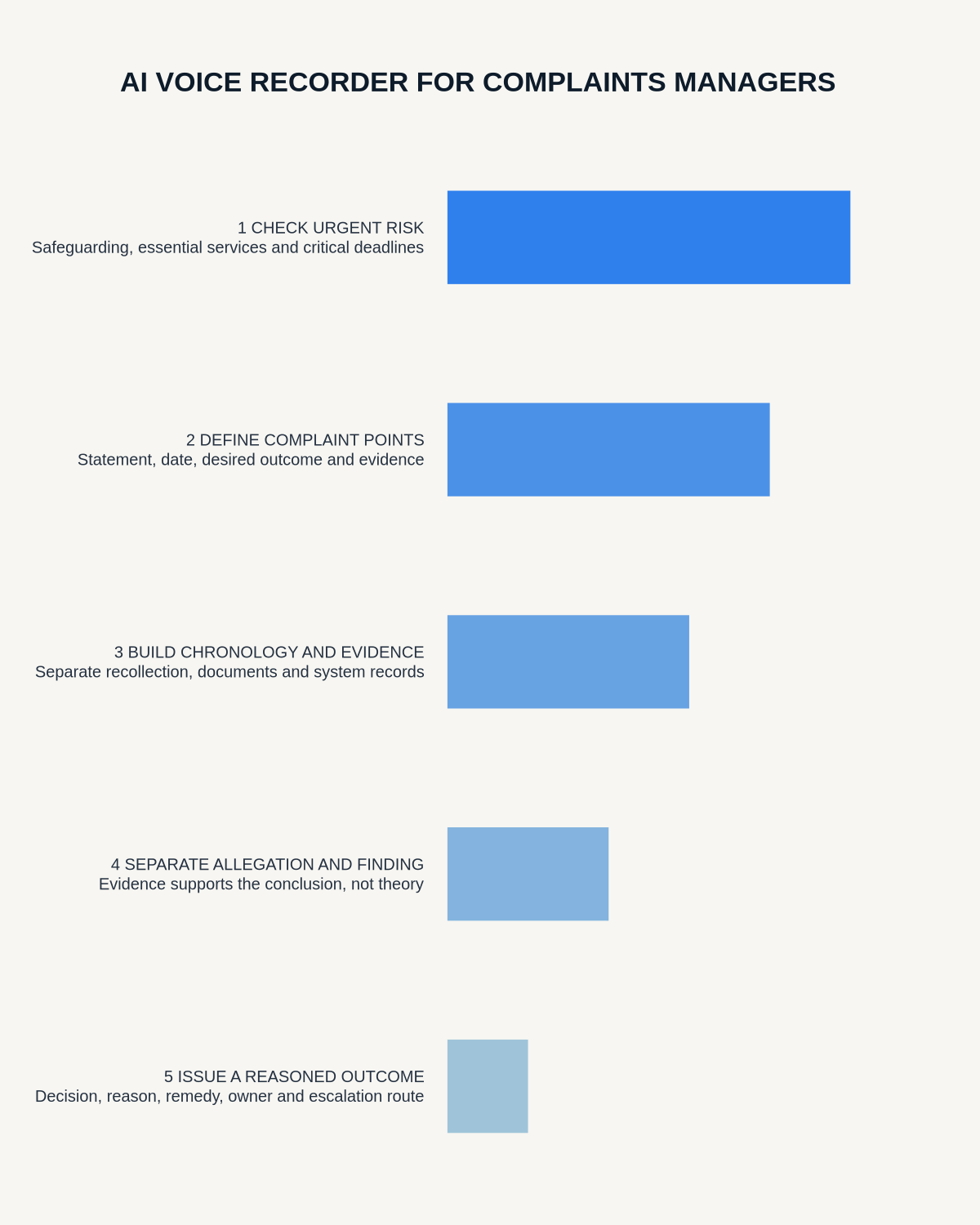
Begin with privacy and urgent risk
Follow the organisation’s recording process and confirm the customer’s preferred communication method and any support needs. Avoid payment details, passwords, security answers and unrelated personal information.
Check immediately for safeguarding, vulnerability, essential-service loss or a deadline that could cause irreversible harm. Escalate urgent issues before completing transcription.
Break the complaint into points
For each point, record:
- the customer’s statement in neutral language;
- date or period;
- service, transaction or decision involved;
- desired outcome;
- evidence required;
- investigator, status and target date.
Confirm the points back to the customer where appropriate. Recording the requested remedy does not promise it will be granted.
Create a chronology and evidence register
Separate recollection from documents and system records. Record source, date obtained, author, relevant passage and limitation. Keep conflicting staff or customer accounts separate rather than merging them.
Verify names, dates, amounts, references and negative wording against the source.
Separate allegation, evidence, finding and conclusion
- Allegation: what the customer says happened.
- Evidence: material available to test it.
- Finding: what the evidence supports.
- Conclusion: upheld, partly upheld, not upheld or unable to determine.
Do not present a working theory as a finding. Identify the applicable policy or service standard by version and date where relevant.
Apply fairness checks
Consider evidence that supports and challenges the complaint. Give relevant staff or service teams an opportunity to respond. Avoid emotive characterisation unless exact wording is material evidence.
Similar cases may provide consistency context but should not override the evidence in the current case.
Write a reasoned outcome
Address every complaint point, identify the evidence considered, state the conclusion and explain why. Record remedy, corrective action, owner and deadline.
If a requested remedy is refused, explain the reason and any alternative. Include review, appeal or escalation routes and time limits.
Capture wider learning separately
When the complaint reveals a recurring service problem, create a separate improvement action with an owner and effectiveness check. Do not lose organisational learning when the individual case closes.
Control access and retention
Restrict source recordings and transcripts, redact third-party information appropriately and remove duplicate working copies according to the retention schedule.
Cloud software, a dedicated recorder or manual notes?
For Complaints Managers, the right answer changes with the setting. This matrix deliberately gives each method a situation where it can be the strongest choice.
| Situation | Best starting point | Reason |
|---|---|---|
| scheduled remote client meetings | Cloud meeting software | Auto-join and central collaboration can remove routine admin. |
| in-person visits and travel | Dedicated recorder | Dedicated hardware suits movement, variable rooms and offline source capture. |
| a client declines or policy requires manual notes | Manual notes or an approved alternative | A clear alternative respects policy and participant choice. |
| mixed CRM and field work | Governed hybrid | One governed process prevents gaps between desk and field work. |
Frequently asked questions
Can the transcript be treated as the finding?
No. It records source material; it does not assess evidential weight or decide the outcome.
How should multiple complaint points be handled?
Track each point separately with its own evidence, finding, conclusion, remedy and deadline.
What if evidence is inconclusive?
State that the point could not be determined and explain the evidential gap.
Should the customer receive the raw transcript?
Use the organisation’s access, disclosure and redaction process.
Useful resources
- Ombudsman Association
- AI Voice Recorder for Ombudsman Investigators
- AI Voice Recorder for Community Engagement Officers
- Assess Halo against the complaints managers workflow matrix
Complaint-record checklist
- Urgent risks and support needs addressed
- Complaint split into clear points
- Evidence traceable to source and point
- Allegations, findings and conclusions separated
- Fairness review completed
- Every outcome explains reasoning
- Remedies, owners and deadlines recorded
- Escalation rights included
- Wider learning routed separately
On this page
More in this topic: Accessible and public-facing professional work
Show 7 closely related guides
- AI Voice Recorder for Focus Groups: Consent, Speaker Attribution and Auditable Themes
- AI Voice Recorder for Professionals with Dyslexia: Spoken Capture and Accessible Notes
- AI Voice Recorder for Neurodivergent Professionals: Practical Meeting and Note-Taking Workflow
- AI Voice Recorder for Ombudsman Investigators: Evidence, Fairness and Decision Workflows
- AI Voice Recorder for Transport Planners: Consultation Evidence, Model Assumptions and Decisions
- AI Voice Recorder for Urban Designers: Better Site Notes and Consultation Evidence
- AI Voice Recorder for Renewable Energy Consultants: Site Surveys, Assumptions and Feasibility Notes
Related guides
See whether Halo fits this workflow
Review the NERALVO Halo specifications, included services, delivery information and current offer only after completing the guide.
Found an error or an out-of-date claim? Email support@neralvo.com with the article address and a supporting source.