The 60-second verdict
Quick answer: tax advisers can use an AI voice recorder to preserve a client’s explanation and draft a fact pattern, but tax conclusions, statutory deadlines and final advice must be based on current law, verified documents and accountable professional judgement.
Best fit: Tax Advisers who need recoverable audio and human-verified notes in an authorised workflow. Use another method when: recording is prohibited, a participant declines or the approved process requires manual notes.
Evidence basis and limits
- Decision factors covered: The best output is a fact schedule; Why spoken tax facts are easy to distort; Use a structured client-meeting note.
- Evidence rule: A claim earns weight only when the source, date, configuration and limitation are clear enough for a reader to check.
- Boundary: Examples and workflow recommendations must be tested with representative recordings, the intended users and the actual approval process before rollout.

The best output is a fact schedule
- People and entities involved.
- Transaction or event.
- Dates and tax periods.
- Amounts and currencies.
- Ownership and relationships.
- Commercial purpose.
- Documents available.
- Information still required.
- Deadlines and next actions.
Keep the client’s account separate from facts verified in accounts, contracts, returns or correspondence.
Why spoken tax facts are easy to distort
Clients may use approximate dates, round figures or informal descriptions. “I sold the company last year” may conceal several legally distinct events. Preserve phrases such as “approximately”, “I think”, “my accountant may have” and “subject to checking”.
Use a structured client-meeting note
| Section | Content |
|---|---|
| Instruction | What the client is asking |
| Reported facts | Client account with source attribution |
| Verified facts | Supported by documents reviewed |
| Assumptions | Temporary basis for initial analysis |
| Missing information | Documents and questions outstanding |
| Deadlines | Filing, payment, election or response dates to verify |
| Advice status | Initial discussion, draft or final written advice |
Record numbers twice
When an amount matters, repeat it with context—for example, “£85,000 gross consideration, before costs.” Confirm currency, whether the number is estimated, the relevant period and whether tax is included.
Check every amount, percentage, date and entity name against the source audio and documents.
Turn the recording into an information request
- Contracts and completion statements.
- Share or asset acquisition documents.
- Accounts and tax returns.
- Payroll and benefit records.
- Residence or travel information.
- Trust or estate documents.
- Valuation evidence.
- Prior correspondence with advisers or authorities.
AI can draft the request from the conversation, but the adviser decides what is relevant and proportionate.
Deadlines require separate verification
Do not rely on an AI summary for statutory dates. Record the event and date mentioned, then verify the deadline using current rules and the source documents. Mark it “to verify” until checked, and place confirmed dates in the authorised diary system immediately.
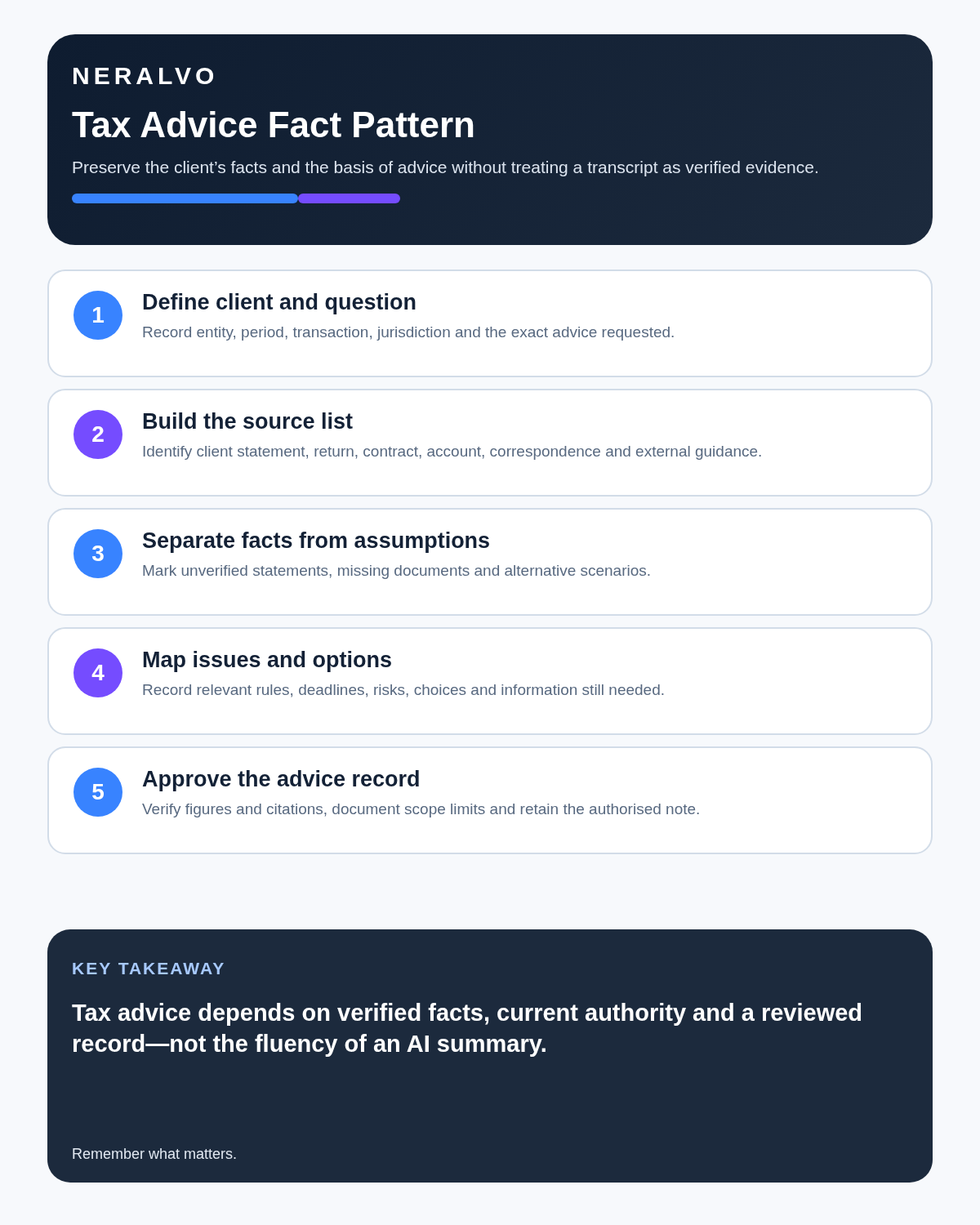
Use a controlled workflow
- Follow the firm’s approved recording process.
- State the client, entities, matter and purpose.
- Let the client describe the transaction in their own words.
- Build a chronological sequence.
- Repeat critical names, amounts and dates.
- Generate a transcript and fact schedule.
- Compare the schedule with source documents.
- Create an information request and task list.
- Complete technical research and review.
- Record advice separately after the facts and law are checked.
- Store the approved attendance note in the matter file.
- Apply retention to audio and drafts.
Telephone advice and qualifications
A conversation may contain preliminary comments rather than final advice. The note should show:
- Information available at the time.
- Assumptions used.
- Issues outside scope.
- Further documents or research required.
- Material uncertainty.
- Whether written advice will follow.
An AI summary should not convert a cautious initial view into an unqualified recommendation.
Separate fact, technical interpretation and advice
The client’s account is not automatically a verified fact; a verified fact does not automatically determine the tax treatment; and an internal technical view is not automatically final client advice. Keep each stage visible and identify the responsible reviewer.
Protect confidentiality and sensitive information
Use approved firm devices, accounts and processors. Avoid dictating passwords, payment credentials or unnecessary third-party information. Restrict access to source audio and define how cloud processing, subprocessors, export, deletion and account offboarding are controlled.
How NERALVO Halo fits tax advice
Assess Halo against the tax advisers workflow matrix can provide source audio for approved client meetings and calls before the adviser drafts a checked fact pattern. It includes 64GB local storage, NOTE and supported CALL modes, up to 35 hours of recording and Bluetooth transfer to DOWAY.
DOWAY can create transcripts, summaries, speaker-separated notes, templates, translations and mind maps, with one year of DOWAY Max included. CALL compatibility varies by phone and route, so test the exact firm setup. Use only within the firm’s confidentiality, recording and retention procedures.
Cloud software, a dedicated recorder or manual notes?
For Tax Advisers, the right answer changes with the setting. This matrix deliberately gives each method a situation where it can be the strongest choice.
| Situation | Best starting point | Reason |
|---|---|---|
| scheduled remote client meetings | Cloud meeting software | Auto-join and central collaboration can remove routine admin. |
| in-person visits and travel | Dedicated recorder | Dedicated hardware suits movement, variable rooms and offline source capture. |
| a client declines or policy requires manual notes | Manual notes or an approved alternative | A clear alternative respects policy and participant choice. |
| mixed CRM and field work | Governed hybrid | One governed process prevents gaps between desk and field work. |
Frequently asked questions
Can AI calculate the client’s tax position from the meeting?
No. The qualified adviser must verify the facts, documents, current law and calculations.
Can a mentioned date be placed straight into the diary?
Record it as a lead, verify the underlying event and rule, then diarise the confirmed deadline through the firm’s process.
Can a transcript become the final attendance note?
It can support drafting, but the responsible professional must check, qualify and approve the final note.
Attendance-note quality check
- Are entities and relationships unambiguous?
- Are dates, periods, amounts and currencies verified?
- Is client-reported information attributed?
- Are assumptions and missing documents visible?
- Are deadlines independently checked and diarised?
- Is preliminary discussion separated from final advice?
- Are confidentiality, access and retention controlled?
Bottom line: for tax advisers, an AI recorder is a fact-capture tool. Its strongest output is a checked chronology, information request and attendance-note draft. Technical conclusions, deadlines and final advice remain the responsibility of the qualified adviser using current evidence and rules.
Related guides
See the guides for bookkeepers, accountants and choosing an AI voice recorder.
On this page
More in this topic: Finance, audit and risk roles
Show 4 closely related guides
- AI Voice Recorder for Emergency Planners: Better Exercises, Debriefs and Action Tracking
- AI Voice Recorder for Payroll Managers: Better Change Logs and Approval Control
- AI Voice Recorder for Auditors: Better Walkthroughs and Evidence Trails
- AI Voice Recorder for Underwriters: Better Risk Interviews and Assumption Registers
Related guides
See whether Halo fits this workflow
Review the NERALVO Halo specifications, included services, delivery information and current offer only after completing the guide.
Found an error or an out-of-date claim? Email support@neralvo.com with the article address and a supporting source.