The 60-second verdict
Quick answer: build an approved-use matrix by rating both the conversation context and the information involved, then defining the permitted purpose, approver, participant explanation, approved technology, human review, destination, retention and stop-and-escalate rule for each use case.
Decision focus: use the method below only where it produces a recoverable source, a verifiable output and a clear next action. If one of those fails, change the workflow rather than trusting a polished summary.
Evidence basis and limits
- Decision factors covered: Rate the conversation context; Rate the information involved; Add the complete workflow fields.
- Evidence rule: The decision is based on the complete capture-to-action workflow, not a single feature or marketing accuracy percentage.
- Boundary: Examples and workflow recommendations must be tested with representative recordings, the intended users and the actual approval process before rollout.

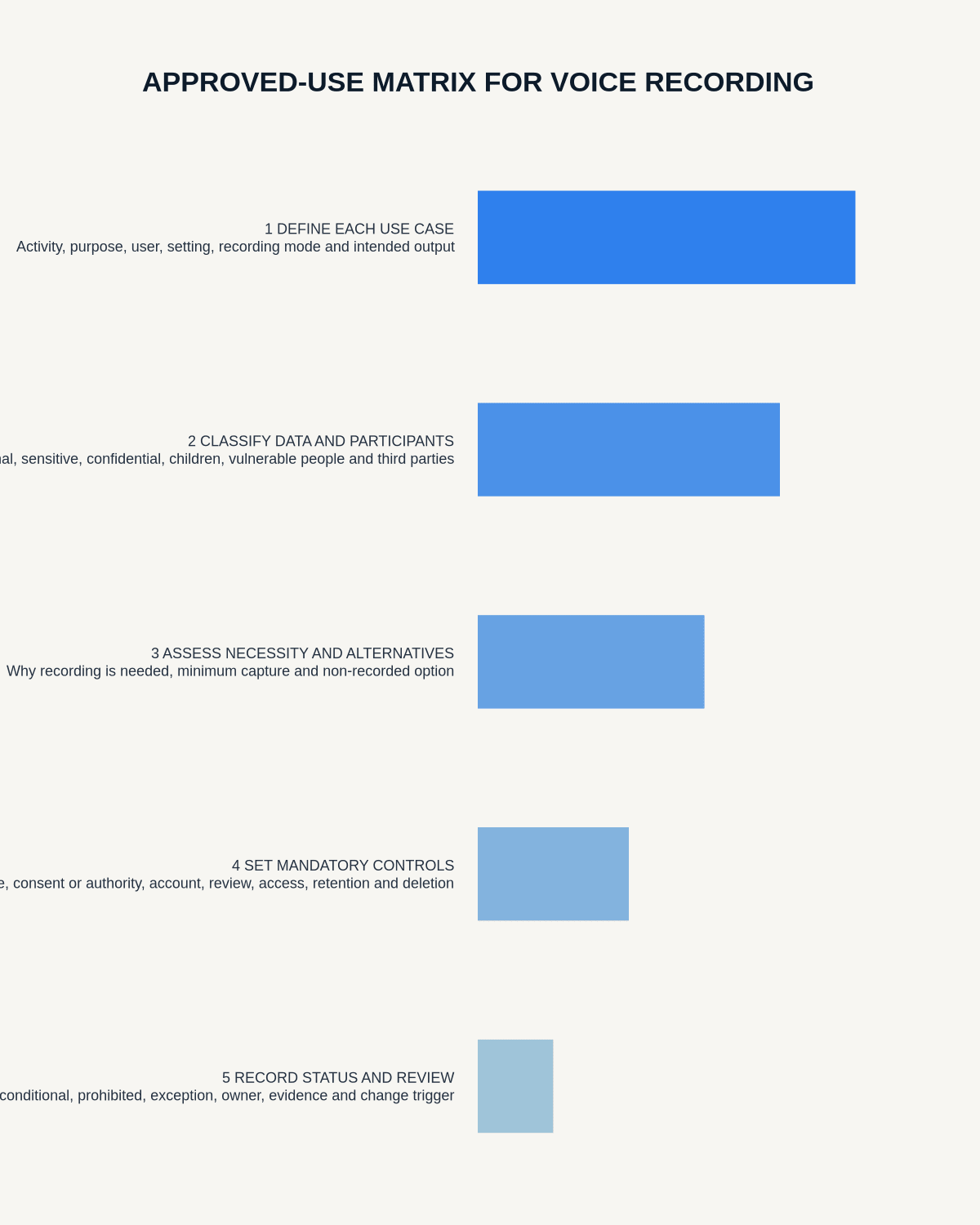
A policy states broad principles. An approved-use matrix helps a person decide whether a real conversation may be recorded, who must approve it and which controls apply.
Rate the conversation context
- C1 routine: ordinary internal work with low expected sensitivity.
- C2 external: clients, suppliers, candidates or members of the public.
- C3 formal: governance, employee, legal, regulatory or evidential process.
- C4 restricted: proceedings, environments or contracts with specific limits.
Rate the information involved
- D1 low sensitivity: ordinary operational discussion.
- D2 confidential: commercial, personnel or customer information.
- D3 sensitive: health, safeguarding, allegations or other high-impact material.
- D4 critical: credentials, payment data, security-sensitive or legally restricted content.
The combination determines the route; neither dimension should be used alone.
Add the complete workflow fields
| Field | Question |
|---|---|
| Purpose | What specific output is necessary? |
| Status | Approved, approval required or prohibited? |
| Approver | Which named role decides? |
| Participant information | What must be explained and what happens after objection? |
| Technology | Which device, app, account and integrations are approved? |
| Review and destination | Who checks the output and where does it go? |
| Retention | When are audio and drafts deleted or reviewed? |
| Special controls | Is redaction, supervision or restricted access required? |
Use a clear decision route
- C1 + D1: standard approved checklist may be sufficient.
- C2 + D2: named approval and participant controls.
- C3 + D3: specialist legal, privacy, HR or professional review.
- Any + D4: stop, prohibit or escalate to an explicitly authorised alternative.
These are examples only; each organisation must define its own status and control owners.
Include a stop-and-escalate rule
Pause or stop when unexpected sensitive information appears, a participant objects, the meeting enters a privileged or restricted section, credentials or payment data are about to be shared or the original purpose has ended. Name the role that may authorise resumption.
Score the complete route, not only the meeting
A routine conversation can become high risk if the transcript is exported to an uncontrolled system. Include local capture, synchronisation, AI processing, sharing, integrations, destination, retention and deletion.
Attach practical workflow tools
Each approved use should link to a participant explanation, file-naming convention, transcript-check checklist, output template, retention instruction, incident contact and escalation route. This turns the matrix into an operational control rather than a static spreadsheet.
Show NERALVO Halo as a complete route
View Halo specifications against the evidence checklist should appear in the matrix as the device, paired phone, DOWAY account, transcription process, export destination and deletion workflow. Approving only the hardware leaves essential stages undefined.
Audit actual use
Sample recordings from each category and compare actual content with the expected sensitivity. Investigate exceptions, repeated escalation, workarounds, missing deletions and outputs stored outside approved systems. Update the matrix when roles, suppliers, features, regulation or business processes change.
Workflow choice matrix for How to Build an Approved-Use Matrix for Voice Recording
Choose the method that protects the source and reduces downstream correction. The table makes the non-hardware options explicit.
| Condition | Preferred route | Why |
|---|---|---|
| High-risk or mixed work | Governed hybrid | Separate capture, review, approval and retention rather than trusting one tool. |
| Recording is refused, prohibited or unnecessary | Manual notes / no recording | Respecting the boundary is the correct workflow, not a product failure. |
| In-person, mobile or unreliable-connectivity work | Dedicated recorder | Independent capture and a recoverable local source are usually more resilient. |
| Repeatable remote work with approved integrations | Cloud software | Automation and central collaboration may outweigh device independence. |
Frequently asked questions
Is an internal meeting automatically low risk?
No. Information sensitivity, participants, processing and destination also matter.
Can the matrix replace professional review?
No. It provides routine routes and escalation for difficult cases.
What if the meeting changes category?
Pause or stop and use the named escalation route.
Who owns the matrix?
A named policy or process owner should maintain it with privacy, security, records, legal and operational input.
How often should it be reviewed?
Use a scheduled review and update earlier after incidents, new suppliers, features or recurring exceptions.
Authoritative guidance and related reading
- ICO accountability and governance guidance
- How to Create an AI Voice Recording Policy for Work
- How to Create a Voice Recording Exception and Escalation Process
- How to Measure AI Voice Recorder ROI
Final matrix checklist
- Context and sensitivity rated
- Purpose and output specific
- Approval roles named
- Participant handling defined
- Complete technology route assessed
- Stop-and-escalate rule clear
- Templates and controls linked
- Actual use audited
On this page
Related guides
See whether Halo fits this workflow
Review the NERALVO Halo specifications, included services, delivery information and current offer only after completing the guide.
Found an error or an out-of-date claim? Email support@neralvo.com with the article address and a supporting source.