The 60-second verdict
Quick answer: create a credible benefits map by linking each programme output to capability, behaviour change, operational outcome and measurable benefit. Every link needs explicit assumptions, evidence, an owner, a baseline and a test, with disbenefits and transferred costs included.
Decision focus: use the method below only where it produces a recoverable source, a verifiable output and a clear next action. If one of those fails, change the workflow rather than trusting a polished summary.
Evidence basis and limits
- Decision factors covered: Begin with the strategic objective; Build the full benefit chain; Record assumptions between every link.
- Evidence rule: Claims are weighted by consequence: capture failure, changed meaning, access and recovery matter more than polished wording.
- Boundary: Examples and workflow recommendations must be tested with representative recordings, the intended users and the actual approval process before rollout.
Programmes often claim benefits that an output cannot create by itself. A system, building or policy is an output; value appears only when it enables capability, people change behaviour and the resulting outcome is measured.

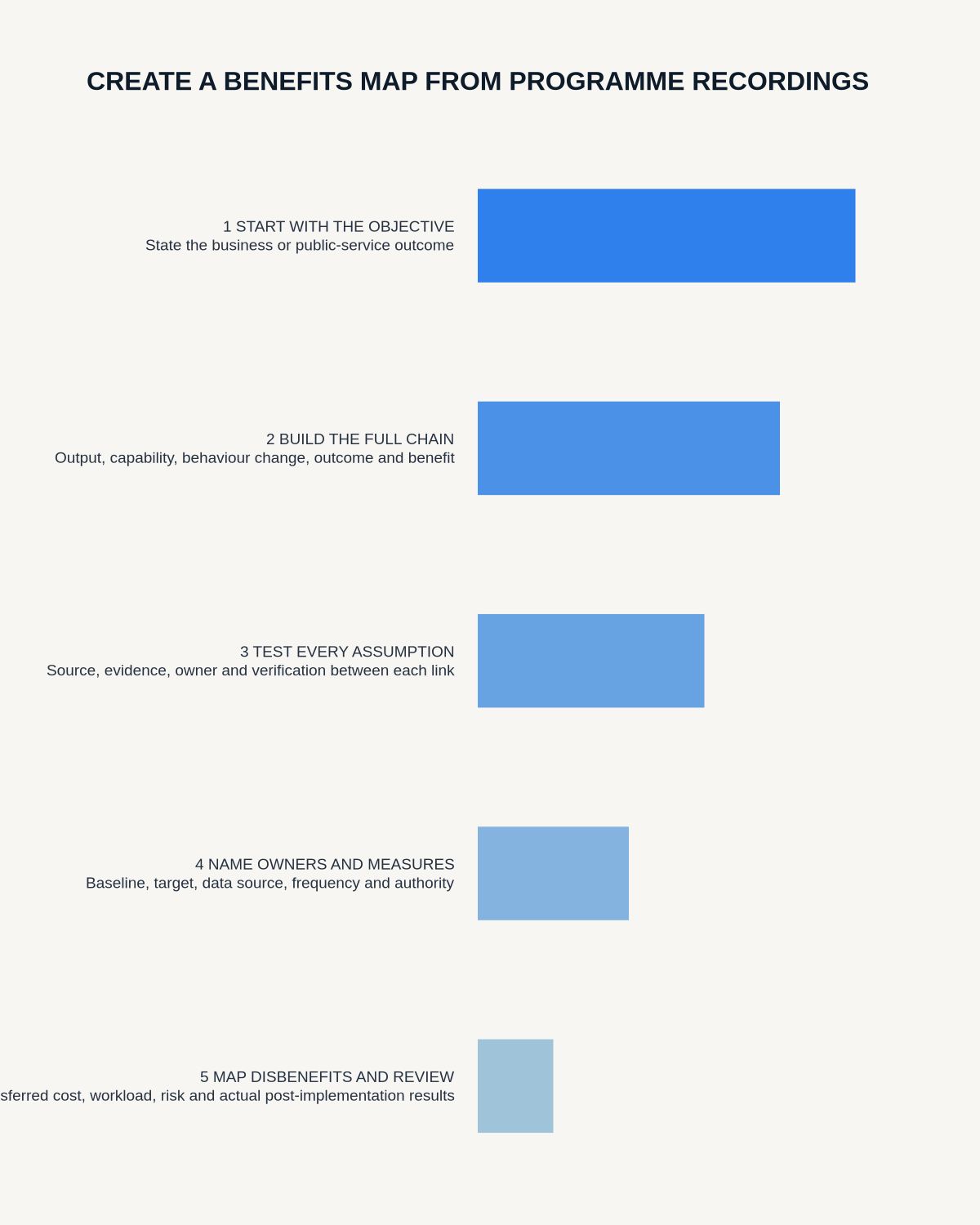
Begin with the strategic objective
State the business or public-service objective the programme supports. A benefit without a clear objective can become a convenient success statement rather than a reasoned outcome.
Build the full benefit chain
- Output: what the programme delivers.
- Capability: what becomes possible.
- Behaviour or process change: what people must do differently.
- Operational outcome: the service or performance change.
- Benefit: measurable value linked to the objective.
For example, delivering a new case-management system is not the same as reducing case duration. Adoption, workflow design, data quality and management controls bridge the gap.
Record assumptions between every link
For each connection, capture the assumption, source, evidence, owner and test. Ask whether the output is operational, people will use it as intended, required training or controls exist, the behaviour can influence the outcome and the benefit can be measured without double counting.
AI should not turn “we expect” into “the programme will deliver.”
Separate benefit types
- Cashable: directly reduces spend or creates evidenced income.
- Capacity: frees time or resources for other work.
- Quality: improves accuracy, experience or reliability.
- Risk reduction: lowers likelihood or impact.
- Strategic: enables a future capability or obligation.
Identify overlaps so the same value is not counted more than once.
Name a real benefit owner
The project team may deliver the output, but an operational owner normally owns adoption and realisation. Record baseline, target, data source, frequency, reporting route and decision authority. Where nobody controls the behaviour or measure, the benefit is not ready to be committed.
Capture disbenefits and transferred cost
Map extra workload, reduced accessibility, transferred cost, implementation disruption and new risks. Assign measures and owners so reporting does not show positive value alone.
Use recordings as source material, not proof
Extract claimed benefits, disagreements, assumptions and proposed measures from the transcript. Verify baselines and metrics against authoritative data. A persuasive statement is evidence of a view, not proof of realised value.
Review after implementation
- Confirm outputs and capabilities exist.
- Measure adoption and behaviour change.
- Compare outcomes with baseline.
- Test whether other factors explain the result.
- Update forecasts, dependencies and owners.
- Stop, redesign or reclassify unsupported benefits.
Workflow choice matrix for How to Create a Benefits Map from Programme Recordings
Choose the method that protects the source and reduces downstream correction. The table makes the non-hardware options explicit.
| Condition | Preferred route | Why |
|---|---|---|
| Repeatable remote work with approved integrations | Cloud software | Automation and central collaboration may outweigh device independence. |
| In-person, mobile or unreliable-connectivity work | Dedicated recorder | Independent capture and a recoverable local source are usually more resilient. |
| Recording is refused, prohibited or unnecessary | Manual notes / no recording | Respecting the boundary is the correct workflow, not a product failure. |
| High-risk or mixed work | Governed hybrid | Separate capture, review, approval and retention rather than trusting one tool. |
Frequently asked questions
Is delivering the project output a benefit?
Usually it is an output. The benefit is the measurable value created afterwards.
Can AI calculate programme benefits from meetings?
No. It can organise claims and assumptions, but baselines, models and actual results require verification.
Who should own a benefit?
A person with authority over the operational change and the ability to monitor the measure.
Useful resources
- GOV.UK project delivery functional standard
- How to Create a Lessons-Learned Report
- How to Create an Executive Briefing from Multiple Recordings
- How to Build a Decision-to-Action Audit Trail
Final benefits checklist
- Benefit linked to strategic objective
- Full output-to-benefit chain visible
- Assumptions explicit and testable
- No double counting
- Owner, baseline and measure present
- Disbenefits and transferred costs included
On this page
Related guides
See whether Halo fits this workflow
Review the NERALVO Halo specifications, included services, delivery information and current offer only after completing the guide.
Found an error or an out-of-date claim? Email support@neralvo.com with the article address and a supporting source.