The 60-second verdict
Quick answer: build a decision-to-action audit trail with one stable decision ID linking the source discussion, approved wording, authority, conditions, actions, implementation evidence and outcome review. Later changes should create a superseding record rather than overwrite the original.
Decision focus: use the method below only where it produces a recoverable source, a verifiable output and a clear next action. If one of those fails, change the workflow rather than trusting a polished summary.
Evidence basis and limits
- Decision factors covered: Create one stable decision identity; Build five linked records; Preserve decision status.
- Evidence rule: Claims are weighted by consequence: capture failure, changed meaning, access and recovery matter more than polished wording.
- Boundary: Examples and workflow recommendations must be tested with representative recordings, the intended users and the actual approval process before rollout.
A decision is not complete when somebody says “agreed.” It becomes accountable only when the exact outcome, authority, dependencies, implementation and result remain connected across controlled systems.

Create one stable decision identity
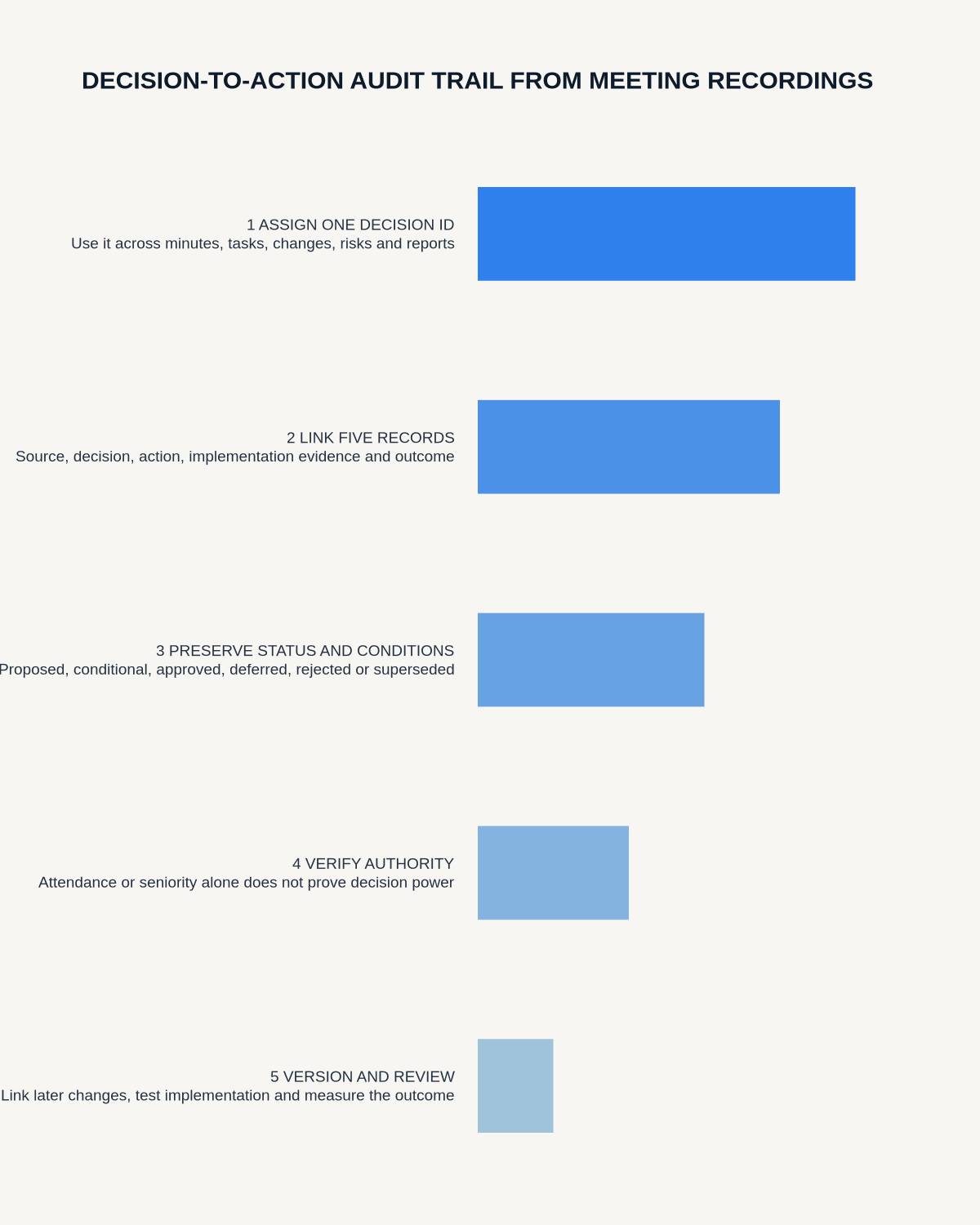
Assign a unique decision ID and use it across minutes, task systems, change requests, risks and reports. Copied wording is unreliable because it can be shortened or changed without showing provenance.
Build five linked records
- Source: meeting, timestamp, participants and papers.
- Approved decision: wording, authority, rationale, status and conditions.
- Action or change: deliverable, owner, deadline, dependencies and acceptance criteria.
- Implementation evidence: document, system change, test or approval.
- Outcome review: whether the intended result occurred and what remains unresolved.
Preserve decision status
Distinguish proposed, recommended, agreed in principle, approved, conditional, deferred, rejected and superseded. A summary can otherwise turn discussion into final authority.
Record conditions and dependencies
Link budget, legal, security, supplier, technical and governance conditions. Identify who owns each dependency, when it must be satisfied and what evidence proves it.
Verify authority
State who had power to decide and how approval was captured. Attendance, job title or seniority alone may not establish authority. Label unclear outcomes as recommendations pending approval.
Turn the decision into controlled action
Transfer the final action to the task, change or case system. Include acceptance criteria. Avoid leaving the only action inside a transcript or AI summary.
Handle later changes transparently
Create a linked superseding decision, record why the position changed and identify which actions were cancelled, amended or retained. Do not silently edit the original record.
Verify implementation and outcome
- Check that the authorised action occurred.
- Review evidence rather than completion status alone.
- Confirm acceptance by the accountable owner.
- Measure the intended outcome where relevant.
- Record residual issues, risks and follow-up.
Protect confidential source material
The recording may contain broader confidential discussion than the final decision record. Restrict source access and apply the approved retention rule while preserving the authoritative audit trail.
Workflow choice matrix for How to Build a Decision-to-Action Audit Trail from Meeting Recordings
Choose the method that protects the source and reduces downstream correction. The table makes the non-hardware options explicit.
| Condition | Preferred route | Why |
|---|---|---|
| High-risk or mixed work | Governed hybrid | Separate capture, review, approval and retention rather than trusting one tool. |
| Recording is refused, prohibited or unnecessary | Manual notes / no recording | Respecting the boundary is the correct workflow, not a product failure. |
| In-person, mobile or unreliable-connectivity work | Dedicated recorder | Independent capture and a recoverable local source are usually more resilient. |
| Repeatable remote work with approved integrations | Cloud software | Automation and central collaboration may outweigh device independence. |
Frequently asked questions
Is “everyone agreed” sufficient evidence?
No. Record the exact wording, status, authority and conditions.
Can an action be closed without evidence?
A status alone is weak. Link the test, document, system change or acceptance evidence.
Should a changed decision overwrite the original?
No. Create a linked superseding version.
Useful resources
- Association for Project Management decision-making guidance
- How to Turn Meeting Recordings into a RACI Matrix
- How to Draft Change Requests from Meeting Transcripts
- How to Create an Issue Log from Meeting Recordings
- Check whether NERALVO Halo fits this workflow
Final audit-trail checklist
- Stable decision ID assigned
- Wording, authority and status exact
- Conditions and dependencies linked
- Actions have owners and acceptance criteria
- Implementation supported by evidence
- Outcome reviewed
On this page
Related guides
See whether Halo fits this workflow
Review the NERALVO Halo specifications, included services, delivery information and current offer only after completing the guide.
Found an error or an out-of-date claim? Email support@neralvo.com with the article address and a supporting source.