The 60-second verdict
Quick answer: the best compact recorder is small enough to carry every day but clear enough to operate deliberately and stable enough to capture the hardest normal meeting. Minimum size is not the same as maximum usefulness.
Decision focus: use the method below only where it produces a recoverable source, a verifiable output and a clear next action. If one of those fails, change the workflow rather than trusting a polished summary.
Evidence basis and limits
- Decision factors covered: Define everyday-carry jobs; Run a seven-day carry test; Compact-recorder scorecard.
- Evidence rule: The decision is based on the complete capture-to-action workflow, not a single feature or marketing accuracy percentage.
- Boundary: Examples and workflow recommendations must be tested with representative recordings, the intended users and the actual approval process before rollout.
Define everyday-carry jobs
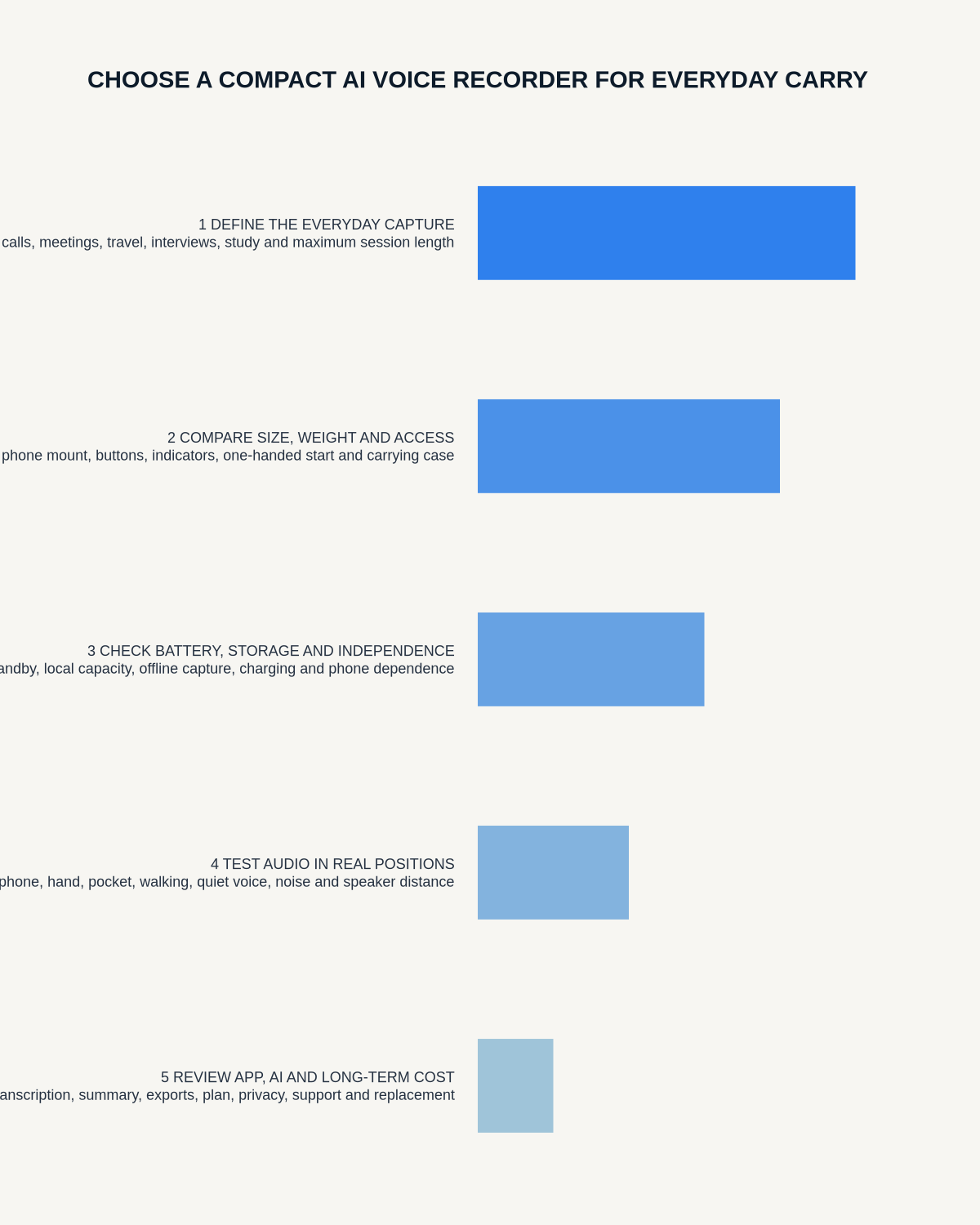
- planned meetings
- client or supplier calls
- private notes
- travel debriefs
- site observations
- authorised interviews or lectures
Run a seven-day carry test
- Carry it normally.
- Record one meeting and several short notes.
- Track missed and accidental starts.
- Measure end-of-day battery.
- Transfer, name and process every file.
- Record any compromise caused by size.
Compact-recorder scorecard
| Area | Pass | Warning |
|---|---|---|
| Availability | Present when needed | Left behind |
| Controls | Deliberate starts | Accidental activation |
| Status | Recording state obvious | Failure discovered later |
| Placement | Stable and acoustically useful | Slides or remains beside one speaker |
| Workflow | Files are checked and exported | Unnamed archive grows |
Test the hardest normal meeting
Include the quietest speaker, farthest seat, names, dates, numbers, specialist terms, one interruption and one conditional action. Review source audio first.
Check detached placement
A phone-mounted recorder may need detaching for central room audio. Confirm independent capture, stable placement and visible status.
Battery and storage
Test the busiest day, standby drain, transfers, warnings, capacity visibility and interrupted-sync recovery.
Privacy and loss
Small devices are easier to misplace. Define ownership, storage, loss reporting, neutral filenames, prompt transfer and secure reset before reassignment.
Compare with a phone app
A dedicated recorder provides separate battery and physical controls; a phone app may be cheaper and easier to secure. Compare availability, distraction, loss risk and total correction time.
What compact specifications actually matter?
Start with the complete workflow, not the headline dimensions. A useful everyday-carry recorder must have controls you can identify without opening an app, an unmistakable recording indicator, enough local capacity for a delayed transfer and a file format you can export. Check whether the microphone openings remain clear in the case or wallet position you actually use.
Also measure the recorder with its charging cable, magnetic ring, protective sleeve and any subscription needed to process audio. A device can look inexpensive and compact until its full working kit is included.
Compare three everyday-carry scenarios
| Scenario | What to test | Common failure |
|---|---|---|
| Private voice note | Start speed, status and filename | The idea is captured but never organised |
| In-person meeting | Quietest speaker and farthest seat | The recorder stays beside one speaker |
| Supported phone call | Exact handset, case, app and audio route | Only one side or poor-quality audio is captured |
Measure useful output, not transcript appearance
Use a repeatable test passage containing names, dates, prices, technical terms and a conditional action. Review the original audio, then count critical errors in the transcript and the minutes needed to correct them. A polished summary is not useful if it changes a number, misses a condition or assigns an action to the wrong person.
Repeat the test in a quiet room, the noisiest normal environment and after a long day of battery use. Keep the same scoring method so a smaller recorder is not judged more generously simply because it is convenient.
Warning signs to reject
- Recording status is ambiguous in a pocket or on a table.
- Important controls depend on an unreliable connection.
- Source audio cannot be exported in a standard format.
- Storage or subscription limits are unclear.
- Deletion removes one copy but leaves others unexplained.
- The device is so small that it is regularly lost, forgotten or activated accidentally.
Workflow choice matrix for How to Choose a Compact AI Voice Recorder for Everyday Carry
Choose the method that protects the source and reduces downstream correction. The table makes the non-hardware options explicit.
| Condition | Preferred route | Why |
|---|---|---|
| Repeatable remote work with approved integrations | Cloud software | Automation and central collaboration may outweigh device independence. |
| In-person, mobile or unreliable-connectivity work | Dedicated recorder | Independent capture and a recoverable local source are usually more resilient. |
| Recording is refused, prohibited or unnecessary | Manual notes / no recording | Respecting the boundary is the correct workflow, not a product failure. |
| High-risk or mixed work | Governed hybrid | Separate capture, review, approval and retention rather than trusting one tool. |
Frequently asked questions
Is the smallest AI recorder automatically the best?
No. Choose the smallest model that still passes your real audio, control, battery, storage and security tests.
How much battery headroom should I allow?
Test your busiest normal day and keep enough margin for standby drain, delays and an unexpected extra meeting.
Should an everyday-carry recorder replace written notes?
Not automatically. Use audio as a source, then move verified decisions and actions into the system where they are owned and tracked.
Document the decision and retest date
Record the model, firmware, phone or computer used, test files, results, important limitations and the person who accepted them. Set a retest trigger for a firmware update, application change, new phone, changed subscription or new recording environment. This turns a one-day impression into evidence you can compare later and helps prevent a previously rejected setup returning without review.
Where NERALVO Halo fits
View Halo specifications against the evidence checklist has a slim card-style format, NOTE and supported CALL modes, 64GB local storage and up to 35 hours of recording.
Final checklist
- Seven-day carry test passed
- Hardest meeting remains intelligible
- Controls and status are clear
- Detached use works
- Battery covers the busiest day
- Loss, export and deletion controls are defined
Related AI voice recorder guides
Workflow map
Visual map for How to Choose a Compact AI Voice Recorder for Everyday Carry
- Define the decisionState the question, required output and acceptance rule.
- Capture the sourceUse the approved route and preserve context, identity and limitations.
- Verify material detailsReplay or check names, numbers, negatives, decisions and actions.
- Move into the real recordAssign an owner, retain evidence and apply the deletion rule.
On this page
Related guides
See whether Halo fits this workflow
Review the NERALVO Halo specifications, included services, delivery information and current offer only after completing the guide.
Found an error or an out-of-date claim? Email support@neralvo.com with the article address and a supporting source.