The 60-second verdict
Quick answer: create an accurate attendance note from a client meeting by separating the client’s account, instructions, professional advice, decisions and actions, then verifying every material name, date, figure and condition before the note is approved and filed.
Decision focus: use the method below only where it produces a recoverable source, a verifiable output and a clear next action. If one of those fails, change the workflow rather than trusting a polished summary.
Evidence basis and limits
- Decision factors covered: Use a consistent attendance-note structure; Keep information states separate; Verify material details.
- Evidence rule: Claims are weighted by consequence: capture failure, changed meaning, access and recovery matter more than polished wording.
- Boundary: Examples and workflow recommendations must be tested with representative recordings, the intended users and the actual approval process before rollout.
A recording can reduce memory gaps, but the raw transcript should not become the official file note. A device such as Check whether NERALVO Halo fits this workflow can support an authorised workflow while the responsible professional remains accountable for the final record.
This article provides general information, not legal or professional advice. Follow the requirements of the relevant profession and organisation.
Use a consistent attendance-note structure
- Matter or client reference
- Date, time, location and participants
- Purpose of the meeting
- Client’s factual account
- Client instructions
- Advice or explanation given
- Decisions and conditions
- Actions, owners and deadlines
- Unresolved or disputed points
- Next contact or review
Keep information states separate
- Client report: what the client says happened.
- Verified fact: confirmed by a document or another reliable source.
- Advice: professional explanation, option or warning.
- Instruction: what the client authorises or requests.
- Decision: an approved outcome.
- Action: a task with an owner and date.
Verify material details
Check names, addresses, dates, amounts, deadlines, quoted wording and conditions against the source audio and relevant documents. Preserve uncertainty where facts remain unconfirmed.
Record advice and client decisions clearly
State the options discussed, material risks explained, client’s decision and any limitation on the advice. Do not allow an AI summary to omit a warning or convert a possible option into an instruction.
Write a concise professional record
Remove repetition and irrelevant personal information while keeping enough context for another authorised professional to understand the matter later. Link documents rather than copying large amounts of text into the note.
Protect confidentiality
Use approved business accounts and matter storage. Restrict source audio and drafts, avoid personal email or messaging, and apply the relevant retention and legal-hold process.
Workflow choice matrix for How to Create Accurate Attendance Notes from Client Meetings
Choose the method that protects the source and reduces downstream correction. The table makes the non-hardware options explicit.
| Condition | Preferred route | Why |
|---|---|---|
| Repeatable remote work with approved integrations | Cloud software | Automation and central collaboration may outweigh device independence. |
| In-person, mobile or unreliable-connectivity work | Dedicated recorder | Independent capture and a recoverable local source are usually more resilient. |
| Recording is refused, prohibited or unnecessary | Manual notes / no recording | Respecting the boundary is the correct workflow, not a product failure. |
| High-risk or mixed work | Governed hybrid | Separate capture, review, approval and retention rather than trusting one tool. |
Frequently asked questions
Can the transcript replace the attendance note?
No. The responsible professional should create and approve a structured record that identifies sources, advice and instructions.
Should the client approve every note?
Requirements vary. Use the professional and organisational process that applies to the matter.
How quickly should the note be completed?
Complete it promptly while context remains fresh and within any required professional timescale.
Useful resources
Attendance-note checklist
- Purpose and authority confirmed
- Client account and verified facts separated
- Instructions and advice distinguished
- Material details checked
- Actions assigned
- Uncertainty preserved
- Final note approved and filed
- Source access and retention controlled
Attendance-note chronology and supervision toolkit
The final note should allow an authorised colleague to understand what happened, what remains disputed and what must happen next without reading a raw transcript. Add an explicit chronology and approval trail.
| Record field | Required content |
|---|---|
| Identity | Matter, client, contact method, participants and authority |
| Chronology | Material event, date, source and whether disputed |
| Instruction | Exact action authorised, person giving it and any condition |
| Advice | Options, material risks, limits and recommendation |
| Decision | Accepted, rejected, deferred or awaiting confirmation |
| Action | Task, owner, deadline, dependency and escalation |
| Review | Author, supervisor, approval status and filing time |
Instruction-verification protocol
- State the decision the client is being asked to make.
- Confirm the person has authority.
- Record the options and material warnings explained.
- Restate the client’s instruction in complete language.
- Identify any written confirmation, payment or document still required.
- Send a checked confirmation where the professional process calls for it.
Chronology rules
Do not merge events from different dates or present an allegation as an established fact. Link each material point to the client, document, third party, professional observation or verified system from which it came.
Supervision and escalation
Define which notes require same-day review, which instructions cannot be acted on before supervisor approval, how conflicts or capacity concerns are escalated and how urgent protective action is recorded. An AI draft should never bypass the responsible professional.
NERALVO Halo workflow
Use Halo only through the organisation’s approved confidential-data process. Test the room or call route, disclose recording appropriately, state the matter reference without unnecessary personal detail and transfer the checked output promptly into the matter system. Apply any legal hold before deleting source files.
Release questions
- Are client statements and verified facts visibly different?
- Are instructions exact and attributable?
- Were advice qualifications preserved?
- Are actions owned and dated?
- Is uncertainty or disagreement retained?
- Has the responsible professional approved the note?
- Are the audio and transcript handled under the correct retention rule?
Related AI voice recorder guides
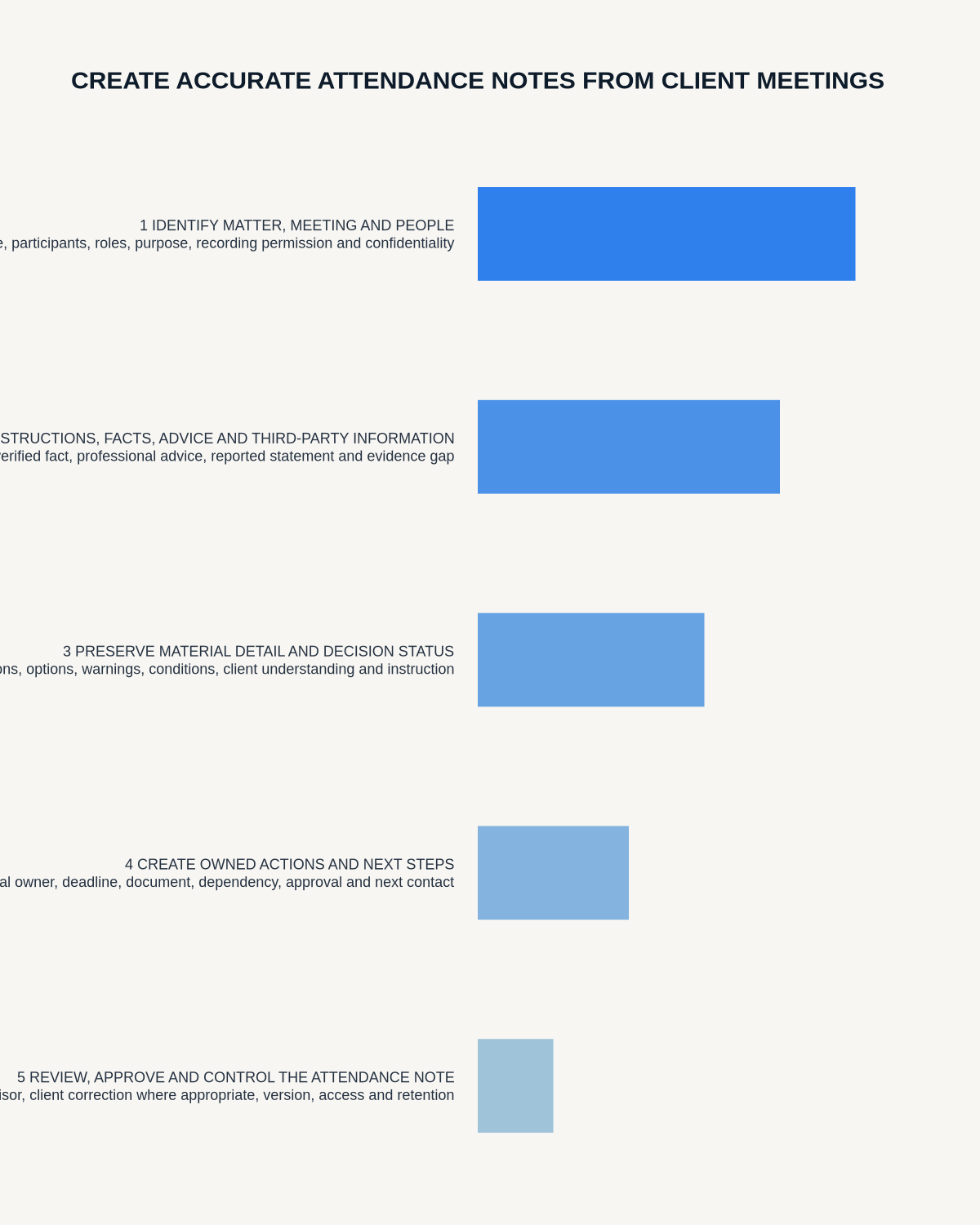
Workflow map
Visual map for How to Create Accurate Attendance Notes from Client Meetings
- Define the decisionState the question, required output and acceptance rule.
- Capture the sourceUse the approved route and preserve context, identity and limitations.
- Verify material detailsReplay or check names, numbers, negatives, decisions and actions.
- Move into the real recordAssign an owner, retain evidence and apply the deletion rule.
On this page
Related guides
See whether Halo fits this workflow
Review the NERALVO Halo specifications, included services, delivery information and current offer only after completing the guide.
Found an error or an out-of-date claim? Email support@neralvo.com with the article address and a supporting source.