The 60-second verdict
Quick answer: build a custom vocabulary list for AI transcription by selecting frequent high-impact terms, recording approved spellings and context, separating shared and restricted entries, testing representative audio and assigning an owner and review date.
Decision focus: use the method below only where it produces a recoverable source, a verifiable output and a clear next action. If one of those fails, change the workflow rather than trusting a polished summary.
Evidence basis and limits
- Decision factors covered: Choose high-value entries; Use complete glossary fields; Separate shared and restricted vocabulary.
- Evidence rule: The decision is based on the complete capture-to-action workflow, not a single feature or marketing accuracy percentage.
- Boundary: Examples and workflow recommendations must be tested with representative recordings, the intended users and the actual approval process before rollout.
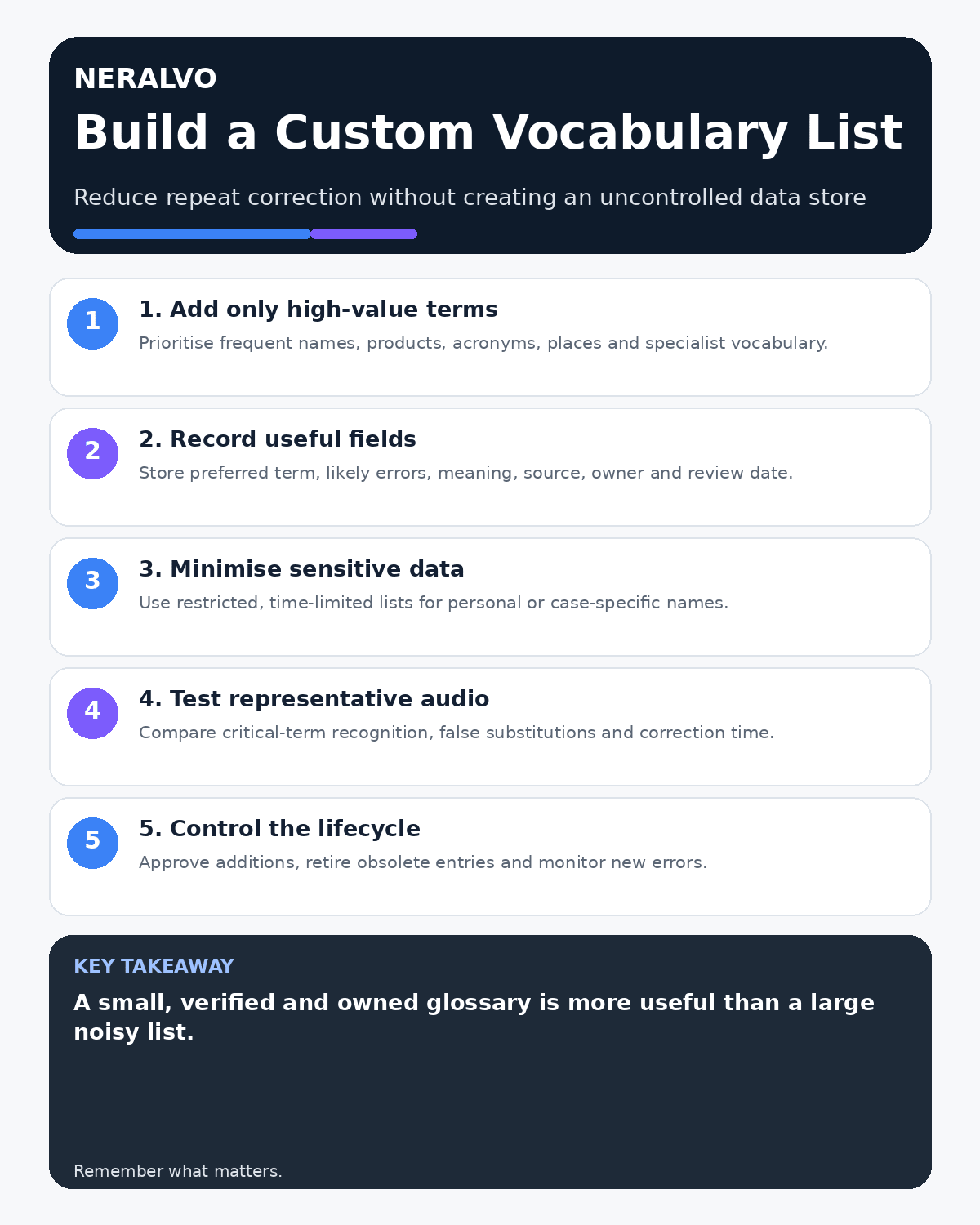
The best vocabulary list is not the largest. It is small, verified, relevant and measured. An uncontrolled glossary can create false replacements and expose unnecessary personal or confidential information.

Choose high-value entries
Prioritise terms that are frequent, important and often misheard:
- organisation and product names;
- approved acronyms and expansions;
- equipment, medicine or technical terms;
- project and service names;
- places and controlled codes;
- recurring participant names where necessary and authorised.
Avoid adding every word that appears once.
Use complete glossary fields
| Field | Purpose |
|---|---|
| Preferred term | Approved spelling or form |
| Likely errors | Common transcript variants |
| Meaning and context | Prevents the wrong substitution |
| Source | Authoritative reference |
| Owner and review date | Maintains lifecycle control |
Separate shared and restricted vocabulary
Shared entries may include brand, product and general technical terms. Customer, patient, employee, case or security-related names may require a restricted, purpose-specific list—or should not be stored at all.
Separate permanent and temporary entries
Permanent vocabulary may cover stable organisational language. Temporary lists may support a project, event or participant group. Give temporary entries an expiry date and delete them when the purpose ends.
Test effectiveness before rollout
Use representative recordings containing target terms and compare:
- critical-term recognition;
- false substitutions;
- correction time;
- consistency across speakers and environments;
- new errors introduced.
Test the exact devices, languages and processing settings used in practice.
Monitor unintended effects
A glossary may cause the system to insert a preferred term where a common word was spoken. Track false positives and remove entries that create more correction than they prevent.
Control additions and removals
Require a source and reason for material changes. Assign one owner, maintain version history and retire obsolete products, staff names and project codes.
Connect the glossary to correction data
Review recent transcript correction logs to identify repeated errors. Do not add terms based only on opinion. Measure whether the entry reduces real correction work.
Workflow choice matrix for How to Build a Custom Vocabulary List for AI Transcription
Choose the method that protects the source and reduces downstream correction. The table makes the non-hardware options explicit.
| Condition | Preferred route | Why |
|---|---|---|
| Repeatable remote work with approved integrations | Cloud software | Automation and central collaboration may outweigh device independence. |
| In-person, mobile or unreliable-connectivity work | Dedicated recorder | Independent capture and a recoverable local source are usually more resilient. |
| Recording is refused, prohibited or unnecessary | Manual notes / no recording | Respecting the boundary is the correct workflow, not a product failure. |
| High-risk or mixed work | Governed hybrid | Separate capture, review, approval and retention rather than trusting one tool. |
Frequently asked questions
Should every customer name be added?
No. Add personal names only where necessary, proportionate and appropriately restricted.
How large should the list be?
As small as possible while covering frequent, high-impact errors.
How do you know it works?
Compare critical-term accuracy, false substitutions and correction time before and after use.
Useful resources
- ICO data-minimisation guidance
- How to Correct Names and Technical Terms
- How to Benchmark AI Transcription Accuracy
- View Halo specifications against the evidence checklist
Final vocabulary checklist
- Entries frequent and high impact
- Spellings, meanings and sources verified
- Sensitive content minimised
- Temporary entries expire
- Representative testing completed
- False substitutions monitored
- Owner and review date assigned
On this page
Related guides
See whether Halo fits this workflow
Review the NERALVO Halo specifications, included services, delivery information and current offer only after completing the guide.
Found an error or an out-of-date claim? Email support@neralvo.com with the article address and a supporting source.