The 60-second verdict
Quick answer: correct names, acronyms and technical terms in AI transcripts by building an authoritative terminology list, searching for phonetic and partial variants, checking each replacement in context and keeping source correction separate from editorial rewriting.
Decision focus: use the method below only where it produces a recoverable source, a verifiable output and a clear next action. If one of those fails, change the workflow rather than trusting a polished summary.
Evidence basis and limits
- Decision factors covered: Build the correction list before review; Classify the term; Search for likely variants.
- Evidence rule: Claims are weighted by consequence: capture failure, changed meaning, access and recovery matter more than polished wording.
- Boundary: Examples and workflow recommendations must be tested with representative recordings, the intended users and the actual approval process before rollout.
These errors are high impact because a polished transcript can still identify the wrong person, product, medicine, component or technical concept.

Build the correction list before review
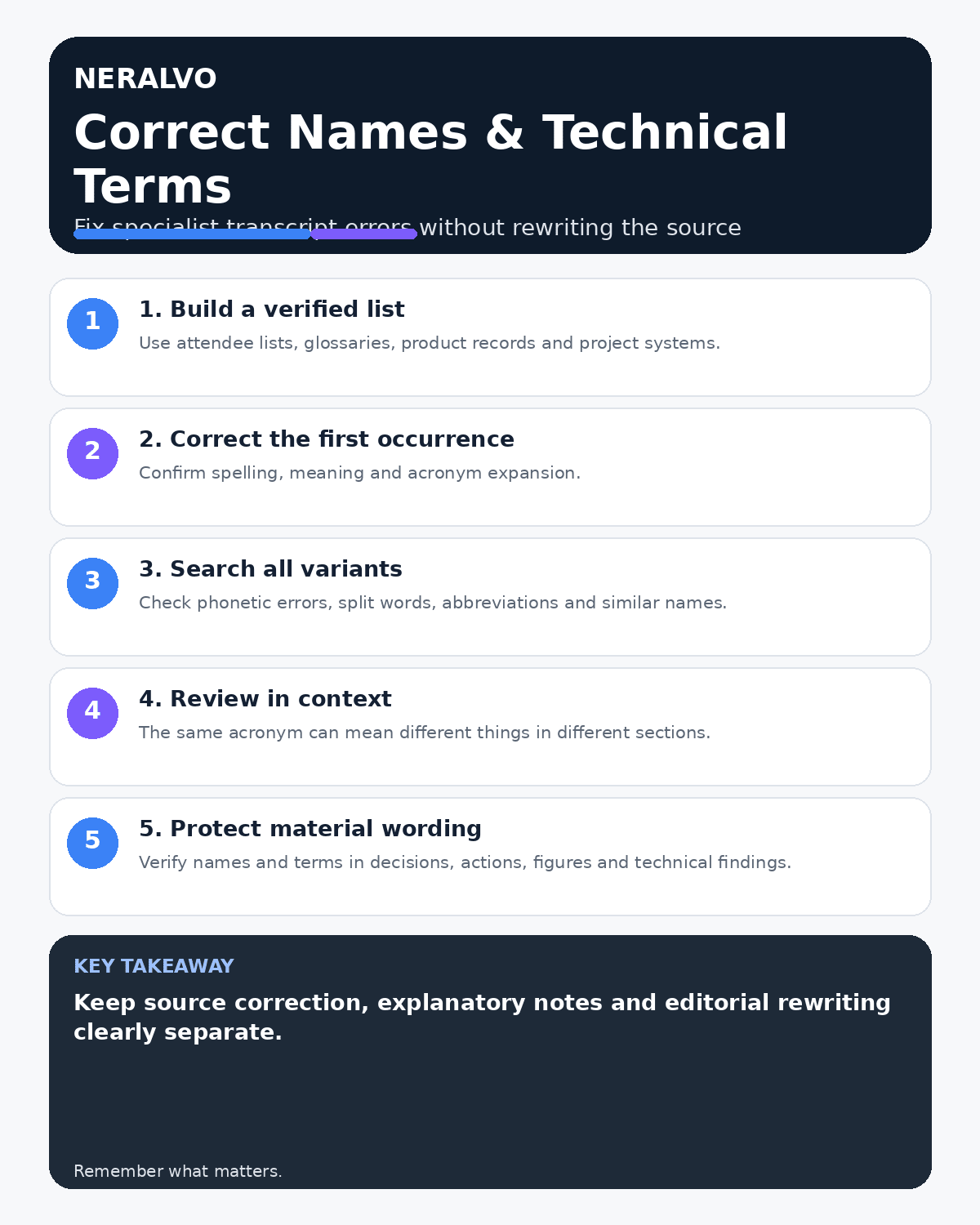
Collect expected participant names, organisations, project codes, products, acronyms, places and specialist vocabulary. Use authoritative sources such as the attendee list, company directory, controlled glossary, product documentation or project system.
Classify the term
- Person or organisation: verify spelling and identity.
- Acronym: verify expansion and context.
- Product or component: verify model and version.
- Specialist term: verify meaning and approved usage.
- Code or identifier: verify characters, punctuation and case.
Search for likely variants
- phonetic fragments;
- common substitutions;
- partial acronyms;
- split or joined words;
- similar participant names;
- abbreviated forms;
- singular and plural variants.
One global replacement rarely catches every error.
Check context before replacing
The same abbreviation may have several meanings, and two people may have similar names. Confirm the sentence, speaker, topic and source before replacing every occurrence. A correctly spelled term can still be the wrong term.
Separate correction from explanation
- Correction: restores what was actually said.
- Expansion: explains an acronym for the audience.
- Editorial rewrite: changes structure or wording for readability.
- Analyst note: adds context not spoken in the source.
Keep these changes visible. Do not silently polish source speech into preferred terminology.
Prioritise material wording
Check terms carefully in decisions, contracts, technical findings, medicine or equipment names, quotations, actions and ownership. One changed noun can alter who owns the work or what was approved.
Use a controlled correction log
Record transcript version, timestamp, machine wording, approved wording, source, reviewer and date for material changes. This supports later reprocessing and quality review.
Maintain a terminology list
For recurring entries, record preferred term, common errors, meaning, source, owner, sensitivity and review date. Remove obsolete staff names, products and project codes.
Do not place unnecessary customer, patient, employee or case details in a widely shared glossary.
Workflow choice matrix for How to Correct Names, Acronyms and Technical Terms in AI Transcripts
Choose the method that protects the source and reduces downstream correction. The table makes the non-hardware options explicit.
| Condition | Preferred route | Why |
|---|---|---|
| High-risk or mixed work | Governed hybrid | Separate capture, review, approval and retention rather than trusting one tool. |
| Recording is refused, prohibited or unnecessary | Manual notes / no recording | Respecting the boundary is the correct workflow, not a product failure. |
| In-person, mobile or unreliable-connectivity work | Dedicated recorder | Independent capture and a recoverable local source are usually more resilient. |
| Repeatable remote work with approved integrations | Cloud software | Automation and central collaboration may outweigh device independence. |
Frequently asked questions
Should every acronym be expanded?
Expand it where the audience needs the meaning, while preserving the source wording in the transcript.
Can global find-and-replace be used?
Only after confirming that the term has the same meaning in every occurrence.
Should grammar be improved at the same time?
Not silently in the source transcript. Keep correction and editorial rewriting separate.
Useful resources
- GOV.UK guidance on clear terminology
- How to Build a Custom Vocabulary List
- How to Compare Transcript Versions
- Check whether NERALVO Halo fits this workflow
Final terminology checklist
- Authoritative spelling confirmed
- Likely variants searched
- Each replacement checked in context
- Source and editorial changes separated
- Material terms checked against audio
- Correction history and glossary maintained
On this page
Related guides
See whether Halo fits this workflow
Review the NERALVO Halo specifications, included services, delivery information and current offer only after completing the guide.
Found an error or an out-of-date claim? Email support@neralvo.com with the article address and a supporting source.