The 60-second verdict
Quick answer: create an evidence matrix by defining the question first, linking every claim or theme to checked supporting and contrary passages, separating source evidence from analyst interpretation and assigning an owner and deadline to every material evidence gap.
Decision focus: use the method below only where it produces a recoverable source, a verifiable output and a clear next action. If one of those fails, change the workflow rather than trusting a polished summary.
Evidence basis and limits
- Decision factors covered: Design balanced matrix fields; Correct quotations against the audio; Keep evidence and interpretation separate.
- Evidence rule: The decision is based on the complete capture-to-action workflow, not a single feature or marketing accuracy percentage.
- Boundary: Examples and workflow recommendations must be tested with representative recordings, the intended users and the actual approval process before rollout.
An evidence matrix prevents a conclusion from being built on the most memorable quotation. It lets reviewers see how the interpretation was reached and which material challenges remain unresolved.

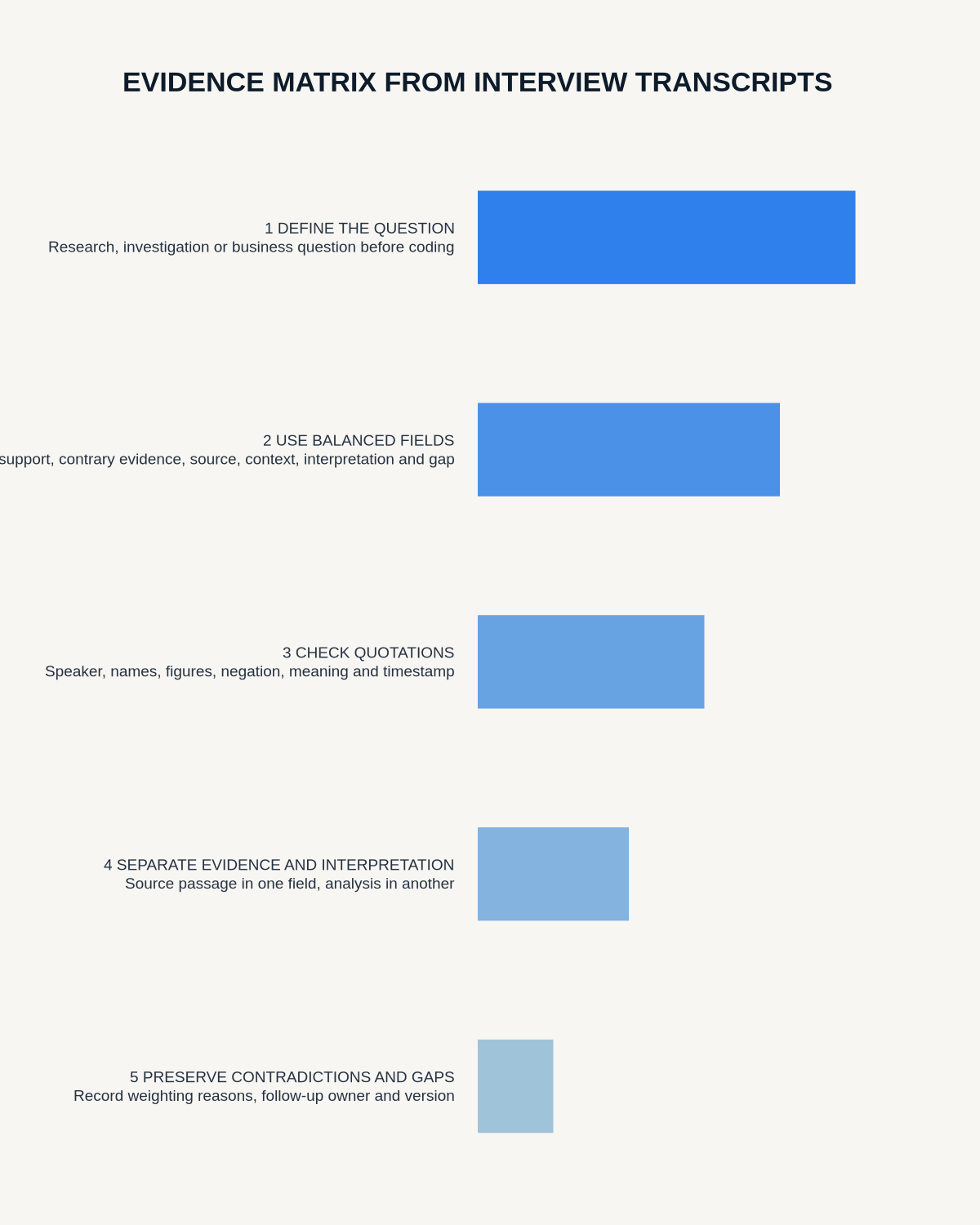
Begin with a defined question
State the research, investigation or business question before coding. A broad topic encourages vague themes; a clear question makes relevance and gaps easier to judge.
Design balanced matrix fields
- Claim or theme: proposition being assessed.
- Supporting evidence: timestamped passages and other sources.
- Contrary evidence: material that weakens or challenges the claim.
- Source status: direct, reported, documentary or verified.
- Context: role, period, setting and limitations.
- Analyst interpretation: reasoned meaning kept separate from quotation.
- Gap: evidence or interview still required.
Correct quotations against the audio
Check speaker identity, names, figures, negative wording and material language. Preserve uncertainty and incomplete speech. Grammar editing must not make the speaker more certain than the source.
Keep evidence and interpretation separate
Store the participant’s words or a close source-labelled paraphrase in one field and analysis in another. This allows reviewers to challenge the interpretation without losing the original evidence.
Weight evidence transparently
Frequency is not the same as importance or truth. Consider role and basis of knowledge, first- or second-hand status, timing, consistency with documents, recruitment limitations, missing perspectives and incentives. Record why a source received greater or lower weight.
Preserve contradictions
Do not average opposing accounts into a neutral-sounding summary. Show the disagreement, source and evidence needed to resolve it. Where it remains unresolved, preserve the uncertainty in the conclusion.
Use a gap register
Convert missing evidence into specific follow-up actions with owner, source and deadline. A matrix is most useful when it reveals what new information could change the conclusion.
Control versions and access
Record transcript version, coding date, analyst and reviewer. Restrict sensitive interviews and use de-identified extracts where possible. Preserve required audit history while marking superseded versions clearly.
Workflow choice matrix for How to Create an Evidence Matrix from Interview Transcripts
Choose the method that protects the source and reduces downstream correction. The table makes the non-hardware options explicit.
| Condition | Preferred route | Why |
|---|---|---|
| Repeatable remote work with approved integrations | Cloud software | Automation and central collaboration may outweigh device independence. |
| In-person, mobile or unreliable-connectivity work | Dedicated recorder | Independent capture and a recoverable local source are usually more resilient. |
| Recording is refused, prohibited or unnecessary | Manual notes / no recording | Respecting the boundary is the correct workflow, not a product failure. |
| High-risk or mixed work | Governed hybrid | Separate capture, review, approval and retention rather than trusting one tool. |
Frequently asked questions
Should every quotation be copied in full?
No. Use relevant extracts with timestamps and enough context to protect meaning.
Can AI choose which evidence is strongest?
It can organise passages, but evidence quality and relevance require transparent human judgement.
What if contradictory evidence cannot be resolved?
Keep the uncertainty visible in the matrix and conclusion.
Useful resources
- UKRI research-data guidance
- Research Transcription with AI
- AI Voice Recorder for Research Interviews
- How to Create an Executive Briefing
Final evidence checklist
- Question clearly defined
- Quotations checked against audio
- Evidence and interpretation separate
- Contrary evidence included
- Weighting transparent
- Gaps have owners and follow-up routes
On this page
Related guides
See whether Halo fits this workflow
Review the NERALVO Halo specifications, included services, delivery information and current offer only after completing the guide.
Found an error or an out-of-date claim? Email support@neralvo.com with the article address and a supporting source.