The 60-second verdict
Quick answer: create an executive briefing from multiple recordings by starting with one decision question, comparing every source against the same evidence questions, separating verified facts from estimates and views, preserving material contradictions and presenting a small number of credible options with an evidence appendix.
Decision focus: use the method below only where it produces a recoverable source, a verifiable output and a clear next action. If one of those fails, change the workflow rather than trusting a polished summary.
Evidence basis and limits
- Decision factors covered: Label evidence quality; Preserve contradictions; Compare options consistently.
- Evidence rule: The decision is based on the complete capture-to-action workflow, not a single feature or marketing accuracy percentage.
- Boundary: Examples and workflow recommendations must be tested with representative recordings, the intended users and the actual approval process before rollout.
An executive briefing should help a senior reader make one defined decision. It should not force them to read several meeting summaries or hide disagreement behind a polished narrative.

Start with the decision question
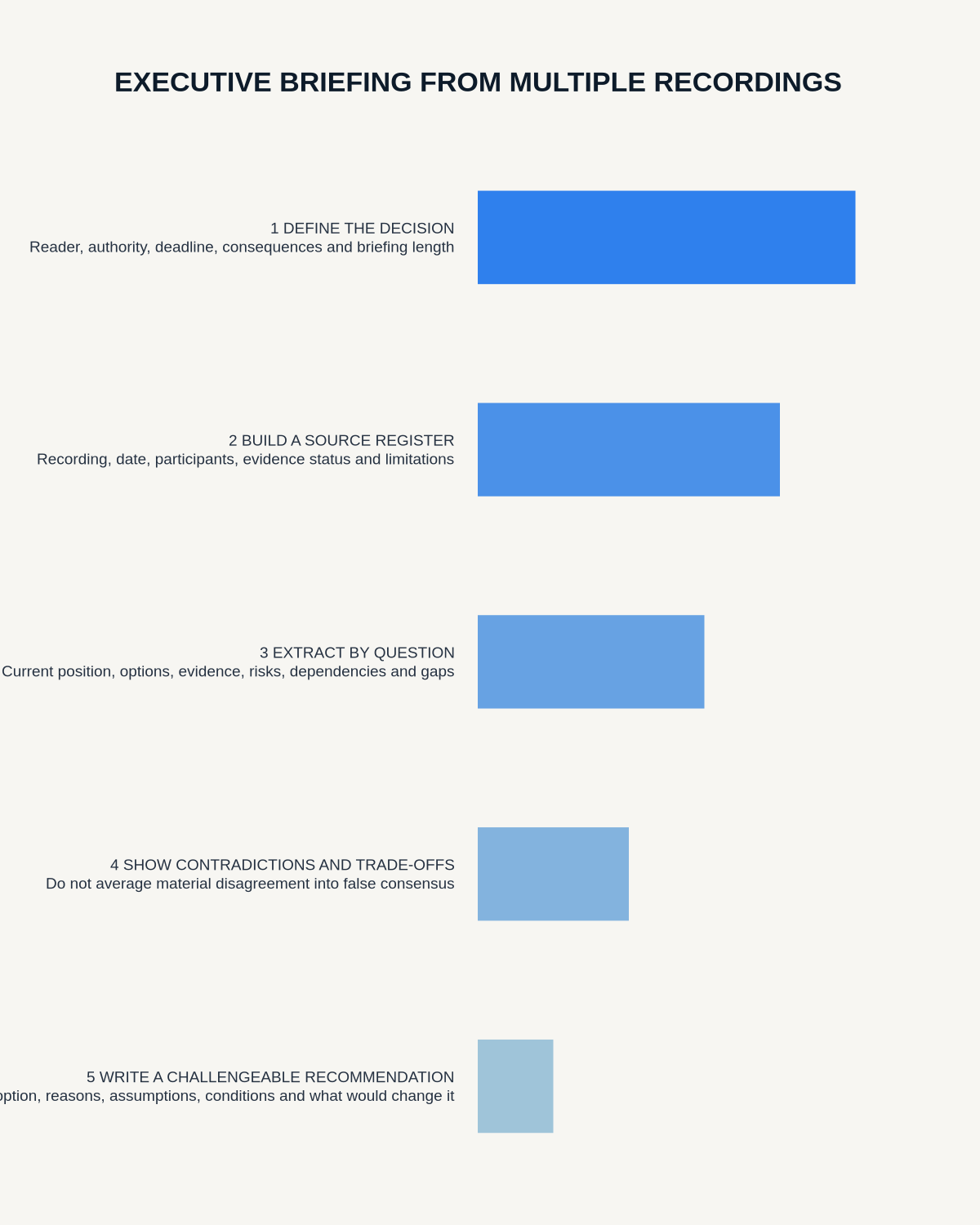
Write the required decision in one sentence. Define the reader, authority, deadline, consequences of delay, expected length and any restricted evidence. Material belongs because it affects the decision—not because somebody mentioned it.
Build a source register
- Source reference, date and purpose
- Participants and relevant authority
- Information or evidence status
- Limitations and missing perspectives
- Current version and access classification
This exposes outdated sources and evidence gaps before drafting begins.
Extract by question, not by meeting
Do not stitch together one summary per recording. Compare every source against the same questions:
- What is the current position?
- What outcome is required?
- What evidence supports each option?
- Where do sources agree or disagree?
- What risks and dependencies exist?
- What remains unknown?
Label evidence quality
- Verified fact: supported by an approved document, measurement or reliable record.
- Estimate: a forecast with stated assumptions.
- Stakeholder view: judgement, preference or experience.
- Analyst interpretation: the author’s reasoned conclusion.
Confident speech is not proof. Link material claims to timestamps, documents or data.
Preserve contradictions
State the competing claims, supporting sources, type of disagreement, decision impact, evidence needed to resolve it and whether a safe decision can still be made. Do not average incompatible positions into “mostly ready.”
Compare options consistently
Present a small number of credible options, including delay or no action where relevant. Apply the same criteria: expected benefit, cost, resource, risk, dependencies, evidence strength, reversibility, timing and consequence of delay.
Write a challengeable recommendation
State the preferred option, reasons, assumptions, dissent and conditions that would change the recommendation. When evidence is weak, recommend a staged decision, limited test or further verification.
Use a concise executive structure
- Decision required
- Recommended position
- Evidence-backed reasons
- Material uncertainty and dissent
- Options and trade-offs
- Risks and dependencies
- Immediate actions
- Evidence appendix
Protect confidential source material
Do not circulate raw recordings merely because they informed the briefing. Use the minimum evidence needed, remove irrelevant personal information and preserve source access restrictions.
Workflow choice matrix for How to Create an Executive Briefing from Multiple Recordings
Choose the method that protects the source and reduces downstream correction. The table makes the non-hardware options explicit.
| Condition | Preferred route | Why |
|---|---|---|
| Repeatable remote work with approved integrations | Cloud software | Automation and central collaboration may outweigh device independence. |
| In-person, mobile or unreliable-connectivity work | Dedicated recorder | Independent capture and a recoverable local source are usually more resilient. |
| Recording is refused, prohibited or unnecessary | Manual notes / no recording | Respecting the boundary is the correct workflow, not a product failure. |
| High-risk or mixed work | Governed hybrid | Separate capture, review, approval and retention rather than trusting one tool. |
Frequently asked questions
Should every meeting receive its own summary?
Not for an executive briefing. Extract each source against the same decision questions.
Can disagreement be removed to keep it short?
No. Material disagreement may change the decision and must remain visible.
How long should the main briefing be?
Only as long as needed to explain the decision, evidence, options, uncertainty and action. Put detailed traceability in the appendix.
Useful resources
- Association for Project Management decision-making guidance
- How to Create an Evidence Matrix from Interview Transcripts
- How to Audit AI Meeting Summaries
- How to Build a Decision-to-Action Audit Trail
Final briefing checklist
- Every section supports the decision
- Facts separated from estimates and views
- Material claims traceable
- Contradictions and missing voices visible
- Options compared consistently
- Actions assigned to named owners
On this page
Related guides
See whether Halo fits this workflow
Review the NERALVO Halo specifications, included services, delivery information and current offer only after completing the guide.
Found an error or an out-of-date claim? Email support@neralvo.com with the article address and a supporting source.