The 60-second verdict
Quick answer: handle code-switching in AI transcripts by documenting expected languages, preserving the original mixed-language wording, applying consistent speaker and language labels, controlling names and specialist terminology through a glossary and using competent bilingual review for important or uncertain passages.
Decision focus: use the method below only where it produces a recoverable source, a verifiable output and a clear next action. If one of those fails, change the workflow rather than trusting a polished summary.
Evidence basis and limits
- Decision factors covered: Identify the expected language mix; Improve capture and attribution; Use consistent language labels.
- Evidence rule: A claim earns weight only when the source, date, configuration and limitation are clear enough for a reader to check.
- Boundary: Examples and workflow recommendations must be tested with representative recordings, the intended users and the actual approval process before rollout.
Code-switching may carry meaning, emphasis, identity or technical precision. Forcing every contribution into one language can produce a fluent transcript that no longer represents what the speaker said.

Identify the expected language mix
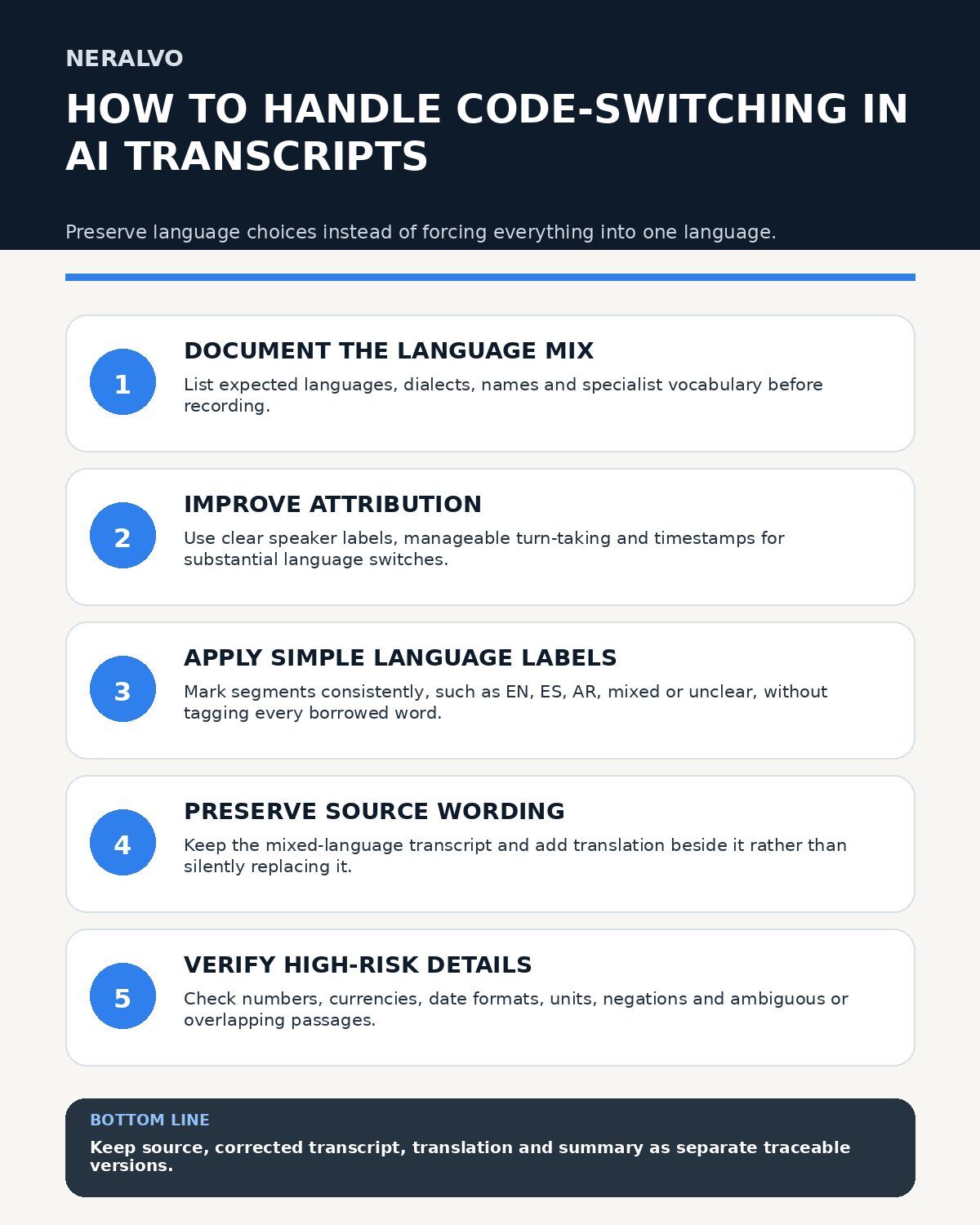
List likely languages, dialects, names and specialist vocabulary before recording. Ask how participants prefer names, titles and technical terms to be written. Prepare a glossary for recurring terms and abbreviations.
Do not assume every switch is accidental. A speaker may quote someone, use an established technical term, express a culturally specific idea or signal emphasis.
Improve capture and attribution
State the meeting reference, speakers and expected languages at the start. Use role labels when names should be minimised. Encourage one speaker at a time where practical because overlapping mixed-language speech is particularly difficult to recover.
Add a spoken marker or timestamp when a substantial switch occurs without forcing speakers to interrupt every borrowed phrase.
Use consistent language labels
- [EN] for English
- [ES] for Spanish
- [AR] for Arabic
- [mixed] for a short combined segment
- [unclear language] when identification needs review
Place labels at the beginning of the relevant segment rather than before every borrowed word. Include timestamps for passages requiring bilingual review.
Preserve the original wording
Keep the original mixed-language text in the source transcript and add translation beside it where needed. Do not silently replace the source with normalised or more formal wording.
Grammar cleanup can remove nuance or make a contribution appear more certain. Distinguish edited text from verbatim source.
Control names and borrowed terms
Maintain glossary entries with source term, language, approved spelling, translation or explanation, context, reviewer and date. Use the same approved term in the transcript, summary and action list.
Some terms should remain untranslated. Verify product names, legal terms, organisations and places through an authoritative source or the speaker where possible.
Protect numbers, dates and negations
Check currencies, decimal separators, date order, units, phone numbers, references and phrases meaning “not,” “never,” “without” or “unless.” Write dates unambiguously where audiences use different conventions.
Add context when literal translation misleads
Preserve idioms, jokes and culturally specific phrases in the source and add a concise translator note. Keep interpretation separate. When meaning is uncertain, request clarification rather than choosing a convenient translation.
Handle overlap and unclear speech honestly
Use timestamps and separate speaker lines. Mark overlapping or inaudible speech instead of creating a complete sentence from fragments. For an important unclear passage, return to the speaker or a competent bilingual reviewer and record any amendment transparently.
Apply proportionate human review
Routine internal notes may need focused checks of decisions, actions and terminology. Legal, medical, contractual, safeguarding, disciplinary or public-facing material may require a qualified or otherwise competent bilingual reviewer.
Review source alignment, terminology, speaker attribution, status, uncertainty, numbers and negations. Fluency alone is not enough.
Keep derived outputs traceable
Link important points in a single-language summary to the timestamp or section in the mixed-language source. Label translated quotations and paraphrases. Store original transcript, corrected transcript, translation and summary as separate controlled versions.
Workflow choice matrix for How to Handle Code-Switching in AI Transcripts and Mixed-Language Meetings
Choose the method that protects the source and reduces downstream correction. The table makes the non-hardware options explicit.
| Condition | Preferred route | Why |
|---|---|---|
| High-risk or mixed work | Governed hybrid | Separate capture, review, approval and retention rather than trusting one tool. |
| Recording is refused, prohibited or unnecessary | Manual notes / no recording | Respecting the boundary is the correct workflow, not a product failure. |
| In-person, mobile or unreliable-connectivity work | Dedicated recorder | Independent capture and a recoverable local source are usually more resilient. |
| Repeatable remote work with approved integrations | Cloud software | Automation and central collaboration may outweigh device independence. |
Frequently asked questions
Should every borrowed word receive a language label?
No. Label meaningful segments consistently without making the transcript unreadable.
Can AI identify every language switch?
No. Unfamiliar dialects, overlap and short phrases may require human checking.
Should grammar be standardised?
Only in a clearly labelled edited version. Preserve the source transcript separately.
What should happen when the meaning remains uncertain?
Mark the uncertainty, add a timestamp and obtain clarification or bilingual review.
Useful resources
- Chartered Institute of Linguists
- How to Create Bilingual Meeting Notes from One Recording
- Apply this guide before assessing NERALVO Halo
Code-switching checklist
- Expected languages documented
- Speakers and switches labelled
- Original wording preserved
- Glossary applied
- Numbers, dates and negations checked
- Ambiguity and overlap marked honestly
- High-risk passages reviewed bilingually
- Derived outputs remain traceable
Related AI voice recorder guides
On this page
Related guides
See whether Halo fits this workflow
Review the NERALVO Halo specifications, included services, delivery information and current offer only after completing the guide.
Found an error or an out-of-date claim? Email support@neralvo.com with the article address and a supporting source.