The 60-second verdict
Quick answer: record multilingual team meetings responsibly by planning languages and interpretation in advance, explaining recording in terms each participant understands, preserving the original source-language record, labelling speakers and language changes and confirming decisions and actions across language versions before the meeting ends.
Decision focus: use the method below only where it produces a recoverable source, a verifiable output and a clear next action. If one of those fails, change the workflow rather than trusting a polished summary.
Evidence basis and limits
- Decision factors covered: Plan the language setup; Explain recording accessibly; Define the interpreter’s role.
- Evidence rule: Claims are weighted by consequence: capture failure, changed meaning, access and recovery matter more than polished wording.
- Boundary: Examples and workflow recommendations must be tested with representative recordings, the intended users and the actual approval process before rollout.
Recording first and translating later is not enough. The meeting process must protect accurate meaning, equal participation, confidentiality and a traceable relationship between source speech and translated notes.

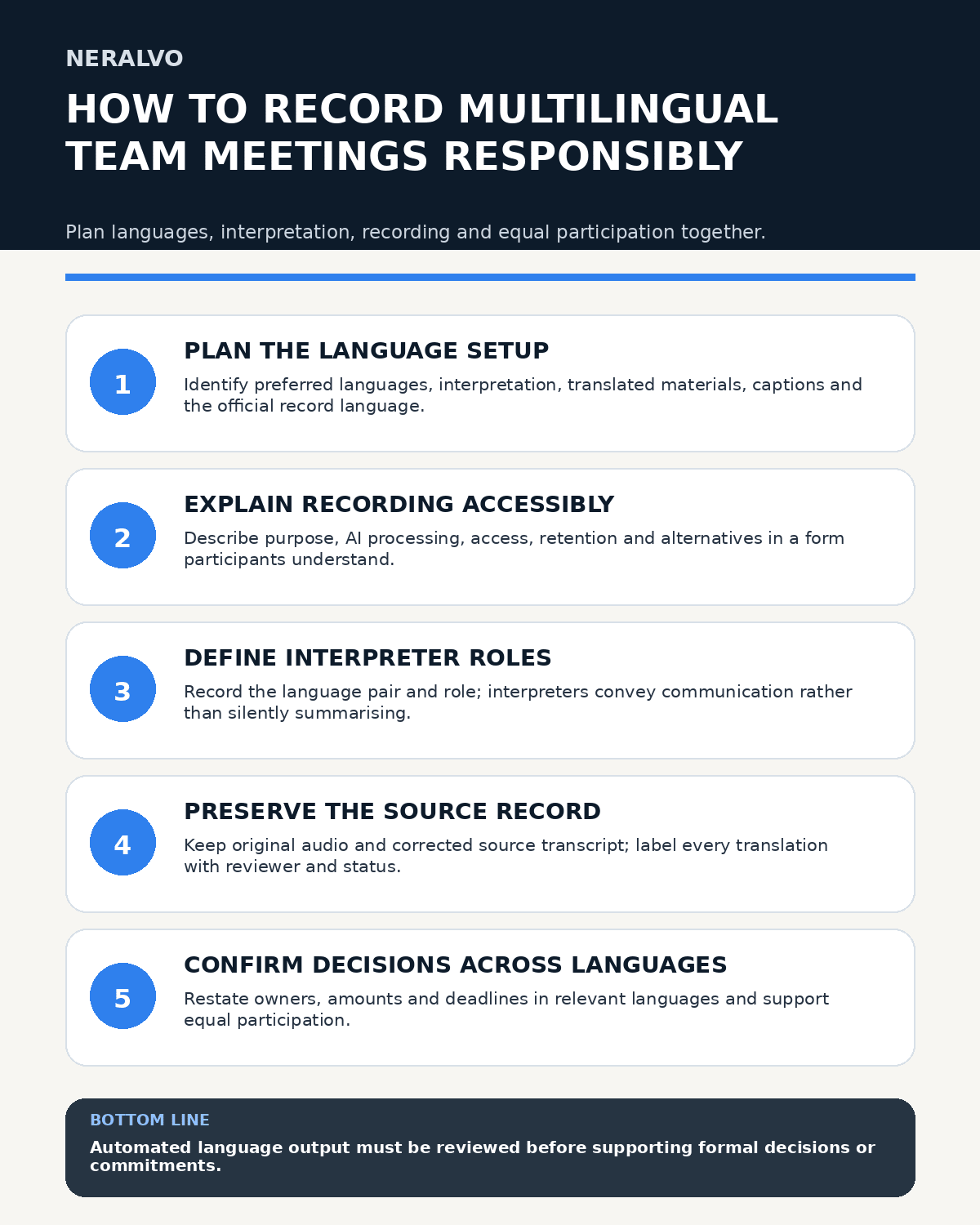
Plan the language setup
Identify expected languages, each participant’s preferred language and any need for interpretation, translated agendas, captions or additional processing time. Do not assume conversational fluency is enough for technical or high-stakes discussion.
Decide which language controls the official record, whether bilingual notes are required and who will review translations. Prepare a glossary of names, organisations, technical terms and abbreviations.
Explain recording accessibly
Provide the purpose, recording scope, AI processing, access, retention and alternatives in a language and format participants can understand. Asking for clarification should not disadvantage anyone.
Follow the organisation’s participant-information, confidentiality and data-protection process. A generic notice in only one language may not be meaningful.
Define the interpreter’s role
Record the interpreter’s approved identifier, language pair and role. The interpreter should convey communication rather than silently summarise, correct or answer for the speaker.
Complete any required qualification, independence or conflict check. Ask participants to address one another directly and speak in manageable segments.
Improve speaker and language attribution
Use clear speaker names or role labels. Mark substantial language changes verbally or with timestamps. In larger meetings, the chair should invite one person at a time and repeat critical decisions in a controlled format.
Test microphone placement before substantive discussion. Paper, ventilation and equipment noise can make quieter interpreted speech difficult to recover.
Preserve the source-language record
Keep the original audio and corrected source transcript. A translation is a derived document, not a replacement. Label each version with language, reviewer, date and status.
Correct names, places, numbers, terminology and negations in the source before translation. Translating an incorrect transcript compounds the error.
Translate meaning, status and uncertainty
Machine translation may struggle with idioms, politeness, dialect, humour and indirect disagreement. Preserve whether a statement is:
- a fact or reported account;
- a question or request;
- a proposal or approved decision;
- a firm commitment or intention;
- certain, qualified or disputed.
Do not turn culturally indirect language into a stronger promise. Mark ambiguity for human review.
Confirm decisions and actions across languages
Before closing, restate critical decisions, actions, owners, amounts and deadlines in the relevant languages. Give participants an opportunity to correct the record.
Use matching action identifiers across versions. Where a term has no direct equivalent, retain the source term and provide an agreed explanation.
Protect equal participation
Interpreted discussion takes longer. Build enough time into the agenda and avoid side conversations that exclude some participants. Ensure papers, slides and chat are available in appropriate formats.
Do not treat silence as agreement. Offer translated written comments, a smaller follow-up or another interpreted route where needed.
Use a controlled post-meeting workflow
- Transfer audio to the approved workspace.
- Create and correct the source-language transcript.
- Apply speaker and language labels.
- Generate translation using the approved glossary and brief.
- Review high-risk sections with a competent bilingual reviewer.
- Align decisions and actions across versions.
- Approve and issue accessible versions.
- Delete unnecessary working copies under the retention policy.
Workflow choice matrix for How to Record Multilingual Team Meetings Responsibly and Accurately
Choose the method that protects the source and reduces downstream correction. The table makes the non-hardware options explicit.
| Condition | Preferred route | Why |
|---|---|---|
| High-risk or mixed work | Governed hybrid | Separate capture, review, approval and retention rather than trusting one tool. |
| Recording is refused, prohibited or unnecessary | Manual notes / no recording | Respecting the boundary is the correct workflow, not a product failure. |
| In-person, mobile or unreliable-connectivity work | Dedicated recorder | Independent capture and a recoverable local source are usually more resilient. |
| Repeatable remote work with approved integrations | Cloud software | Automation and central collaboration may outweigh device independence. |
Frequently asked questions
Should the interpreter be identified in the record?
Use the organisation’s approved identifier and record the language pair and role.
Can one language version be treated as a summary of the other?
Only when that is explicitly intended and labelled. Formal bilingual records should align on substantive decisions and actions.
Can AI translation be issued without review?
Not for important professional use. Check terminology, status, amounts, dates and negations.
How can equal participation be supported?
Allow more time, provide accessible materials and offer interpreted or translated follow-up routes.
Useful resources
- Chartered Institute of Linguists
- How to Create Bilingual Meeting Notes from One Recording
- Check whether NERALVO Halo fits this workflow
Multilingual-meeting checklist
- Languages, formats and interpreter needs planned
- Recording explained understandably
- Speakers, interpreters and language changes attributed
- Source-language record preserved
- Terminology, numbers and negations checked
- Decisions and actions aligned across languages
- Equal participation and follow-up supported
- Versions, access and retention controlled
Related AI voice recorder guides
On this page
Related guides
See whether Halo fits this workflow
Review the NERALVO Halo specifications, included services, delivery information and current offer only after completing the guide.
Found an error or an out-of-date claim? Email support@neralvo.com with the article address and a supporting source.