The 60-second verdict
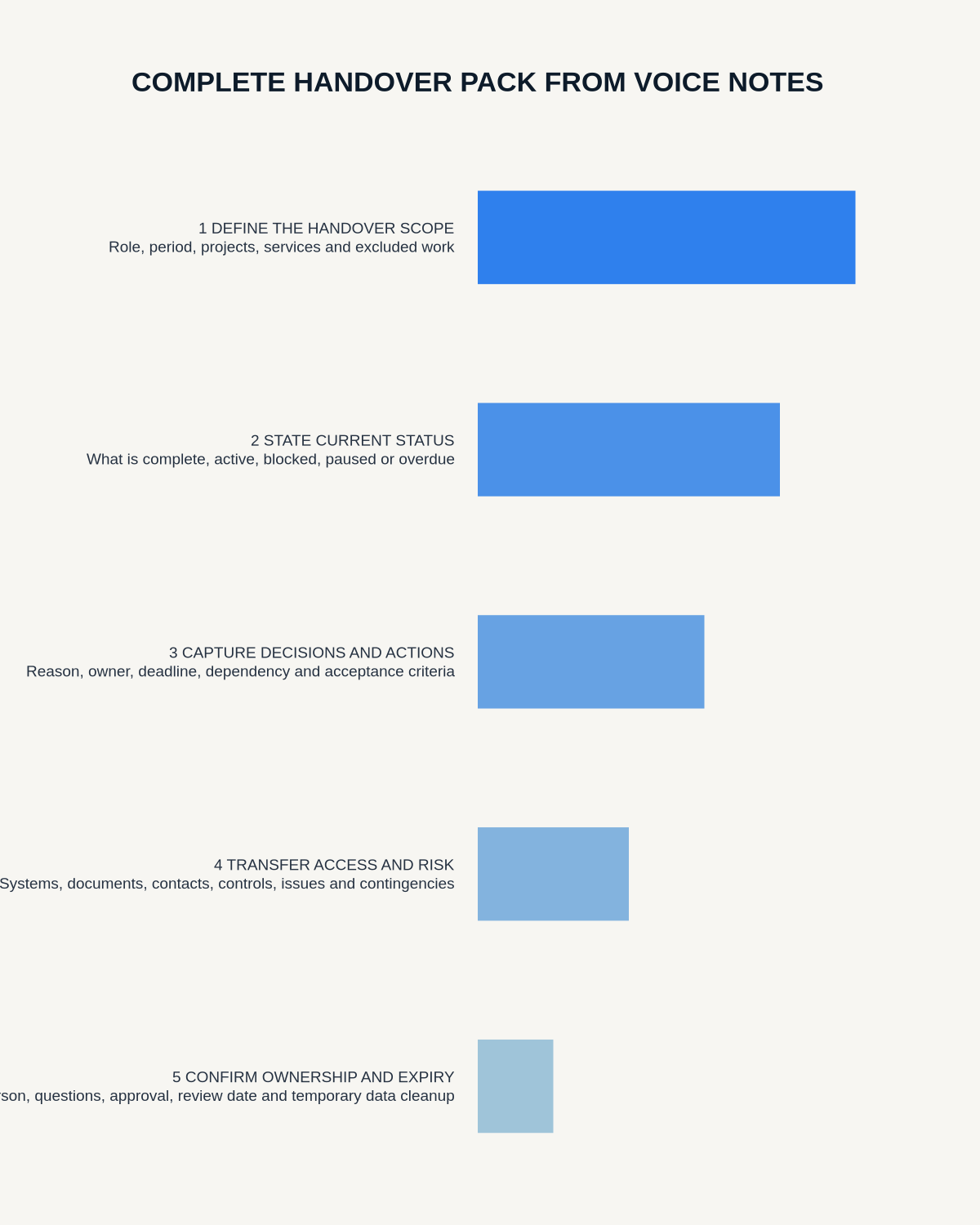
Quick answer: create a complete handover pack by defining the receiver and decision date, inventorying every source, documenting current status and accepted work, separating open actions from risks and assumptions, and testing whether the incoming owner can operate without relying on the outgoing person’s memory.
Decision focus: use the method below only where it produces a recoverable source, a verifiable output and a clear next action. If one of those fails, change the workflow rather than trusting a polished summary.
Evidence basis and limits
- Decision factors covered: Define the handover contract; Document current status honestly; Separate open record types.
- Evidence rule: A claim earns weight only when the source, date, configuration and limitation are clear enough for a reader to check.
- Boundary: Examples and workflow recommendations must be tested with representative recordings, the intended users and the actual approval process before rollout.
A collection of recordings is not a handover. The receiver needs a controlled, current and navigable package that shows what is true now, what remains uncertain and what must happen next.

Define the handover contract
State what is being transferred, the outgoing and incoming owners, effective date, included systems and excluded areas. Define what acceptance means and who can approve it.
Create a source inventory
- Current plans, schedules and specifications
- Decision and change logs
- Risk, issue and dependency registers
- Contracts, approvals and commitments
- Operational procedures and support contacts
- Data, reports, drawings and configurations
- Recordings and verified summaries still required
Record version, owner, location, access and status. Remove duplicates and superseded drafts.
Document current status honestly
Show completed and accepted, completed but awaiting acceptance, in progress, blocked, deferred, rejected and superseded work separately. A positive narrative should not hide unresolved defects or conditions.
Separate open record types
- Action: task, owner, deadline and acceptance criterion.
- Risk: uncertain future event and control.
- Issue: current problem requiring resolution.
- Dependency: external input or condition.
- Assumption: unverified belief affecting the plan.
- Decision: authorised outcome and rationale.
Include practical operating knowledge
Document recurring routines, calendars, suppliers, escalation routes, common failure modes and recovery steps. Do not record passwords, secret keys or security answers; point to the approved credential system.
Build a controlled briefing
Use the recordings to explain context, but verify names, dates, commitments, figures and status against authoritative records. Link important points to source files without copying every discussion into the pack.
Run an acceptance test
- The incoming owner locates critical records.
- They explain current status and priorities.
- They identify urgent actions, risks and dependencies.
- They complete a representative routine or decision.
- Access gaps and missing context are recorded.
- Acceptance or conditional acceptance is signed.
Control the transition period
Define overlap, support availability, decision authority and the date the outgoing owner’s role ends. Track remaining gaps with owners and deadlines.
Workflow choice matrix for How to Create a Complete Handover Pack from Voice Notes
Choose the method that protects the source and reduces downstream correction. The table makes the non-hardware options explicit.
| Condition | Preferred route | Why |
|---|---|---|
| High-risk or mixed work | Governed hybrid | Separate capture, review, approval and retention rather than trusting one tool. |
| Recording is refused, prohibited or unnecessary | Manual notes / no recording | Respecting the boundary is the correct workflow, not a product failure. |
| In-person, mobile or unreliable-connectivity work | Dedicated recorder | Independent capture and a recoverable local source are usually more resilient. |
| Repeatable remote work with approved integrations | Cloud software | Automation and central collaboration may outweigh device independence. |
Frequently asked questions
Should raw recordings be included?
Only where there is a defined need. A verified, structured pack is normally more usable.
Can a handover be accepted with open actions?
Yes, when they are visible, owned and the residual risk is accepted.
What proves the handover worked?
The incoming owner can locate evidence, operate the process and manage open work without hidden dependency on the previous owner.
Useful resources
- Association for Project Management handover guidance
- AI Voice Recorder for Shift Handovers
- How to Create a RACI Matrix
- How to Create an Issue Log
Final handover checklist
- Scope, receiver and effective date clear
- Current sources version-controlled
- Status and outstanding work honest
- Credentials excluded
- Incoming owner tested the pack
- Acceptance and residual actions recorded
On this page
Related guides
See whether Halo fits this workflow
Review the NERALVO Halo specifications, included services, delivery information and current offer only after completing the guide.
Found an error or an out-of-date claim? Email support@neralvo.com with the article address and a supporting source.