The 60-second verdict
Quick answer: build a RACI matrix from meeting recordings by defining the work packages first, extracting candidate ownership from checked statements, separating suggestion from acceptance, resolving missing or competing accountability and confirming every role with the people named.
Decision focus: use the method below only where it produces a recoverable source, a verifiable output and a clear next action. If one of those fails, change the workflow rather than trusting a polished summary.
Evidence basis and limits
- Decision factors covered: Start with work, not names; Apply the four roles precisely; Extract candidate ownership from the recording.
- Evidence rule: Claims are weighted by consequence: capture failure, changed meaning, access and recovery matter more than polished wording.
- Boundary: Examples and workflow recommendations must be tested with representative recordings, the intended users and the actual approval process before rollout.
Ownership problems often begin with language that sounds committed but names nobody. “We will handle it” and “finance should review” are not dependable assignments until the work, authority and role are explicit.

Start with work, not names
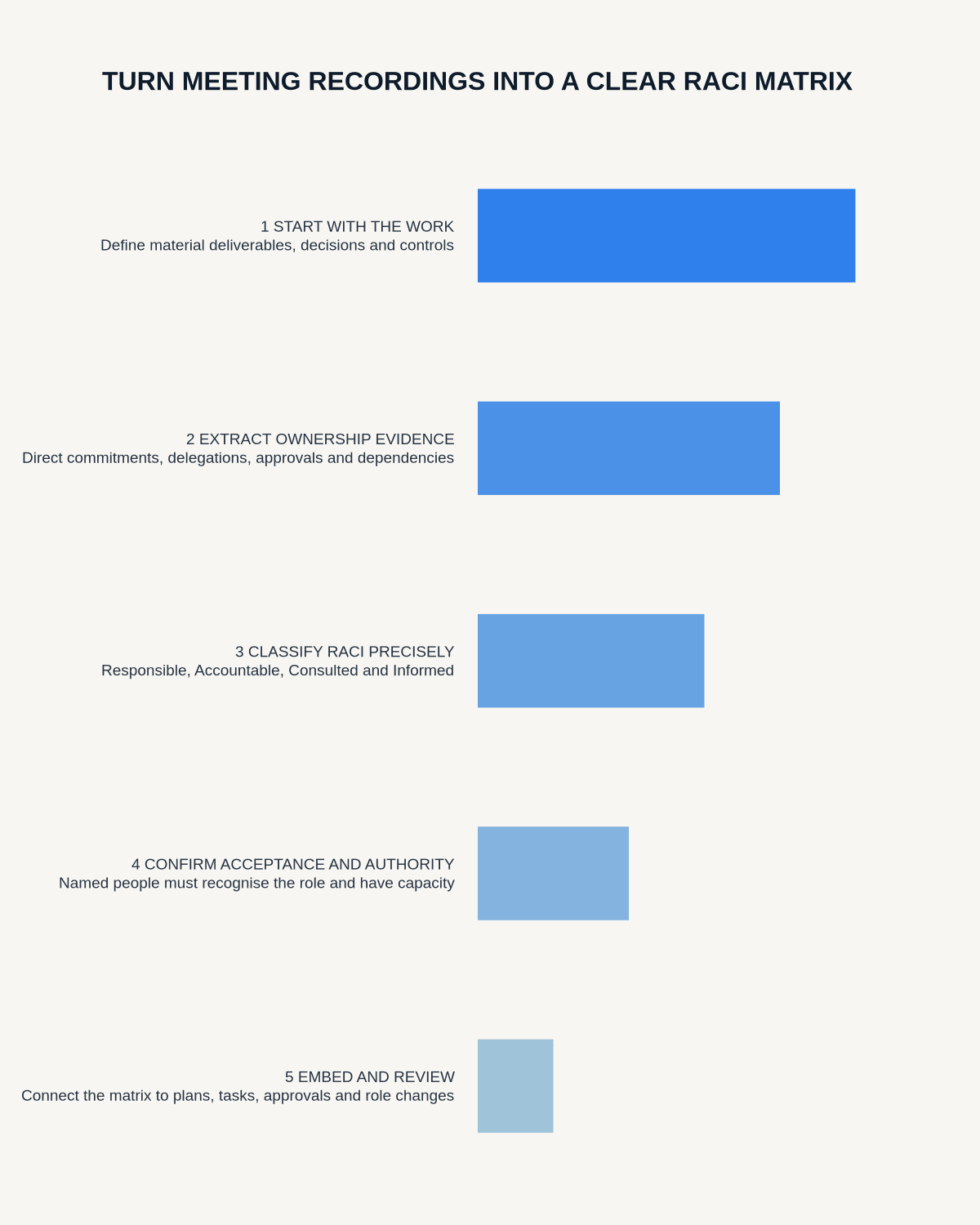
List the material deliverables, decisions, controls or outcomes that need ownership. Each row should be specific enough that completion can be tested but large enough to warrant governance. Detailed activities still belong in the project system.
Apply the four roles precisely
- Responsible: performs or coordinates the work.
- Accountable: owns the outcome and accepts completion.
- Consulted: provides required input before action or decision.
- Informed: receives the result or material status.
Each row normally needs one clearly accountable role. Several responsible contributors may be appropriate, but broad team ownership often hides the gap.
Extract candidate ownership from the recording
Search the corrected transcript for direct commitments, delegations, approvals, dependencies, acceptance language and authority gaps. Check material wording against the audio.
A person being suggested for a task is not the same as accepting it. A senior attendee is not automatically accountable. “My team can help” may indicate consultation rather than delivery responsibility.
Use an evidence-based ownership record
- Work package
- Candidate person or role
- Proposed RACI classification
- Meeting and timestamp
- Acceptance status
- Authority and capacity check
- Final confirmation and date
Resolve common RACI defects
- No accountable owner
- Two competing accountable roles
- A senior leader shown as responsible for work performed elsewhere
- People assigned without authority, capacity or access
- Consulted lists so broad that decisions cannot progress
- Informed roles receiving confidential detail they do not need
Flag unresolved gaps for governance rather than inventing ownership.
Confirm the draft
- Share the matrix with clear role definitions.
- Ask accountable and responsible people to confirm or correct their roles.
- Resolve overlaps through the project or governance owner.
- Check authority, resources and access.
- Record the approved version and effective date.
Connect RACI to the real work
Transfer ownership into project plans, approval routes, task systems and service procedures. Include acceptance criteria for important deliverables so accountability has a clear completion test.
Review after change
Update the matrix after scope, supplier, structure or role changes and after repeated ownership failures. Preserve version history instead of silently overwriting earlier assignments.
Workflow choice matrix for How to Turn Meeting Recordings into a Clear RACI Matrix
Choose the method that protects the source and reduces downstream correction. The table makes the non-hardware options explicit.
| Condition | Preferred route | Why |
|---|---|---|
| High-risk or mixed work | Governed hybrid | Separate capture, review, approval and retention rather than trusting one tool. |
| Recording is refused, prohibited or unnecessary | Manual notes / no recording | Respecting the boundary is the correct workflow, not a product failure. |
| In-person, mobile or unreliable-connectivity work | Dedicated recorder | Independent capture and a recoverable local source are usually more resilient. |
| Repeatable remote work with approved integrations | Cloud software | Automation and central collaboration may outweigh device independence. |
Frequently asked questions
Can AI assign RACI roles automatically?
It can identify candidates, but people and governance owners must confirm the final matrix.
Can one row have two accountable people?
That often creates ambiguity. Resolve the governance model and identify one final accountable role where possible.
Should every task appear?
No. Use RACI for material ownership and manage detailed tasks in the project system.
Useful resources
- Association for Project Management responsibility-assignment guidance
- How to Build a Decision-to-Action Audit Trail
- How to Create a Complete Handover Pack
- How to Create an Issue Log from Meeting Recordings
Final RACI checklist
- Each row is a clear work package
- One accountable role visible
- Responsible people accepted the assignment
- Authority and resources checked
- Consulted and informed lists proportionate
- Matrix connected to operational work
On this page
Related guides
See whether Halo fits this workflow
Review the NERALVO Halo specifications, included services, delivery information and current offer only after completing the guide.
Found an error or an out-of-date claim? Email support@neralvo.com with the article address and a supporting source.