The 60-second verdict
Asking “Is it okay if I record?” is a useful start, but responsible recording requires more than a rushed yes. People need enough information to understand what is being created, how it will be used and whether they have a genuine choice.
Use this guide when: the recording purpose, authority, participants, access and retention can be defined. Pause when: any of those controls is unclear.
Evidence basis and limits
- Decision factors covered: The purpose → explain → choice → record → review workflow; Permission is not always the UK GDPR lawful basis; Stage 1: Define the exact purpose.
- Evidence rule: A claim earns weight only when the source, date, configuration and limitation are clear enough for a reader to check.
- Boundary: This is practical information, not legal advice. Verify current ICO guidance, sector rules, contracts and organisational policy for the real use case.
This guide explains how to ask for permission before recording a conversation and how organisations can document that process. It is not legal advice. Recording law, professional duties and data-protection requirements depend on the context, people, purpose and jurisdiction.
The purpose → explain → choice → record → review workflow
| Stage | Permission question | Required output |
|---|---|---|
| Purpose | Why is recording necessary and what will it produce? | Specific use |
| Explain | What does the person need to know before deciding? | Clear information |
| Choice | Can the person agree, refuse or use an alternative without unfair pressure? | Meaningful decision |
| Record | How will the permission and privacy information be documented? | Traceable evidence |
| Review | Does later use still match what was explained? | Controlled lifecycle |
This workflow makes permission an ongoing boundary rather than a one-time phrase.
Permission is not always the UK GDPR lawful basis
In ordinary conversation, people often use “consent” to mean agreement to recording. Under UK data-protection law, consent is one of several possible lawful bases and has a specific standard. An organisation may use another lawful basis and still need to explain the recording clearly.
The ICO says organisations do not always need consent to use personal information; they must identify and document an appropriate lawful basis. See the ICO guide to lawful basis.
Do not describe a data-protection process as “consent” unless the organisation genuinely relies on consent and can meet its requirements, including the ability to withdraw.
Stage 1: Define the exact purpose
Before asking, decide:
- What part of the conversation will be recorded.
- Why audio is necessary.
- Whether a transcript or AI summary will be created.
- Who will use the result.
- Whether the recording supports notes, evidence, publication, research, assessment or another purpose.
- How long each version will be kept.
- Whether a less intrusive alternative exists.
“For reference” is too vague. “To create a checked action summary for this project meeting, then delete the source audio after approval under our policy” is more informative.
Stage 2: Explain what will happen
A clear request should cover the material points:
- Who is recording.
- The purpose.
- The device or platform where relevant.
- Whether cloud transcription or AI processing is involved.
- Who can access audio, transcript and summary.
- Whether quotations or clips may be shared.
- How long the material is retained.
- How to ask questions or exercise applicable rights.
- The alternative if the person declines.
The ICO’s right-to-be-informed guidance expects privacy information to be concise, transparent, accessible and written in clear language. See the current ICO transparency guidance.
Use wording people can understand
A straightforward request might be:
I would like to record this discussion so I can create an accurate written summary. The audio will be processed through our approved transcription service, accessed only by the project team and deleted according to our retention policy. The checked summary will go into the project record. We can take written notes instead. Are you comfortable proceeding?
Adapt the wording to the actual process. Do not promise local-only storage, deletion or limited sharing unless the technology and policy support it.
Stage 3: Make the choice genuine
Agreement is weaker when the person feels unable to refuse. Consider power differences involving:
- Employer and worker.
- School and student.
- Clinician and patient.
- Public authority and service user.
- Researcher and participant.
- Manager and junior employee.
- Professional adviser and client.
Provide a practical alternative where possible, such as written notes, an institutional recording, a non-recorded meeting or a separate written confirmation.
Do not treat these as agreement
- Silence.
- Failure to object.
- Attendance at a meeting without clear prior information.
- A pre-ticked box.
- Agreement hidden inside unrelated terms.
- Continuing because refusing would cause unfair disadvantage.
- Permission for one purpose being stretched to another.
If recording is mandatory under a law, contract or regulated process, explain that accurately rather than pretending the person has a free choice.
Check capacity, communication and accessibility
The explanation may require:
- Plain language.
- Interpreter or translation support.
- Easy-read or visual information.
- Additional processing time.
- Support for hearing, speech or communication needs.
- An authorised representative or specific legal process.
Automated translation should not be the only safeguard where a high-stakes decision depends on accurate understanding.
Special-category information needs additional analysis
Conversations may reveal health, ethnicity, religion, political opinion, trade-union membership, sexual orientation or biometric information. Organisations processing special-category data need both an Article 6 lawful basis and an Article 9 condition.
Explicit consent is one possible condition, but not the only one. Where it is used, the ICO says it requires a clear oral or written statement. See the ICO’s special-category conditions guidance.
Stage 4: Document the permission correctly
The record should show:
| Field | What to preserve |
|---|---|
| Person | Participant or role, using minimum necessary identity |
| Date and context | When and for which conversation |
| Purpose | What recording and processing were explained |
| Information version | Privacy notice, script or participant sheet used |
| Decision | Agreed, declined or agreed with a limitation |
| Method | Written, digital or oral confirmation |
| Withdrawal or change | Later request and action taken |
The ICO says that where consent is relied on, organisations should keep evidence of who consented, when, how and what they were told. Oral consent can be documented with a contemporaneous note rather than a full recording of the consent conversation. See the ICO’s consent-recording guidance.
Confirm permission at the right moment
For a planned meeting, information can be supplied in advance and confirmed at the start. For an unexpected call or interview, give the necessary explanation before substantive personal information is captured.
When someone joins late, explain the recording to them as well. Do not assume another participant informed them.
Respect limits during the conversation
A participant may agree to the meeting being recorded but ask to pause for:
- Personal or medical information.
- Passwords or payment details.
- Legal advice.
- Safeguarding information.
- Confidential third-party material.
- A statement that is off the record under an agreed professional context.
Design an obvious pause and restart process. Record the boundary in the final note.
Stage 5: Review later use
Before reusing the material, ask:
- Is the new use covered by the original purpose and information?
- Would the participant reasonably expect it?
- Does the lawful basis and any additional condition still apply?
- Does sharing expose new people or risks?
- Is fresh permission or revised privacy information required?
- Has the source material reached its deletion point?
Permission to create notes does not automatically cover marketing, training a model, public clips, performance assessment or unrelated research.
Handle refusal professionally
When a person declines:
- Stop or do not begin recording.
- Use the agreed alternative.
- Do not pressure them to justify the decision.
- Do not penalise them unless recording is genuinely mandatory and that was explained lawfully.
- Document the non-recorded outcome only as necessary.
How NERALVO Halo fits a permission-led workflow
Check Halo specifications before applying this guidance provides NOTE recording, supported CALL capture, 64GB local storage, up to 35 hours of recording and Bluetooth sync with DOWAY.
DOWAY can create transcripts, summaries, speaker-separated notes, templates, translations, mind maps and exports. One year of DOWAY Max is included from activation.
The device cannot determine whether permission is valid, which lawful basis applies or whether a later use remains compatible. Those decisions belong to the person or organisation responsible for recording.
Pre-recording permission check
- Is the recording purpose specific?
- Has the lawful basis and any sector rule been assessed?
- Does the explanation cover AI processing, access and retention?
- Can the person understand the information?
- Is there a genuine alternative where appropriate?
- Has agreement or another recording authority been documented accurately?
- Can sensitive sections be paused?
- Are later uses restricted to what was explained?
- Is withdrawal or objection handled through a defined process?
A responsible recording request gives people clear information, respects the limits of their decision and keeps every later use within the boundary that was explained.
Workflow choice matrix for Recording Consent & UK GDPR
Apply the strongest control before choosing a device. The table makes the non-hardware options explicit.
| Condition | Preferred route | Why |
|---|---|---|
| High-risk or mixed work | Governed hybrid | Separate capture, review, approval and retention rather than trusting one tool. |
| Recording is refused, prohibited or unnecessary | Manual notes / no recording | Respecting the boundary is the correct workflow, not a product failure. |
| In-person, mobile or unreliable-connectivity work | Dedicated recorder | Independent capture and a recoverable local source are usually more resilient. |
| Repeatable remote work with approved integrations | Cloud software | Automation and central collaboration may outweigh device independence. |
Related recording guides
See the UK phone-recording checklist, research-interview recording and AI meeting minutes.
Related guides
Governance control flow
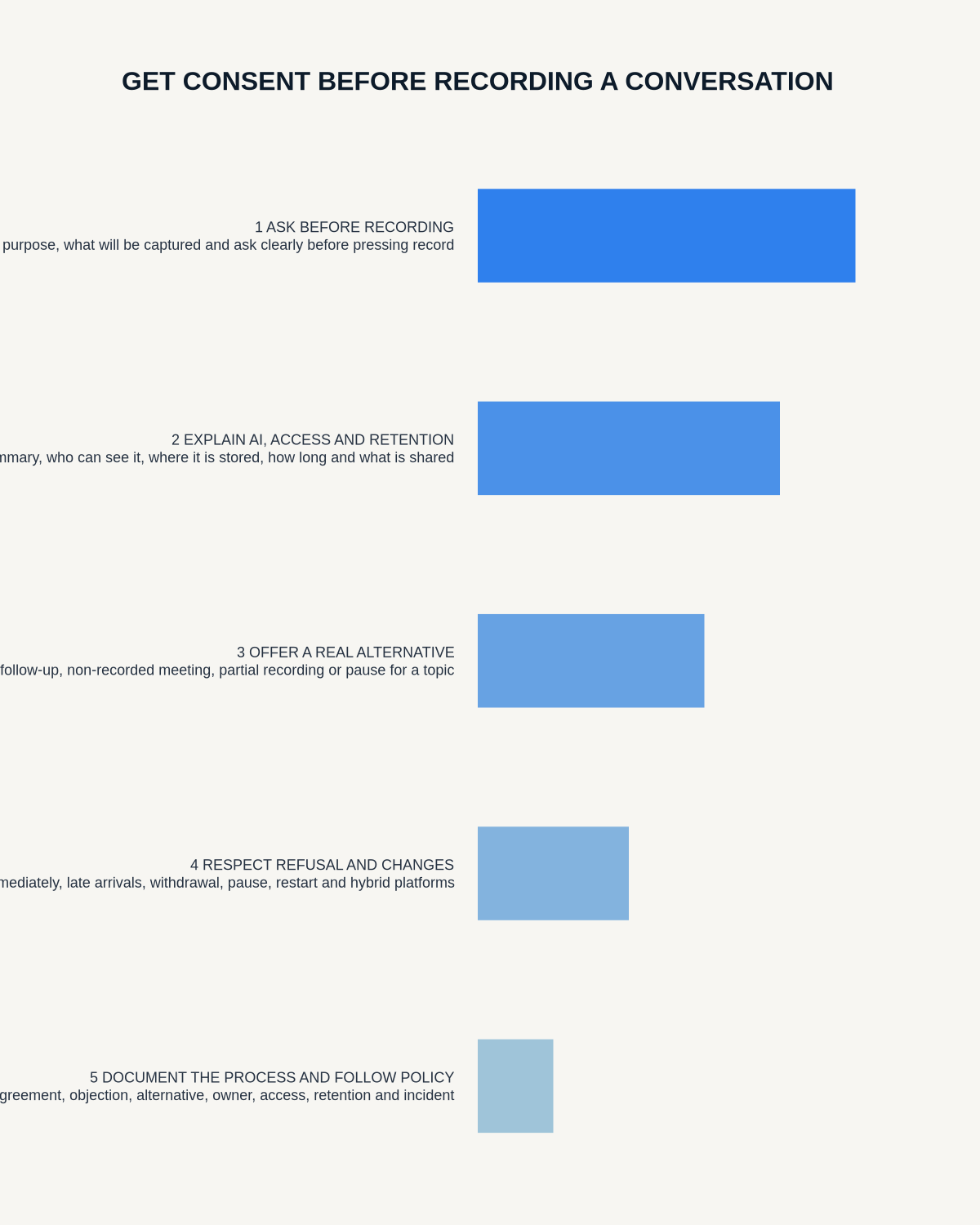
Visual map for Recording Consent & UK GDPR: Permission and Lawful Basis Checklist
- Confirm purpose and authorityCheck law, policy, participant information and an approved alternative.
- Minimise captureRecord only what the stated purpose requires.
- Verify and restrict accessHuman-check material details and protect raw audio and transcripts.
- Retain or delete deliberatelyApply the matter, policy or statutory retention rule.
On this page
Related guides
Check permission, retention and access before choosing hardware
Once the policy requirements in this guide are satisfied, compare Halo’s specifications, local storage, included services and current offer against your approved workflow.
Found an error or an out-of-date claim? Email support@neralvo.com with the article address and a supporting source.